

The basic point of the last instalment was that the grubby fiasco of Shabtai Tzvi’s messianic movement was not some bolt out of the blue, or just one of the periodic recrudescences of fervour that are inherent to a religion that denies the redemption has happened and insists it will happen. As with any historical event of significance, there were contingent - you can say random if you want - factors involved, and it is true that messianic movements have been a recurring feature of Judaism. Nevertheless, the Sabbatean calamity is both unique in Jewish history and specifically comprehensible as the culmination of the Zoharist movement that began in Spain towards the end of the 15th century.
For the purpose of confirming this, we will make a brief tarry into prosopography before getting to the main point. Anyone who wishes to claim that Sabbateanism is a perversion or unnatural outgrowth of the messianic expectations of Zoharism has to deal with the problem that it was greeted with such enthusiasm by the kabbalists of the age.
The most important, obviously, was Natan of Gaza himself, the most talented pupil of the pre-eminent kabbalist of the age, Rabbi Yaakov Hagiz, head of the kabbalistic yeshiva in Jerusalem, which had gradually become the centre of Zoharic study as Tzfat declined amidst recurrent conflict between the Druze and Ottoman authorities and the decline of the textile trade. Natan was a young man, but also generally acknowledged to be next in line as one of the greats, if not the great, of kabbalah, and to many it was inconceivable that his prophetic vision of Shabtai Tzvi’s messiahship was false.
However, it wasn’t just him. Perhaps most important was Shmuel Vital, son of Chaim, Isaac Luria’s foremost pupil and most jealous custodian of his legacy who guarded his teachings from publication until his death in 1620. Our most reliable witness of Luria’s teachings (in the view of most scholars) comes from selections of these writings published by Shmuel, in particular the Eight Gates. Shmuel was preeminent among the Egyptian kabbalists and, as a result, the naggid of Egyptian Jewry, Raphael Yosef Chelebi, became supporter and bankroller of the new movement. Tzvi’s messiahship was also accepted by the kabbalists of Hebron and the remaining kabbalists of Tzfat. In Italy, the second home of kabbalah, there was no known opposition before Tzvi’s apostasy. Even Moshe Zacutto, later a key opponent of Sabbateanism, only made his decision after Tzvi converted to Islam despite ample documentation of Tzvi’s antinomian behaviour (including ordering the assault and murder of his opponents on the sabbath as its ultimate fulfilment).
There is, however, one important exception. Rabbi Hagiz himself, Natan’s teacher, was a ‘denier’ from the beginning. This has been attributed to his generally conservative bent, but the key factor is that he had previously been responsible for repeatedly ordering Tzvi to be flogged for his lunatic behaviour during his period living in Jerusalem, and had eventually ordered him to leave. Natan’s early propaganda included a lot of invective against those who had persecuted the messiah during his cosmic spiritual struggles, so it is perhaps more accurate to say that Sabbateanism rejected Hagiz than the other way round (though, presumably he could have been accepted had he been willing to sufficiently grovel before the freak). He is, therefore, the exception that proves the rule and, as Scholem pointed out, though there is no doubt that he was one of the very few to keep their heads at the height of enthusiasm, there is precious little evidence of him taking an active role in opposing it either.
It says right here on page 13
That’s the prosopography part out of the way, but that is only part of establishing that Sabbateanism was the culmination of Zoharism. We have already discussed the most basic point, which is that, throughout the previous 150 years, the apostles of kabbalah had explicitly taught both that the revelation of their doctrines was hastening the messianic era and that it was the fact of imminent revelation that made it licit for them to reveal what had hitherto been concealed. There are, though, additional ways in which Zoharism paved the way not only for a messianic explosion across world Jewry, but also determined its character.
In the manic enthusiasm following his initial vision and revelation to Tzvi that he was indeed the messiah (an idea Tzvi had previously toyed with but had given up on), Natan authored then ‘discovered’ an apocalyptic prophecy that he would then write an explanation on, showing how it explained the messianic significance of Tzvi’s erratic behaviour and general weirdness. You might well ask however, what was the point in producing a messianic prophecy out of nowhere after your alleged messiah had already arrived. Wouldn’t people immediately realise that this didn’t prove anything, especially in light of the farcical accounts given of its origin?
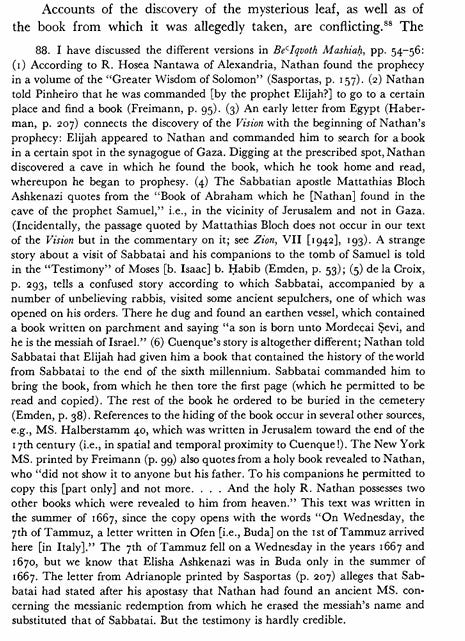
But, of course, the answer is that scepticism of this sort had already been ruled out in advance because the Jewish people had accepted the Zohar. Chabad have been in the news recently, so let’s look at their explanation of where the Zohar comes from:
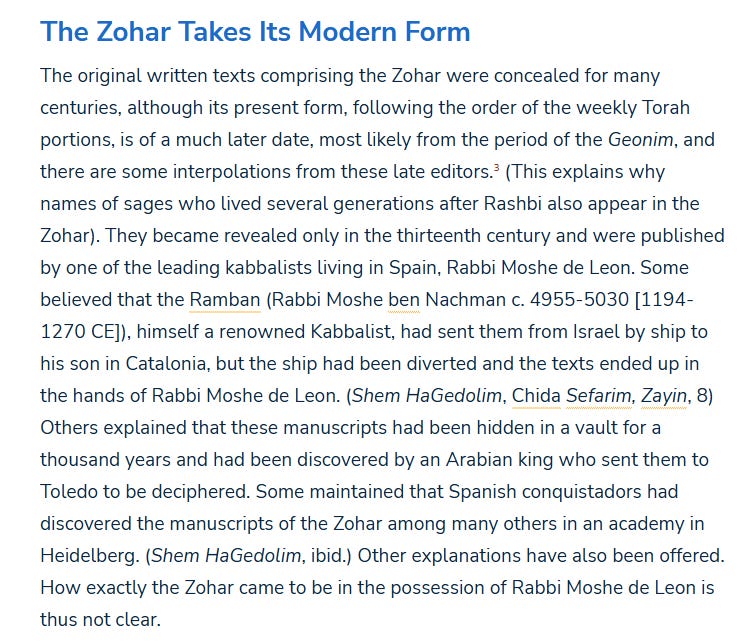
Sad to say, this is actually a relatively enlightened take since it engages in a certain respect with the obvious proofs that Rabi Shimon ben Yohai did not compose the Zohar. However, this is the best they can apparently do after more than 500 years in which they have had to formulate something resembling a coherent explanation and we’re still stuck at ‘maybe a goy found it in a box’. The point here is that, in accepting the Zohar, Jewry had already essentially subjected itself to a form of cult conditioning in which incredibly obvious frauds could be promoted. For a good hundred years, anyone asking basic epistemological questions had been subject to vitriol, denunciation and sometimes violence by the very holy advocates of kabbalah, and, as such, the Jews were left without the basic conceptual tools to resist Sabbatean propaganda.
The power of vision
Even more primary to Sabbateanism, though, was Natan’s own 24-hour vision, the contents of which he struggled to expound to himself and others for the rest of his life. Unlike his apocalypse, there is no doubt that the vision was real. People have visions all the time, and they can be induced through extreme physical deprivation, structured meditation or hallucinogenics. The traditional approach of Judaism, however, is that visions are irrelevant both to doctrine and practice. The test of whether a prophet is true or false is whether his prophecy conforms to what the Torah has already decreed, which anyone can do anyway, just in a less impressive way. For that reason, Judaism did without prophecy altogether from the crystallisation of the biblical canon. The response to Natan’s vision, therefore, should have been ‘so what?’
The reason it wasn’t is that the Zoharist movement had explicitly justified its revolution of theology through its adepts’ visions. Each new teacher had been gifted these visions through which they learned new depths of the secrets contained within kabbalah. Such visions on the part of ethereal holy men who possessed secret knowledge were now the chief source of religious authority. There were, therefore, no principled grounds left upon which to question Natan’s vision and the imprimatur it gave to its contents. Soon enough, Sabbateans were having visions all over the place and, instead of this being grounds for rejecting this movement, as it would have been at any time in the thousand years before 1492, it was considered ever mounting proof of its truth. In these two ways, Judaism’s immune system had been hijacked and all of the Rabbinic safeguards against an explosion of madness and antinomianism had been not only rendered ineffective but turned into their opposite by the theology that had infected halacha from the inside and transformed it into a vehicle for everything it is designed to resist.
Strange and stranger deeds
Natan’s apocalypse is not long, but it’s not interesting either. Scholem, as was his wont, considered it to be a powerful piece of imagery. However:
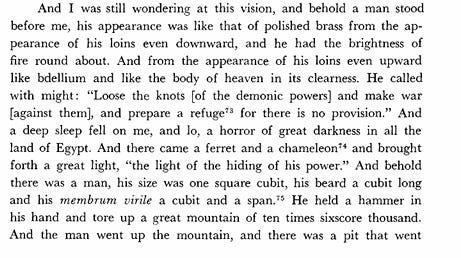
Why do we need to know about the Messiah’s giant penis? To understand, we need to grapple with the most important way in which Zoharism determined the character of the Sabbatean explosion. No matter how frantically this has been covered up by conservatives in a commendable effort to keep the house of cards from falling down, the fact is that long before Shabtai Tzvi came along, Zoharism was really weird and really dumb. The reason why the messianic movement it produced was idiotic is that it itself was idiotic. Idiocy is its chief distinguishing characteristic.
Now, this is going to need some qualification. Kabbalah seeks to answer certain questions that are inevitable in any kind of intellectually sophisticated version of monotheism:
If God is completely transcendent, how can He interact with the physical universe and what does it really mean for Him to do so?
If God is infinite, how can anything exist apart from Him?
If God knows everything already, what is the point of praying for Him to change His mind?
Stuff like that, and the truth is that, if you zoom out, the answers aren’t dumb either. Some of them are legitimately smart; tzimtzum probably is a genuinely groundbreaking contribution to theology. Because these questions are quite obvious, though, roughly these same kind of answers have been arrived at all over the world: God is pure love, or pure consciousness; all is truly one, the divisions between objects are only from the vantage point of our perception; God emanates out in unfolding layers of decreasing spirituality, or alternatively withdraws Himself, to allow the material to exist, after a fashion. The Vedanta Hindus arrived at more or less these conclusions three thousand years ago; Bernardo Kastrup is advocating them today. It’s very plausible as metaphysics. The problem is that what most naturally follows is the conclusion that the matters of the world are vain and you should just kind of vibe in a monastery. Applied to Judaism, it would probably lead to the view that the mitzvot are social tools for the harmony of society, or preparatory training for the higher life of meditation. However, that is what the more radical Maimonideans had already concluded, and what kabbalah was precisely formulated to deny. The whole point of Zoharism was to make ritual life more meaningful, not less.
Thus, kabbalah was never just theosophy, but also, and more fundamentally, theurgy, the analysis of how human action changes and influences the divine realm. While theosophy might be smart, theurgy is inherently and irredeemably dumb. Moreover, the smarter the theosophy, perforce the dumber the theurgy, because the more refined and delicate the analysis of the divine, the more intuitively ridiculous it is to believe you can influence it by saying words or moving your hands. The only thing that can make Jewish law religiously meaningful, namely the existence of a God with will who demands obedience, is precisely what is denied by kabbalah at the more abstract level, and so the further the mystics depart from this simplistic model, the more insane things they have to posit to make their intellectual project work.
Or, at least, that’s how it seems to me. Maybe you think otherwise about the etiology, but what can’t be denied is that the more intellectually sophisticated Zoharism became, the more madcap material it incorporated, and the more any safeguards against just really obviously loopy, messed-up stuff fizzled. Take this:
