

Antisemitism is back. If, like me, you are down with the kids and hip to the latest trends, then you will know this, but otherwise take it from me, or from the ADL, which has the facts. As we have seen before, antisemitism is, pace all the losers and haters, quite easy to define. It means believing Jews are the main problem in the world and the way to make the world better is to combat the Jews. For reasons we have explained, it exerts a magnetic pull on the rightoid mind seeking anthropomorphic explanations for complex social phenomena. With the right institutional pressures, this can be kept under control, but that started cracking with the rise of the internet, and then fell apart entirely with Israel’s livestreamed post-October 7th chimpout.
There are, however, different varieties of antisemitism, inasmuch as there are different ways of explaining how or why Jews are the main problem in the world. Back in the gaye old times of the alt-right, the most popular, at least formally, was that of Prof. Kevin MacDonald. However, after getting mogged by Nathan Cofnas asking basic questions about evidence and causal inference, MacDonald’s prestige went into decline. Anyway, his theory is rather convoluted and requires making admissions (for example about high Jewish IQ) that most antisemites would prefer not to make. As his star was waning, there was a brief flirtation with Michael E. Jones, but this was far from perfect. First of all, if you aren’t a particular kind of TradCath, it doesn’t get off the ground (Jews promoted the Reformation, and the American Revolution and modernity, how, err, terrible). Secondly, it’s pretty insane.1 Thirdly, you no longer get to say ‘run a physiognomy check’ anymore as a dunk on Twitter.

So, in due course, antisemites converged on a different version of antisemitism, that basically combines the old school Talmudjude tradition with various elements of modern antizionism. A good representative of the synthesis is Will Sexton, but it’s all over the place nowadays and it goes like this:
Judaism has no theological content in the normal sense. There’s a vague inyan to affirm belief in one God, but after that you can believe pretty much whatever including the most unhinged, blasphemous guff and outright schizoid rambling, and it’s totally fine and no-one is allowed to object to it. Just believe whatever motivates you to be a committed Jew and it’s gravy.
The actual doctrinal content of Judaism is that Jews are innately superior to gentiles, and that the Land of Israel belongs at all times to Jews and anyone else who lives there can either get lost or get killed. God is subservient to Jews, or maybe Jews are really God in some sense.
Judaism has no concept of ethics at all outside the bounds of its own community. Gentiles are looked at as either rivals or objects to be exploited to whatever degree is possible. When Jews are weak, it’s permissible to be nice to them, but only for the sake of Jewish wellbeing.
Any Jew who rejects any part of the above is not representing Judaism, but is, whether he knows it or not, reflecting western values that are alien to the Jewish tradition itself.
That’s a pretty damning assessment and, if true, would justify a fairly high degree of animosity towards Jews, and, arguably, the legal proscription of their religion. We have a bit of a problem, though, because there is a growing, confident, and increasingly ascendant movement within Judaism that argues the following:
Judaism has no authoritative theological teaching in the normal sense. There’s a vague inyan to affirm belief in one God, but after that you can believe pretty much whatever including the most unhinged, blasphemous guff and outright schizoid rambling, and it’s totally fine, and no-one is allowed to object to it. Just believe whatever motivates you to be a committed Jew and it’s gravy.
The actual doctrinal content of Judaism is that Jews are innately superior to gentiles, and that the Land of Israel belongs at all times to Jews and anyone else who lives there can either get lost or get killed. God is subservient to Jews, or maybe Jews are really God in some sense.
Judaism has no concept of ethics at all outside the bounds of its own community. Gentiles are looked at as either rivals or objects to be exploited to whatever degree is possible. When Jews are weak, it’s permissible to be nice to them, but only for the sake of Jewish wellbeing.
Any Jew who rejects any part of the above is not representing Judaism, but is, whether he knows it or not, reflecting western values that are alien to the Jewish tradition itself.
Colloquially, this movement is known as ‘Kahanism’, which is not misleading, but is a bit inaccurate. Kahana was more a prophet of the movement than its theoretician, and, whether for form’s sake or otherwise, included some conventionally religious elements within his call to arms. The avatar of the movement, of course, is disgusting pig, Itamar Ben Gvir. Already, it is far safer within orthodox Judaism to be an ally of this tendency than an opponent. The safe bet is it will continue to grow.
The prevalent form of antisemitism, therefore, has as a fairly valuable advantage the fact that it is partly true, and becoming progressively truer with the passage of time. This does not per se justify antisemitism, because Judaism, considered as such, is not the world’s biggest problem and wouldn’t justify the kind of obsessive and prurient attention antisemites give it, but, even so, this is a relatively strong factual base to work with. Many ideologies have to make do with much worse.
Where does this variety of antisemitism come from? Based on the above, one might say it is simply, as its proponents allege, a response to Jewish behaviour, but nothing is actually a simple response to anyone’s behaviour in that respect, let alone the behaviour of people in another, albeit rather disruptive, country half the world away. Someone has to shove it in your face and tell you how to understand it. Of course, as is ever the case, it’s possible to trace back the new antisemitic synthesis to many sources, but I believe the most important of those was an eccentric Israeli Chemistry Professor, Israel Shahak. And with that we get to the subject of our article.
Shahak’s main work Jewish History, Jewish Religion, is a book I would encourage Jews to read, because I think it’s valuable to read hostile caricatures of your own group. It’s not a book I’d encourage gentiles to read, because I don’t think it’s a good thing to read hostile caricatures of other groups. Unfortunately, reality generally works the opposite way round. Even so, I was rather surprised to find the following in Edward Said’s foreword:
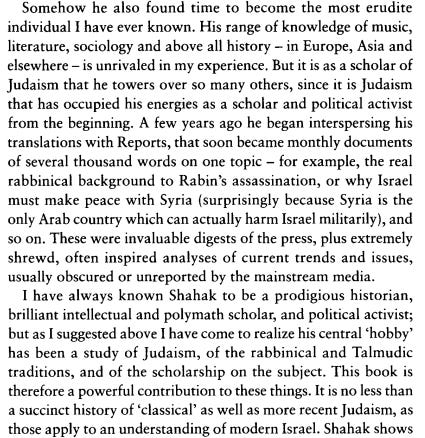
If Said had said ‘this is a well-written and cogently argued polemic against Judaism which inspires in its moral urgency’, I would have disagreed because, as we shall see, I think the book is badly written, badly argued and possessed of profound moral imbecility, but I would have known what Said meant. To say the book is a ‘succinct history of … Judaism’ that towers over so many others isn’t even in the right genre of approbation. It would be like declaring Dan Burwami the foremost scholar of Islam.2 If this is what a Palestinian moderate who opposed (at least some forms of) terrorism and was willing to consider (at least some forms of) territorial compromise thought was a helpful way of going about understanding the enemy, then that’s a good data point in support of it all just being completely hopeless.
This book sucks
Israel Shahak has been described as ‘the last Israeli liberal’; a more precise and illuminating definition would be libtard. Another obvious thing about him is that he had Asperger’s. You’re not supposed to diagnose stuff like this over the internet, but sometimes you’re allowed.

The upshot is that Israel Shahak was the Jewish equivalent of a Portlandia character who spends all his time shrieking at normy well-socialised libs who celebrate Thanksgiving when it’s a festival celebrating genocide and the dispossession of Native Americans. The idea that a Jew, having discovered the ghastly truth, could do anything other than dedicate his life to exposing the foul nature of Rabbinic Judaism was incomprehensible to him, and so his worst ire was focussed on the ‘fake liberals’ who let him down. In the book, Begin gets a mere five mentions, Likud only two and the Irgun, none at all. There is a bit more treatment of Gush Emunim, but mostly Shahak concentrates on pouring excrement on the true villains: Martin Buber, Moses Hess, Leo Rosten. He is particularly outraged that any gentile could be philosemitic: just look at them!
I’ll content myself with citing two passages. They are, naturally, particularly egregious examples of Shahak’s method, otherwise I wouldn’t have chosen them; but there are more than a hundred cases in the book where the same techniques of argument by non-sequitur and perverse innuendo are employed.
In the first example, Shahak describes the reception of a particular passage in Maimonides’ Guide for the Perplexed, in which he briefly recapitulates the Aristotelian theory of race differences. Basically, if you grow up somewhere that’s too cold (like Turks or Franks) or too hot (like Nubians), you come out all messed up, but if you grow up in the Mediterranean, you come out just right. This theory seemed to track relative social development in the Hellenistic era pretty well, but didn’t work so much when the Roman empire expanded northwards. It came back into fashion in the early Middle Ages when Aristotle was massive, plus Islam and the Italian states were killing it and northern Europe reverted to savagery. Strictly speaking it’s not clear that this theory actually counts as racism, since it’s really a particularly extreme form of environmentalism, but, regardless, it’s not comfortable for enlightened audiences, even 100 years ago, to read that Africans are intermediate between monkeys and people. So in Friedlander’s translation of 1925, he translated the Arabic word hyper-literally as Cushite, which would leave the less attentive reader in the dark about who was being referred to. Shahak has a massive libout out over this egregious deviation from scholarly accuracy and concludes by saying this:

If I were to answer the ‘question’ of why a Conservative or Reform Rabbi (or, more rarely, even an Orthodox one) might support the Civil Rights movement even though Maimonides thought black people were subhuman, a few possibilities come to mind. First, in the majority of cases, they just didn’t know. Despite Shahak’s incomprehensible claim that Guide for the Perplexed is a ‘most important and necessary work of Judaism’,3 very few Jews, including learned Jews, have ever read it. Nor do they need to because most of the book is either (a) resolving contradictions between medieval Aristotelianism and the Bible, which is all a moot point today, (b) explaining historical reasons for the mitzvot based on the Nabatean Agriculture, a fake book of zero value in understanding Bronze Age near-East religion or (c) stuff that honestly doesn’t seem to make a great deal of sense and the scholars say has an esoteric meaning, and they’ll get back to us any day now on what that is. Even among those Jews who did read it, many likely did so in the English translation (not a dishonourable thing since the work was composed in Arabic, not Hebrew) and so didn’t realise Maimonides was a big racist. Secondly, among those civil rights Rabbis who had read the work and realised what was up, the great majority probably didn’t care at all. Guide for the Perplexed has at least half a dozen imprecations against ‘those who are foolish as women’ and believe in the atomic hypothesis. Nevertheless, none of the moderns who see in Maimonides’ philosophical struggles something of value to the modern Jew have a difficult time accepting the standard model of particle physics.4 As I just hinted, Maimonides’ views on women were quite stridently, err, Islamic, and these were expressed rather more frequently than his views on Black people, and yet, somehow, JTS went co-ed regardless. Finally, among the vanishingly small number of Jews who found it necessary to reconcile Maimonides’ theory of race with their own beliefs, maybe they just came up with something. Taken literally, Maimonides’ climactic theory would imply that white and black Texans were equally monkeyish and the solution would be to move them all to Boston, so maybe, if we hunt around enough, we’ll find a scholar at Hebrew Union College who scribbled that in his notebook.
Shahak, though, ignores all of that and jumps to the most unreasonable and idiotic ‘explanation’ possible, namely that the liberal rabbinate engaged in ‘hidden enjoyment’ of Maimonides’ racism while using blacks for their own nefarious aims. This is the ‘paranoid reconciling hermeneutic’ so beloved of rightoids, but with Shahak’s own neurodivergent twist. If Shahak spends a frantic evening combing through Maimonides and then gets a juicy racism quote and obsesses over it for the next four years, then that’s just what any other reader would do. The whole concept of ‘hmm, don’t like that, turn the page’ just doesn’t register with him.
I want to add here that I was recommended by a number of readers to look at Shahak, so I do have to ask: what book were you reading? Like, this sucks. It really sucks. Is this convincing to you? Isn’t it obvious that it’s very silly? I kind of feel like doing a Fuentes rant about goyim, but I’ll restrain myself. Next example:
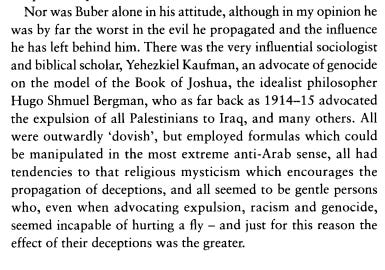
Some background for you readers who don’t know how to ask ChatGPT questions and rely on me to do it for you. Bergman was co-founder of Brit Shalom, the best-known organisation advocating a Jewish-Arab binational state. He responded to the 1929 massacres of Jews at the hands of Palestinian Arabs by insisting that it meant Jews needed to work harder to reach rapprochement, and condemned the principle of ‘Hebrew Labour’ in Zionist enterprises that he (and the Peel Commission) believed lay behind Arab resentment. After 1948, he accepted defeat, but continued to campaign for reconciliation with local and regional Arabs. If anyone is a peacenik gaylord, it’s him, and Hazony wrote a book about how his gang were subversive traitors.
But that’s not good enough for Shahak. Akshully, Bergman was an advocate of ‘expulsion, racism and genocide’. The evidence is that in 1914-15 he advocated expulsion of Palestinians to Iraq. At the time Bergman was an officer in the Austro-Hungarian army, and he didn’t come to Palestine until 1920, so, if it was true, it would only prove he changed his mind, but I (OK, AI) have been unable to find any evidence it is true. I’m a little bit loathe to accuse Shahak of outright lying, because in all other cases of him saying something totally ridiculous there’s some factual crumb which he could use as a motte to retreat to. However, whatever it is (and Shahak basically never cites anything, even though the book has 15 pages of mostly useless endnotes), it’s definitely not enough to substantiate the clear libel being made here.
That’s Bergman, but remarkably what he says about Kaufman is even more ridiculous. Here’s what he’s referring to:
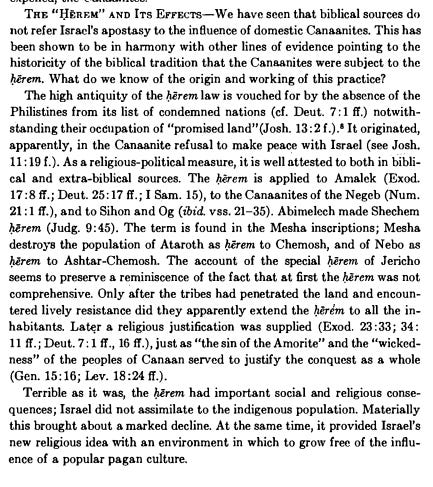
To take a recent and remarkably close analogy, there’s a well-known and affable, if somewhat slippery, Christian apologist called William Lane Craig. As part of his job, he had to explain what was up with the Book of Joshua, and his explanation is basically a combination of (a) if God says it, it’s OK (b) it was a mercy to Canaanite children to be killed before they reached the age of moral responsibility and faced eternal damnation. Famously, Dawkins used this as an excuse to chicken out of a debate he was likely to lose. Now, there’s a bunch of things you could say about Lane Craig’s argument. At the very furthest reaches of plausibility, you might argue it makes him dangerous because if he ever got schizophrenia and thought God was telling him to kill the children of MS-13 members he wouldn’t have a moral objection. However, obviously, it would just literally be stupid to call him ‘an advocate of genocide on the model of the Book of Joshua’ today. So it is with Kaufmann. Unlike Bergmann, he wasn’t a big peacenik, but he was moderate enough, leaning towards territorialism as a way of avoiding conflict with Arabs, and comfortable with partition. Maybe his justification, such as it is, of the Israelite conquest is condemnable, but it’s not advocating genocide.
So, with that out of the way, I want to turn to another passage:

I’ll start by pointing out everything wrong with this passage, in which Shahak exhibits the same kind of basic failures of intellectual competence we have seen.
It is stupid and dickish to imply that Elazar Shazar secretly agreed with the metaphysical racism of Chabad because he maintained contacts with and interest in the religious community of his youth including its leader. Clearly Shazar wasn’t an ‘ardent adherent’ of Chabad in the normal sense of the term because he was secular. Shazar was a moderate dove and gave no indication of being a racial supremacist. Even if we take a maximal interpretation of his interest in Chabad philosophy, he could simply have taken the view of Hillel Zeitlin, that what Chassidic thought says about the dignity and importance of the individual Jew can simply be expanded to the dignity and importance of all mankind, a popular current in 20th century Jewish thought, and with plenty of exponents today.
It’s pointlessly inflammatory to call Schneerson the Fuhrer of Chabad.
The fact that Schneerson would not visit Israel was not one of the main reasons he was widely criticized in the orthodox world.
Shulamit Aloni was not an impartial witness, but a far-left anti-religious activist (which is, of course, her right).5 In a controversy in the 1990s over (still unsubstantiated) claims that doctors at Sha’arei Tzedek hospital were given pamphlets telling them not to treat gentiles on the sabbath, she mentioned in testimony that she had it on good authority that something similar was distributed among soldiers during the Lebanon war. She mentioned nothing about Chabad, or this propaganda being ‘stepped up’.
Schneerson was, if anything, pro-black, and while he did not acquit himself very well in the run up to the Crown Heights riots, the local black community acquitted itself much worse. Among liberal-leaning Chabadniks, there is a widespread belief that Schneerson invented food stamps.
And yet, check this out:
That’s Ben Gvir being treated like a rock star at one of their heretic conventions. Here’s him arriving at the belly of the beast:
This is a well-documented phenomenon. Many have pointed out that Schneerson substantially modified the original misanthropy of Chabad philosophy in favour of a paternalistic and friendly racial supremacism, much like Rav Kook, but ordinary Chabadniks in Israel don’t want to hear that. What they do want to hear is Schneerson’s genius argument that to save one Jewish soldier, it is obligatory to kill infinity gentile civilians. Not one, not one hundred, not one million: as many as it takes. The story of how Chabad and Breslev got locked into an ever-escalating battle to see who could come up with the weirdest justifications for murder while grinning inanely is for another day, but it’s very much something that has already happened (even if it’s likely far from over). If anything, in retrospect, Shahak looks like he’s underplaying it. The people who let it happen, and still more those who assisted it, messed up big time, and, at some point, comeuppance is due.
Shahak provides a hostile caricature of Judaism, a product of a vindictive and spiteful mind, on the brink of a kind of madness, if not over it. But there’s another term for a caricature: failure mode. And Judaism is failing; it’s failing very badly, much worse than anyone could have predicted only a few years ago, except, of course, Shahak.
I thought it might be appropriate now to go through Shahak’s book, chapter by chapter and divide out the nonsense from the critiques that have bite. I always regret committing to these kind of series, but I guess it’s one more thing to regret.
James Lawrence had an excellent article about this on AffirmativeRight, so hopefully Colin Liddell will pull his finger out and put it up.
Actually, the analogy has more layers to it than you might think, as we’ll see in the sequels.
Italics are his.
I did meet one Jew who insisted that Maimonides was correct in believing the planets are conscious entities, but he’s a total idiot.
This meme is widely shared, apparently by people who think it’s a confession, not an accusation.

Very glad you are doing this series, looking forward to the next essay.
"Ruppin, who several years later founded the Brit Shalom movement advocating a binational Arab-Jewish state, repeated his proposal for the removal of the Arab fellahin to Syria in a letter dated 12 May 1914 to Victor Jacobson, a member of the Zionist Executive and the Zionist Organization's representative in Istanbul (1908-15)."
I found this in Nur Masalha's book cataloguing the history of transfer. Notably, Nur does not mention any letter by Bergmann despite the fact that, if it exists, it almost certainly would appear in that book. This is the only possible source I can find for Shahak's claim and even then it's the wrong person, dated to 1914-15 implying there's multiple letters when it's just one letter from 1914, and the wrong country (Iraq vs Syria). The best case is he garbled basically all his facts here.