

Here is a meme. To paraphrase some mentally ill French pederast (probably), the words and numbers it contains belong to the domain of facts and data, but the import of the meme belongs to the domain of ideas and discourse. It is not - even if, and possibly especially if, it is completely accurate - a neutral description of the world, but an attempt to change it, or, more precisely, an attempt to change your perception of it. Be now overwhelmed by the visual reification of statistics as ideological superstructure. (Did I get that right? If I did, I screwed up).
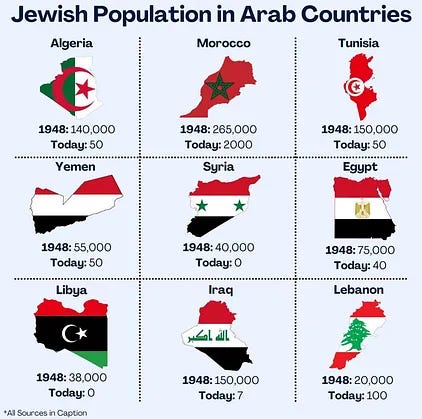
This is an argument for Zionism. Or is it? What type of argument is it?
One way it could be an argument is in service of based, zero-Fs-given Zionism that prides itself on the negation of exile.
Before the State of Israel, these Jews lived in foreign lands, under the rule and subject to the whim of other nations, while speaking goyish languages. Now they are back in their homeland, speaking their ancestral tongue, and are free, self-governing people living lives of dignity in Afula.

However, that’s probably not the argument intended. Instead, the meme likely serves the agenda of cringe, hasbara Zionism and it goes like this:
Israel is accused of genocide, ethnic cleansing and every other sin, but we see who are the real perpetrators of ethnic cleansing. Communities of hundreds of thousands who had lived there for thousands of years were expelled or forced to flee by Arab and Islamic intolerance. The Jews of the Middle East are left with one tiny patch of land, whereas the Arabs have TWENTY TWO COUNTRIES. By nature and logic, having fewer countries gives you the moral high ground, and thus you should support Israel.

The human heart contains multitudes and the human brain contains principally miscellaneous litter and half-remembered clichés. Thus it is not only possible, but actually the case that the average Zionist believes both of these arguments. Zionism is vindicated both by virtue of its success in liberating the Jews of MENA from the inherent indignity of exile, but also vindicated by the fact that these Jews were tragically wrenched from their homes by the same forces that attack Israel today. To be both free and victim is, ultimately, the Jewish dream; free to mawkishly cry out in pain as you level another apartment block.
OK, that allusion is a bit over the line maybe, but let’s circle back. We’ve seen that there are two ways that this meme can serve as an argument for Zionism, but there is also an obvious way it can serve as an argument against, and it goes like this:
For thousands of years, Jews lived across the Middle East. Sometimes it was better sometimes it was worse. Jews drifted towards the places where it was better. Thus Morocco had 265,000 Jews whereas Libya had 38,000. However, Zionism made all this untenable. Arab nationalism, while in its formative years, found in opposition to Zionism its essential test of legitimacy. Inevitably, this was turned against domestic Jewish populations, and, all the more so, when, following the total failure of their original plan to overwhelm the Palestinian Arab population by immigration, the Zionists elected to rescue their project by means of mass expulsion. Jewish life from Morocco to Iraq became untenable, and, in scarcely more than a decade, thousands of years of culture, faith and dignity went up in smoke, living on now only in the ghastly pastiche of the Shasnik, at best, and the common ars, at worst.
As I said, the facts themselves do not create the story. We each must choose which narrative structure makes the most sense. However, we need not do so arbitrarily. Here are two possible narratives of what might have happened to Middle Eastern Jewry in the absence of Zionism.
In the absence of Zionism, the early participation of Jewish intellectuals such as Anwar Shaul or Mir Basri in Arab national revival would have continued, and Jews would have played a roughly similar role to Christians in the formation of Arab national consciousness.
In the absence of the Balfour Declaration, Arab Nationalism would have evolved to be less hostile to British imperialism and thus Anglo-American culture generally.
For both of the above reasons, Arab Nationalists would not have seen the Nazis as allies or a source of inspiration, and so would have not absorbed all the bad ideas they did from Nazism, including, but certainly not limited to, antisemitism.
In the absence of the state of Israel, Arab Nationalists would have taken a more pro-American stance during the Cold War.
For reasons (3) and (4), Arab Nationalism would have converged on a market-based path to economic growth.
In the absence of repeated humiliations by Zionism, as well as with a slightly larger demographic base and better human capital, and enjoying the sympathy of global Jewry, Arab Nationalism would have resisted the paranoid and lunatic trends that have bedevilled it.
Arab Nationalists would have achieved their dream of uniting most of the Levant as Greater Syria, which would have broadly peaceful relations with both Egypt and Iraq. They would create stable economic growth that would allow them to successfully suppress the Muslim Brotherhood. Radical Islamism never becomes a thing outside of Saudi Arabia and some Gulf States, which eventually drop it too out of embarrassment.
Obviously, that’s a very, very best case scenario. So here’s Option no. 2.
Just as with Italian Fascism, Arab Nationalism eventually turns against the Jews who did so much to aid it in its earlier stages.
British obstinacy or incompetence alienates the Arabs anyway.
The pull of Nazism is irresistible.
After the defeat of Nazism and absorbing its worst ideas, Arab Nationalists are still fiercely hostile to Britain and so flip to the Russian side in the Cold War.
Arab Nationalism makes a giant tit of everything.
Because of its manifest incompetence, and the general tendency of all nationalist movements to rightoidism, Arab Nationalism descends on a path of paranoia and the search for a scapegoat.
Islamic radicalism rises in response to the gross incompetence of Arab Nationalism. Desperate to stave off rising popular support for the Brotherhood, Arab regimes give in to their least destabilising demand and initiate an escalating cycle of persecution of Jews. Jews have nowhere to go, and it all eventually culminates in a Middle Eastern Holocaust.
Which narrative we see as more likely is not a simple function of facts. It is even less a simple function of facts than how we choose to interpret the history that actually happened. However, what cannot be ignored is the multiple ways that Zionism has in reality made the Middle East worse:
Defeat in the 1948 War (which many Arab regimes only entered with reluctance as a result of public outrage over reports of expulsions and massacres), led directly to regime change in Egypt in 1952 and Syria in 1949, and contributed to the eventual revolution in Iraq in 1958. In all these cases, relatively civilized and sane regimes were replaced with relatively barbaric and disgusting ones. Syria, in particular, was sent into a spiral of coups that progressively elevated the most depraved elements of the body politic.
Palestinian refugees from the 1948 war destabilised Lebanon and caused the Lebanese Civil War, collapsing the region’s best country.
Zionism created Palestinian Nationalism and national identity out of essentially nothing (as our hasbarists are ever eager to remind us), giving the world the PLO and Hamas.
Defeat in 1948 boosted the Muslim Brotherhood in Egypt and around the Middle East.
One big problem with Israel-Palestine discourse is that the real and legitimate criticism of Zionism as a cause of bad things in a region are rarely made because the critics of Zionism are themselves supporters of, or at least simps for, those very bad things. It falls to me therefore to point out the obvious:
Arab Nationalism probably would have picked up some bad things from European fascism in the absence of Zionism, but it probably would have done so less.
Arab Nationalism probably would have been attracted to Soviet patronage, and thus implemented disastrous economic policies, in the absence of Zionism, but it probably would have done so less.
Arab Nationalism probably would have succumbed to paranoid and mad tendencies, but it probably would have done so less.
Islamic revivalism would probably have risen in response to the general rubbishness of the Middle East, but it probably would have done so less.
etc. Overall, the likely story of Middle Eastern Jewry in the absence of Zionism is like neither of the extremes above. It’s probably more or less similar to Arab Christians in our timeline. Over time, the population would have gradually declined, as Jews took advantage of assistance from wealthier western Jews that isn’t open to Druze, Yazidis and Alawites. In some places, the Jewish population would have emptied out quickly as they collapsed into civil war, but overall it would be a drip-drip thing, and it’s likely that Morocco would have seen its Jewish population increase from immigration from other MENA countries. Jews who left would not have been subjected to the Zionist hazing ritual of learning a new language in a concentration camp, so they would have come out talkative avaricious fops in pointy shoes like French Jewry, rather than genocidal orcs with stripes on the side of their head like in Israel [these are GENERALISATIONS, calm down]. In some cases, there probably would have been short- to medium-term issues getting Jews out of sticky situations without the permanent Israeli backstop. Certain populations of Jews would be stuck in really deplorable circumstance as common today among Christians in parts of Egypt and Iraq. In some ways it would have been better, and some ways worse.
One Zionist argument is that because a really bad event is a possible result of an alternative Zionism-free timeline, then Zionism is vindicated on the precautionary principle. However, it’s cheating to compare the full variance of an alternative timeline with one variable change to what actually happened. We also need to take into account the full range of possibilities in the timeline with Zionism. Perhaps the biggest redpill about Zionism is that what happened was quite far towards the better end of possible outcomes. A lot of stuff in this country’s history could quite easily have gone wrong:
After Yitzhak Rabin shot down the Altalena, Menahem Begin might have decided not to cuck and went to war. Either the infant state collapses in chaos, or the pressures of the resulting civil war turn Israel into a full Left-authoritarian regime and Soviet puppet.
The Czech Republic refuses to sell arms to the Yishuv, and so does everyone else. Despite its massive advantages in terms of human capital and organisation, the Yishuv is outgunned, and can only keep control of a rump state in the Galilee.
The IDF high command took a lot of calculated risks in 1967, and they rolled 6s every time. If they had rolled 3s, they still would have won, though less stunningly. But if they had rolled 1s they could have lost the war, and the state collapses.
If 200 people die on the USS Liberty, not 34, and Lyndon Johnson is just a bit more touchy, he makes a big issue about it, Israel loses all international support, and the economy completely collapses.
US refuses to resupply Israel in 1973 and Israel loses the war with massive territorial concessions. A ceasefire is imposed, but Israel is now not viable and goes into a tailspin.
Hizb’Allah goes all in on October 7th and the IDF collapses across the board. Iran thinks, ‘why not’ and chucks all its ballistic missiles in. Iran is destroyed as a result, but so is Israel.
In any of these cases, you get all the negative consequences of Zionism on the Jews of the region, but without Israel being able to act as a refuge for them (or it does, and they all die). One way out of this is to say that Israel’s history is protected by Providence, so all these bad things couldn’t happen. The obvious objection is that the State of Israel was founded (a) against the express will of 80%+ of Rabbis entrusted to express God’s will and (b) by atheists who explicitly saw it as an act of renunciation of the Jewish religion. So you need to explain why it’s God’s will to disobey God’s will and that requires some theology that I’ll describe today as ‘funky’ because I’m pushing 40 and people tell me I can’t keep calling things gay and retarded. More obviously, though, if you think Zionism a religious obligation then this conversation was concluded before it begun.
So that leaves us with comparing the likely alternative scenario with what actually happened. One specific thing (a refuge for MENA Jewry that would never close its doors) was better, and pretty much everything else was worse. If you find value in Jews living in Eretz Yisrael (qualified yes), or lower rates of assimilation (qualified yes), or national self-determination (no), or you think Israeli cultural and religious achievements are impressive (bro), then certainly it was all worth it, and, if not, then not. Zionism stands or falls based on whether what it creates is something of which Jews can be justly proud; the question cannot be circumvented.

In a similarly boring manner, one of the best cases for Zionism's success is that Israel's child mortality rate in the 60s was about 3% whereas even in relatively wealthy Morocco is was about 20% and Yemen was about 35%.
Now that's definitely confounded by the fact that child mortality in Israel was definitely higher among poor immigrants, and in Yemen maybe was lower among Jews, but whichever way you slice it the expulsion of Arab Jewry probably saved hundreds of thousands of children from early death.
But the same argument could be made today for western countries to take in tens of millions immigrants from basket case countries with similarly high child mortality rates. But regardless of whether you think that's a good idea, that would be politically unfeasible.
So I guess the real success of Zionism is that it managed to integrate a large number of poor and uneducated immigrants without jeopardising the stability of the country as a whole.
These unique, unsentimental offend-everyone curmudgeon takes on Substack are a welcome and refreshing contribution to this general subject matter.
It’s too bad your appeals to get more paid subscribers on chat are only seen by paid subscribers.