

We’ve been off to a slow start, and now we’re going to slowly amble through the middle. So far, we have established that the farce of Shabtai Tzvi was the natural culmination of the successful movement over the past two centuries, beginning in Spain, to reimagine the Jewish religion as a cosmic drama played out through the life of each individual Jew using the collection of quasi-midrashic writings known as ‘the Zohar’. The problem was that Zoharism isn’t true. Their messiah came and nothing happened, then he converted to Islam, then he just kind of hung around the Sultan’s court, periodically slipping notes to his followers about how he was still the messiah, and dropping vague hints about all the very important stuff he was working on in the other realms. GAY.
There were two main responses among the Jewish intellectual classes who had accepted Zoharism as the theological core of Judaism (those who did not, though doubtless meriting great rewards in the World to Come, were too marginal to mention). The first response, which we shall title ‘orthodox’ was to pretend as hard as they could that it never happened. Yes, obviously, there was a man called Shabtai Tzvi who had proclaimed himself the messiah, but his followers had been a minority, mostly drawn from the ignorant rabble, and even those had been hoodwinked by a calculated conspiracy on the part of Tzvi and his inner circle of evildoers. Huge numbers of records demonstrating the breadth and intensity of the messianic fervour were eradicated. If you could get away with denying that you had been involved, that was best; if you were - say - literally Shabtai Tzvi’s Chief Rabbi in Izmir, as was the author of Kenesset haGedolah, a central text until today in the Sephardi halachic tradition, and widely cited more broadly as the source of the ‘correct’ function of kabbalah in halachic casuistry, then you apologised, excused yourself on the grounds that you meant well, and moved on.
The orthodox answer to the problem of how Zoharism had promised a messiah and came up with a pup was a shrug. Maybe the real messiah would come soon, or maybe by picking the wrong guy the Jews had delayed the promised time by another hundred or so years. In order to deal with the problem of how Zoharism had caused such as catastrophe, earlier traditions of esotericism were called upon, and a wave of decrees was made limiting kabbalistic study to those over 40 who were first thoroughly versed in Talmud. Zoharism was still the theological core of Judaism, but its contents were to be restricted somewhat lest they be again misunderstood. This wasn’t very intellectually satisfying, but the rough edges were smoothed over by vitriol aimed at Shabtai Tzvi and his remaining followers who were depicted as consciously malign agents who had knowingly perverted the pure kabbalistic doctrine. If you asked too persistently where the line was between interpretation and perversion, then that looked suspiciously like you might sympathise with them. So don’t do that. Eat your kugel.
Anti-Sabbateanism was, therefore, not so much a set of ideas as a mixture of evasion and irritable mental gestures. Like post-war American conservatism, it sought to re-arrange a cluster of concepts that clearly and ineluctably led precisely to the results that it was organised to oppose. In as much as it worked, it was because ideas aren’t everything. Jews wanted their religion to not be destroyed, so they said whatever they needed to say. It was not for a full century that anyone attempted to attack Sabbatean doctrines in a fundamental and principled way. We will get to that in due course, but in the meantime the Sabbateans, without doubt the majority of intellectually productive Jewry, had a more interesting task.
Antinomianism
Because he was the first to take it seriously, Gershom Scholem’s model of Sabbateanism is the starting point of discussion. According to him, Sabbateanism evolved under two pressures. The first was the refusal of some significant section of Jewry to admit that their inner experience of redemption had been in vain, and the second was the shock of an apostate messiah. Under such conditions, Tzvi’s remaining believers were forced into extrapolating from his scandalous act a doctrine that their messiah had come to redeem them from the law itself, drawing them towards a doctrine of ‘redemption through sin’ a term invented by Scholem himself, not used even by the most extremist antinomian Sabbatean sects. The focus on antinomianism as the characteristic feature of Sabbateanism was central to Scholem’s understanding of it as the wellspring of Jewish Reform movements and, ultimately, Zionism, and has also been accepted by the Orthodox who find in it an excuse to absolve a number of 18th century rabbinical figures of Sabbatean guilt. Scholem’s narrative, however, is sufficiently misleading that, while containing much truth, at a certain level of simplification, it is necessary to declare it false.
The first reason for this, which remarkably enough has barely been commented on, is that Shabtai Tzvi’s conversion to Islam was not in fact antinomian. Five-hundred years prior, the Almohads, a renegade Berber dynasty whose rebellion against the corruptions and compromises of the Abbasids had led them to jettison much of normative Sunnism in pursuit of purifying it, abolished dhimmi protections for people of the book and demanded Jews and Christians convert on pain of death. Whether the Jews of the Maghreb and Andalus who had fallen under their rule could save their lives by saying the shahada, or were rather required to accept execution was extensively discussed by the decisors of the time. The accepted view was that of Maimonides, namely that Islam is not Avodah Zarah, and that, as such, it was permitted (indeed, obligatory) to perform conversion for the purpose of saving a Jewish life. Thus, Shabtai Tzvi, in fact, did the correct thing according to Jewish law, all the more so since, had he refused, many other Jews would certainly have been killed by the Ottomans in punishment for his farcical quasi-rebellion.
What was scandalous about Tzvi’s conversion was that he told his followers that, despite being humiliated, he was still the messiah and his conversion was part of some messsianic plan. He absolutely did not tell his followers the plan was to redeem the Jewish people through sin; in fact, he didn’t tell them anything much, partly because his modus operandi was being a massive weirdo and dropping hints instead of ever just saying something clearly, and partly because he himself wasn’t clear what the plan was. The idea that he had to descend into the realm of darkness to liberate sparks still trapped there was Nathan’s idea, and is anyway not the same thing as saying that the sin of conversion itself effected this liberation. However, the other major theologian of Sabbateanism, Abraham Cardoso, interpreted it as Tzvi taking on the punishment of exile on behalf of the Jewish people as a whole, in a way roughly analogous to how Christians view the sacrifice of Jesus.
While the conversion, however, was not, at any rate not necessarily, an antinomian act, Shabtai Tzvi, both before Nathan declared him Messiah, and during the period from then until his conversion, had committed multiple serious and public violations of Jewish law, and had explicitly marked them as having mystical antinomian significance by repurposing the traditional blessing ‘who frees the bound’ to mean ‘who permits the forbidden’. The masses of believers were unaware of the full extent of this, but it was well known to his kabbalist core believers.1 Nathan had devoted his very first publications to explain the necessity of the messiah’s strange deeds in the scheme of cosmic salvation, and substantial detail was included in his letter to the Chelebi’s court which secured the movement financial backing and international support. Scholem arbitrarily chooses to find in this only the ‘seeds’ of an antinomian theology only realised after the apostacy, but it seems simpler to say that the theology of the movement was antinomian from the start. The developments in doctrine after the catastrophe of the conversion were not necessitated by a new need to explain a sinning messiah, but to explain away his failure. The presence of antinomianism from the start is not at all surprising because, as we have established at length, Shabtai Tzvi was the heralded messiah of Zoharism, and Zoharism is antinomian.
The essence of the Torah according to the Rabbinic understanding is that it is law. The nature of law is that (a) it requires compliance as its mode of engagement and (b) its details are determined by judicial means. Regarding the specifics of (b) there has always been disagreement about exactly what this entails, with different figures giving more or less weight to lawgiving institutions, textual interpretation, analogy, custom and other features familiar from other legal systems. However, generically, the use of judicial tools to determine what halacha allows and obligates was a fundamental assumption of everyone. Kabbala, however, involves a reimagination of halacha as a system of theurgy. It may be that what halacha obligates has been commanded, but that is not why it obligates. It is necessary to do this and not do that because in so doing one either fixes or damages the universe, and this would be so to exactly the same extent if it was uncommanded.
This change in the essential nature of halacha inevitably put tremendous and escalating strain on its subjection to judicial arbitration. Let us say that there is a dispute about the detail of a particular ritual act and the kabbalist has divined that one of the suggested alternatives is more effective in channelling positive cosmic forces. To subject his judgment to considerations like which alternative better comported to the probable meaning of an elliptical statement in the Talmud, or what a majority of jurists had hitherto decided, or what the prevailing custom was would be a sort of madness. This is especially so given that, as the Beit Yosef writes in his introduction, by the mid 16th century, the proliferation of hermeneutical techniques in the midst of institutional anarchy had rendered appeal to primary sources ineffective as a mode of judicial resolution, leading to the use of arbitrary and unsatisfactory ad hoc tools of decision making such as the one he outlines there. The fact that, for a century and a half, kabbalists mostly did so subject their judgment to halachic decisors is testimony to the tremendous taboo Judaism had erected on interfering with the legal process by quasi-prophetic means. However, this taboo had broken down long before Shabtai Tzvi was revealed. It is easy to cite examples, but perhaps the best one is Simhat Torah.
According to the Babylonian custom of completing the cycle of Torah readings each year, the final section is read on the second customary day of Shemini Atzeret observed in exile. In the Geonic period, this day came to be known as Simhat Torah, and certain liturgical innovations were made, most notably the seven hakafot. In one responsum of Rav Hai Gaon found quoted by Ri Migash, he reports two anomalous customs observed on this day which violate Jewish law, one lighting incense and the other dancing, justifying them based on custom and the lesser status of Yom Tov Sheni (itself an anomalous ruling). Both practices died out, but in Tzfat, the kabbalists took a fancy to this historical oddity, and decided to revive the first of these practices, with a key difference: since there is no second customary day of Yom Tov in the Land of Israel, they observed it on the biblical mandated day of Shemini Atzeret itself, in effect abolishing the original festival.2 The kabbalists demanded not merely dancing, but ecstatic dancing, the more ecstatic the better to effect cosmic repairs by means of open, overt and wilful violation of an unambiguous prohibition. Judgement was visited on Tzfat five years before Shabtai Tzvi’s revelation, but the new festival of joyous desecration spread first throughout the Sephardi lands, then to Poland, and then gradually everywhere, the last holdouts mostly giving up in the 19th century. Halachic ‘justifications’ found in major codes make the Disabled Lesbian Reconstructionist Rabbinical Seminary of San Francisco look like a peerless exemplar of intellectual honesty and strict fidelity to codified law.
Rant over. I hear, however, a reader call out ‘that’s not real antinomianism, like having sex orgies rolling in whipped cream on Yom Kippur like the Sabbateans did!' Dancing is nice and sweet’. Well, first of all, lots of things are nice and sweet. Wearing a linsey-woolsey suit is sweet; eating gammon and chips while reading the morning newspaper is sweet; watching the football after lunch on a Shabbos afternoon is sweet, but you’re not allowed to do all that, OK. All of those things are a lot more sweet than crashing around in a room full of plastic wrappers and screwed up disposable cups, incontinently slurring songs that sucked to begin with (sorry, we said rant over). You can pick which bits of antinomianism you like for yourself, but you don’t get to pick which bits of antinomianism other people like, and what a lot of people like is sex. However, more to the point, the vast majority of Sabbateans were not antinomians in that sense either. Even many followers of the biggest extremist, Jacob Frank, who we’ll get to, didn’t join in his shenanigans, but rather lived staid lives in compliance with normative Jewish law whilst being inspired from afar by his ‘strange deeds’. The mainstream of Sabbateanism didn’t go that far even. For them, the ‘strange deeds’ were part of Shabtai Tvi’s own personal tussle with metaphysical forces and not to be emulated by anyone. There might be a bit more antinomianism to go round, in due course, but that would have to wait for the completion of redemption. In the grey area where they now lived, only controlled doses of antinomianism were allowed.
This brings us to another point, which is that the idea that, since Jewish law is actually really a vehicle for repairing a broken cosmic reality, once that cosmic reality had been fixed there’s no point in doing it anymore. To return to our example above, the dancing on Simhat Torah was licit partly because the kabbalists of Tzfat were unanimously agreed that the messianic age was right around the corner, and hence you could afford to be a bit more creative with the boringer parts of Jewish law. This idea is implicit in all of kabbalistic literature, and it’s explicit in some of it, so the difference between the ‘orthodox’ kabbalists and the Sabbateans was not about antinomianism at all, but about whether the messiah had come. But that’s the whole dispute in the first place!
Antinomianism, then, is to a substantial degree a distraction in understanding what made Sabbateanism Sabbatean. Certainly, regular outbreaks of antinomian energy were a feature of the movement, but it wasn’t what it was really about. What was it about?
Simple Faith
It’s easy to overcomplicate things, so let’s repeat again: fundamentally, the difference between Sabbateans and non-Sabbateans was about whether the messiah had come. The non-Sabbateans had a problem, namely how Zoharism could promise the messiah and a messiah came, but he was a dud. They responded by trying to take an evolving tradition and freeze it right before the point at which it evolved into Sabbateanism, elevating Lurianic kabbalah into the final statement of Zoharism beyond which no progress was possible.3 The Sabbateans had a different problem: if the messiah had come, how come nothing had happened?
The Sabbatean answer at a basic level was the same as the Christians before them: the redemption had two stages, the full redemption with the end of evil and suffering was still to come, but an intermediate kind of redemption had already happened. The contents of this redemption were also the same, generically, as in the Christian version: the believers in Shabtai Tzvi felt a sense of liberation, from doubt, from the indignities of life, and to some extent from burdens of the Jewish religion, at any rate from it feeling so burdensome. This feeling, they declared, was not just a delusion it was an actual divine gift, given through His anointed, and all you had to do to be granted it was believe.
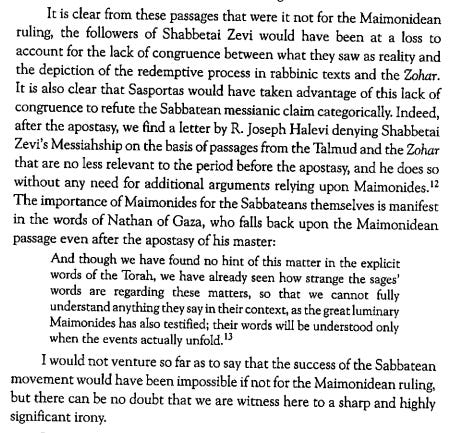
From the beginning of the Sabbatean movement, Nathan of Gaza had emphasised the need for a pure faith unevidenced by miraculous signs and argued that those who did not have this faith were ipso facto, of the Erev Rav. After the apostacy, he doubled down on the doctrine: the true Jew must believe not only without evidence, but against all evidence, ironically drawing on a famous statement of Maimonides that one should not expect the messiah to be accompanied by miracles.4 The renunciation of worldly wisdom, of common sense, was now the highest religious value. The term כופר (denier), which had always been used in Rabbinic discourse as part of a phrase (כופר בעיקר, כופר בתורה), now become a standalone designation for the unbelievers, opposed to מאמינים (believers) who, alone, had an unblemished soul.
However, faith must be faith in something. The Sabbatean elevation of faith as the supreme religious good had two doctrinal components. The first was belief in the messiah, the perfectly righteous person whose soul was uniquely attached to God, through whom the ordinary believer could attain spiritual heights he could not reach on his own. Different Sabbateans understood this differently, with the most extreme versions saying that Shabtai Tzvi was literally God (though, as with all kabbalists, they would then proceed to write a million words explaining how that was not literally true, but also was literally true, and was and wasn’t and [SCREAMS]). The moderates, however, saw him as elevated to some quasi-divine intermediary status by virtue of the unique tribulations he had endured in his fight with the forces of evil. In order to cultivate connection to the tzaddik, completely unprecedented practices, such as having a portrait of Shabtai Tzvi in the house, were innovated.
The classic text of this new doctrine was Tzaddik Yesod Olam, authored by Yehuda Leib Prossnitz, but often attributed to Isaac Luria, and not infrequently printed in editions of Chaim Vital’s Sha’ar Yihudim. This book presents the new doctrine צדיק גוזר והקב''ה מקיים (the tzaddik decrees and God establishes) based apparently on a garbled version of a talmudic passage. Originally, this cultivation of faith in the tzaddik was restricted to Shabtai Tzvi, but gradually it came to be extended more widely. Some of these tzaddikim were identified as reincarnations of Tzvi himself, or as supplementary messiahs (the doctrine of two messiahs being employed for the purpose). Eventually, though, the Sabbateans came round to the idea that there were no fixed number of quasi-divine intermediaries for them to adore, so long as they gave off the right vibes.
The second aspect of the Sabbatean faith was the search for a new doctrine of God Himself. As we have mentioned now a few times, the orthodox response to the Sabbatean farce was to try and freeze Zoharism in precisely the position it had evolved into just before the farce happened. Many moderns have pointed out, not without justice, that this turns kabbalah into a kind of parody of itself, a set of dogmas in place of what was once a dynamic intellectual system. The problem is that if you let Zoharism evolve any further, it evolves into Sabbateanism! For the Sabbateans, themselves, of course, this was a feature not a bug, and they set themselves the task of finally completing the job that had begun with the revelation of the Zohar and proclaim to the Jewish people of who their God had been all along:
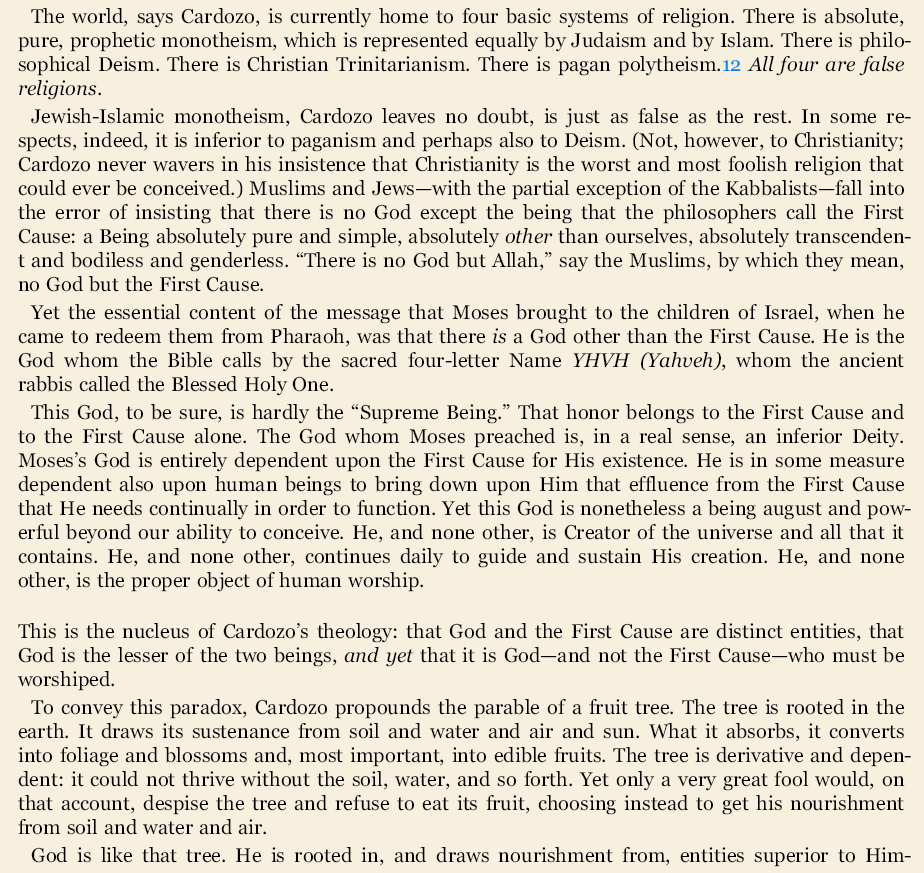
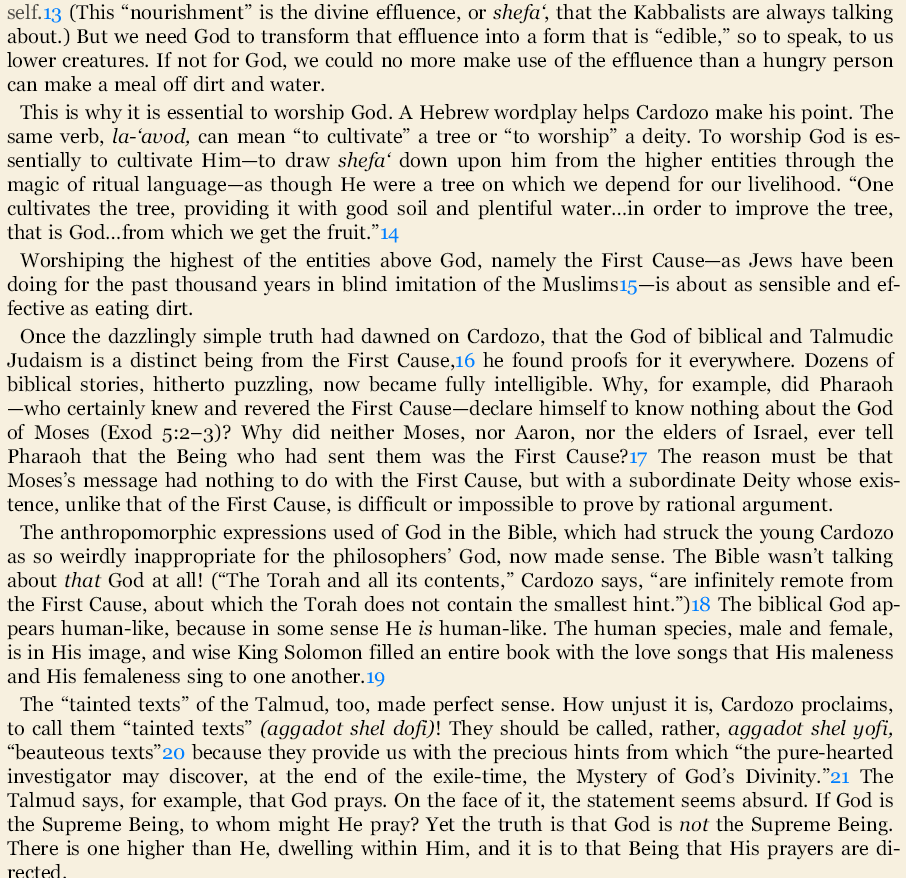
That was Cardoso’s view, and he was the second most important Sabbatean theologian, but it would be a mistake to see his or anyone else’s version of Sabbatean theology as definitive. Like the early Christians, the Sabbateans had multiple figures frantically arguing about doctrine.5 A common alternative belief, attacked fiercely by Cardoso but quite possibly held by Shabtai himself, was that the true God of Israel was simply the Sefirah of Tiferet. What united the Sabbateans was, first, the search itself, and secondly the hatred for the ‘rationalists’ who had concealed the true God in their philosophy. What they sought to do was combine the intellectually sophisticated version of kabbalah articulated by Isaac Luria with the raw, blasphemous power of the Zohar itself, to complete the task of turning a mechanical God into a personal one via the kabbalistic concepts they had inherited. Unlike the Christians, they never arrived at a ‘catholic’ version of the fulfilled kabbalah because the movement died out before consensus could be reached. (Or did it? Stay tuned!)
Finally, the Sabbateans saw it as their duty to complete the job of spreading knowledge of the Zohar. The Jewish masses had by and large accepted the kabbalists as their doctrinal authorities, but they still knew relatively little of the contents of their doctrines. It was partly for this reason, the Sabbateans believed, that they had abandoned their messiah over a trifling matter like apostacy. While the orthodox did their utmost to halt and reverse the proliferation of Zoharic texts that had happened in the century prior, the Sabbateans continued to promote their publication and distribution. For the next hundred years or so, it was chiefly them who funded such work. New texts such as Hemdat Yamim (source of the Tu Bi’Shvat Seder and much else) freely mixed pre-Sabbatean and Sabbatean Zoharic material in a way that, even today, no-one can fully disentangle.
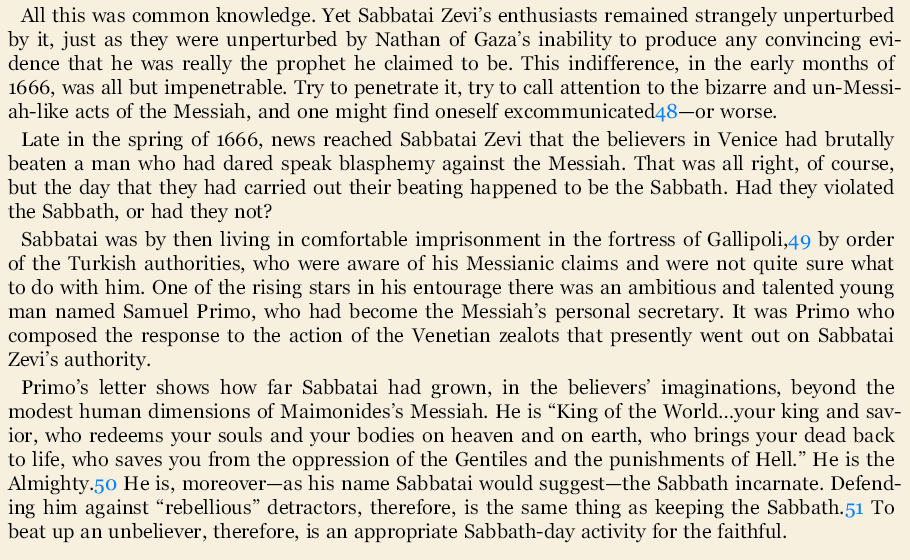
Regarding how much the masses did know, see this important detail:
Another important aspect which is rarely noted is that, according to the fixed Jewish calendar in use for the last 1,600 years or so (depends who you ask) Simhat Torah in exile cannot fall on the Sabbath, but Shemini Atzeret, and thus the Simhat Torah of Israel, can. This last happened on October 7th 2023, and will happen again this year.
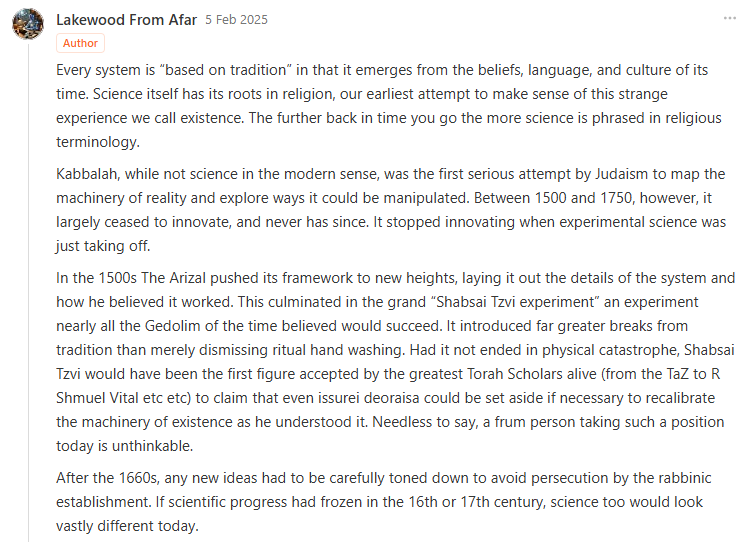
The crispest statement of this I have seen is from one of the Substack OTDs.
David Berger שליט''א has a good article on this:
Interestingly, the famous debate about whether the Lurianic doctrine of tzimtzum is to be taken literally (thus risking a limitation of God and/or His being disconnected from the universe) or non-literally (thus risking pantheism) was had between Nathan and Cardoso, with the first taking the position of the Vilna Gaon (literal), and the second that of the Ba'al haTanya (not literal).
I've enjoyed the historical analysis of this series, but a couple of the halacha vs kabbalah claims you make I have some questions. Too much for a comment, I'll respond via article
Fantastic read, thoroughly enjoyed. In the words of America's greatest ever gaon, "Nonsense is nonsense, but the history of nonsense is scholarship."