

To read previous items in the series, go here.
Everyone is interested in Chassidim. If you want stock footage of Jews for a documentary, you want Chassidim; if you’re a secular philosopher wannabe looking for something to solve your overwhelming feeling of ennui, you want Chassidus; if you’re trying to spice up Religious Zionism with something to keep the kids engaged once they go off to the army, you want Hassidut. Conversely, their opponents, the Misnagdim are boring. No-one cares about them or wants to think about them at all. Three decades ago, Allen Nadler set out to fill the strange hole in historical study with The Faith of the Mithnagdim, portraying for a wider audience the religious beliefs of this group from primary sources. Because they saw the Misnagdim through the eyes of the Chassidim whose radicalism and demotic instincts they admired, historians generally have been willing to accept Chassidic caricatures of their opponents as miserable misanthropists offering nothing to masses of ordinary Jews except contempt and demands for money. Nadler was determined to let the Misnagdim speak for themselves and it turns out that … yeah, actually, that was pretty much correct.
Adler starts the book by debunking the one apparently interesting thing that earlier historians had focussed on, namely the question of whether tzimtzum is literal or not, and, therefore, whether some kind of pan(en????)theism is true. Nadler argues that it is impossible to arrive at a consistent Misnagdik, as opposed to Chassidic, position on the matter: both sides thought it was not literal, but also that something ‘real’ had happened as well. The difference between the two groups was not ontological, but epistemological: Chassidim called upon Jews to look, by hook or by crook, beyond the visible world to the divine reality pulsing through it whereas the Misnagdim said, no, don’t do that, and even if you try you can’t. Nadler then goes on to summarise the key points of Misnagdik ideology as they were propagated in semi-popular tracts:
Zoharism, in particular its Lurianic version, is objectively true, and should only be studied by a tiny minority of scholars already fully expert in Talmud. Even for them, transcendent experience of mystical union is probably not possible on earth.
Because of the low spiritual state of Jews in general, the best they can hope for in prayer is concentrating on what they are saying. Any kind of connection to God, let alone mystical union, in prayer is impossible. It’s better to spend time studying than praying beyond the statutory amount.
All material pleasure is bad and distracts from your true purpose. Active asceticism is also pointless, though. Therefore, for example, you shouldn’t fast, except on days when it is required by halacha, but rather eat small portions of plain food quickly so that you can focus on studying.
The world we live in is one big test in which material pleasures tempt us away from mitzvot and, especially, study, and if we resist them well enough, we get bliss after death.
Chassidim and Maskilim are bad for the same reason, namely that they are optimistic about the potential of Jews to do anything except be miserable all the time and study.
Torah study is the thing that matters most, not because it leads to practical observance of its contents, or because it trains the intellect or character. It just simply is the only really worthwhile human endeavour.
This is an ideology almost uniquely tailored to fail in the marketplace of ideas, and its proponents were aware of this fact. The cultural-economic Jewish establishment and its semi-aligned rabbinical class wanted to preserve traditional Ashkenazi Judaism against the threats of the upstart Chassidic movement and the Jewish enlightenment imported from Germany, but, before the battle began, the true Misnagdim knew that they had already lost.
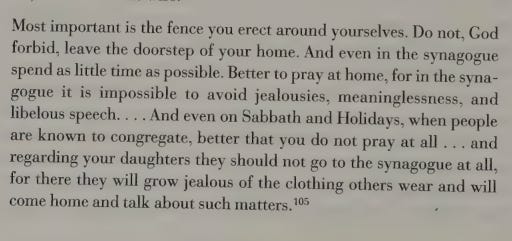
This was R. Eliyahu the Gaon of Vilna (henceforth Gra), at a time when he was the treasured celebrity of Vilna, employed to study full-time at the public expense, and with the ability to issue bans on whichever strain of Judaism he wished. But he knew: it was all hopeless. The modern state was hollowing out the institution of the kehilla from above, the Chassidim were replacing it from below, the winds of secularism were taking Jews looking for something more away from their community and faith. None of this had really happened yet, but the Gra saw it all, and his advice to his students was simple and consistent: withdraw, eschew rabbinical employment, focus on the pure service of God through study.
The Gra himself was, in a sense, cheating. His asceticism was entirely sincere, but he had no wish to die, and, because of his unique genius, he was supported by communal funds without having to ask for it. As brilliant as some of his students certainly were, you can’t build a social movement out of scholars showing up in Jewish communities and wowing everyone with their smarts so they give them free money unasked. Quite likely, the Gra had no plans for any such movement. We know so little beyond his myriad annotations of Jewish texts and legends of his piety and intellectual abilities that it is impossible to know much at all. However, his student R. Chaim of Volozhin did have a plan, and that plan was the modern yeshiva.
The idea of a yeshiva was nothing new, but R. Chaim innovated in multiple overlapping respects. First, the Volozhin Yeshiva was a permanent, freestanding institution, not tied to the local kehilla, and not dependent on the local rabbinical authority. Secondly, the purpose of the yeshiva was not to train future members of the rabbinate, but to promote full-time scholarship, as much as possible within its own walls. As such, the yeshiva solicited donations from wealthy donors around Europe, focussed on study of Talmudic tractates with little contemporary practical relevance, and cultivated a mentality of elite status among its students and graduates.
The new yeshiva movement grew quickly. It suffered terribly during the Holocaust, though less than Eastern European Jewry generally. The Mir, famously, relocated to Shanghai. After the war, it grew again, buoyed by the unexpected fillip of an Israeli state willing to fund it for all sorts of tactical reasons, as well capitalist modernity and the welfare state in general. It is arguably the most successful religious institution of the modern age. Anyone who wishes to think about how to do traditionalism for real, at scale needs to look at it.
In many respects, the yeshiva system has travelled very far away from its original impetus in the Gra’s heroic life of secluded study. He was entirely self-taught, whereas the yeshiva system holds lifelong institutionalisation as an ideal and stigmatises independent learning. He believed textual emendation to repair corrupted texts was both essential to proper study and a religiously valuable act in its own right, whereas the yeshiva world is famous today for holding the concept in suspicion, if not contempt. He rejected pilpul, for centuries the dominant scholarly mode, in favour of precise understanding of what we might call authorial intention and maximum breadth of knowledge, whereas the regnant model of yeshivish b’iyun study and chakiros today is essentially pilpul revived and stripped of epistemic safeguards through elevation to a madcap pseudoscience. However, any attempt to replicate genius at scale must involve distortions of this kind, if not necessarily scale.
In essence, the yeshiva system solves the dilemma of an elitist religious ethos in a democratic age. If only Torah scholars are really human beings in a meaningful sense, then just make everyone a Torah scholar, boom. In yeshivish communities, there are yeshivos where you can send your son with Downs syndrome. Everyone knows, I hope, that this is a feint, something to make him feel better, but there are innumerable institutions which are no less fake and a lot less cute. It is what is. Humans are what they are. Even with Ashkenazi Jews you can’t make a society of scholars and make it not fake. In the meantime, much else from the misnagdic ethos has fallen by the wayside. Litvaks are ascetic in the same way that LWMO keep shomer negiah. All sorts of Chassidic tools have been employed willy nilly to stop the inmates from going insane. The essence of idea, though, namely endless talmudic study for its own sake as the only real religious good, has been preserved. As I have written, after Shabtai Tzvi, Judaism gave itself constipation by refusing either to reject Zoharism or endorse its consequences. In the yeshivos, Zoharism, while never knocked off its pedestal, or even threatened per se, in practice receded ever more into the distance. This, too, was very much a departure from the Gra, who spent most of his time on kabbalah both in study and commentary. This bought, not a solution to the interminable problem, but space to pretend it didn’t really exist.
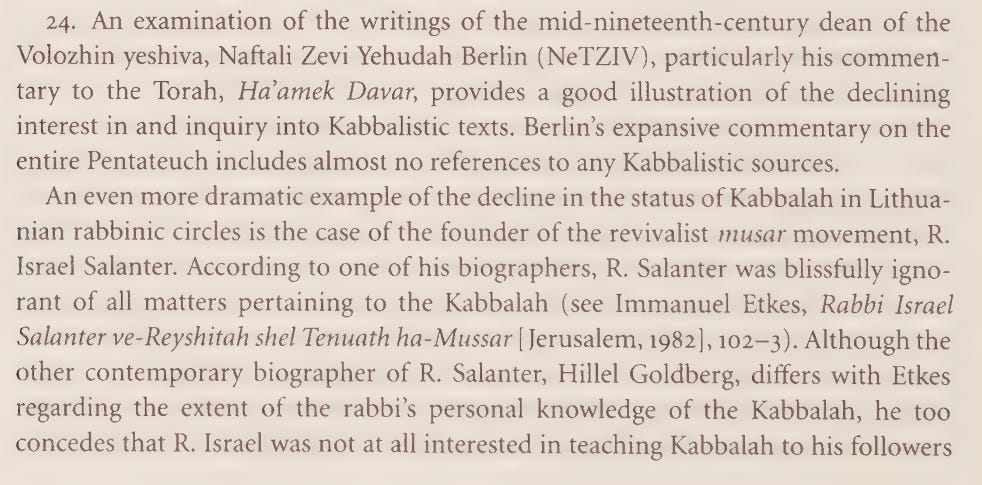
Matters, though, were a bit more complicated than that. R. Chaim was the Gra’s most influential student; the jury is out as to whether he was the most faithful. Some stranger things were happening elsewhere. Read about it here and here. How important is all this? In truth I don’t know. Chime in if you wish.
What can be said with a high degree of confidence is that the Gra believed the solution to the chronic tension in the Jewish religion since the advent of Zoharism was full integration. Zoharism was the essential content of Judaism, full stop, and, as such, could not contradict any part of it. If there appears to be such a contradiction it is because one of the contradictory items has been misunderstood (or is textually corrupt). On most occasions, the Gra resolved the contradiction by reinterpreting (or fixing) a Zoharic text, not a halachic one. Because Zoharism entered Jewish history about 150 years after most of its contents were written and in a haphazard and chaotic manner, the Gra was very often correct regarding the technical question at hand. He considered himself able to do this task of reinterpretation because he was a superior kabbalist not only, naturally, to the Chassidim around him, but to all other kabbalists alive, perhaps in some ways even to Isaac Luria himself. When the Gra could not solve the problem this way, he reinterpreted the Talmudic sources instead, with violence if necessary.
Anyone who has argued against Zoharism will have met with the retort ‘even the Gra believed in kabbalah’. It’s a bit of a strange claim, like saying ‘even Trotsky believed in Marxism-Leninism’. The genesis of this is that some Maskilim identified the Gra as their intellectual forebear on not very good grounds to get some clout, and because they hated Chassidim too, he got lumped in as some kind of rationalist. Thus, if even the arch-rationalist endorses the Zohar, then why purity spiral against it? This is so wrong it’s not even wrong. In reality, the Gra fixed Zoharism in the heart of Judaism perhaps more than ever before, while the movement built out of his example made it possible to ignore it in practice. Whether that’s a step up or a step down depends on who you’re comparing it to.
Your description reminds one of an old Chasidish Joke. Why do we read one verse in the Megila with the Lamentation cantilation? So the Litvaks also have something to be happy about on Purim. But why only one verse? Because more would already be debauchery.
If the Gra invented the modern yeshiva, then I’m a little confused what was going on beforehand; were Rabbis being trained locally? If so, that seems like the story about the yeshivas constituting a sort of eugenic devshirme where all the verbal talent got scooped up, centrally ranked, and the best were married off to wealthy merchants’ daughters was seriously exaggerated.