

Very esteemed friend of the blog, Daas Torah, had an extreme Flatbush moment and sperged out because I asked for someone to pick up some fags for me from the States, so I think it’s time to get some thoughts off my chest about that ‘custome lothsome to the eye, hatefull to the Nose, harmefull to the braine, dangerous to the Lungs, and in the blacke stinking fume thereof, neerest resembling the horrible Stigian smoke of the pit that is bottomelesse’.
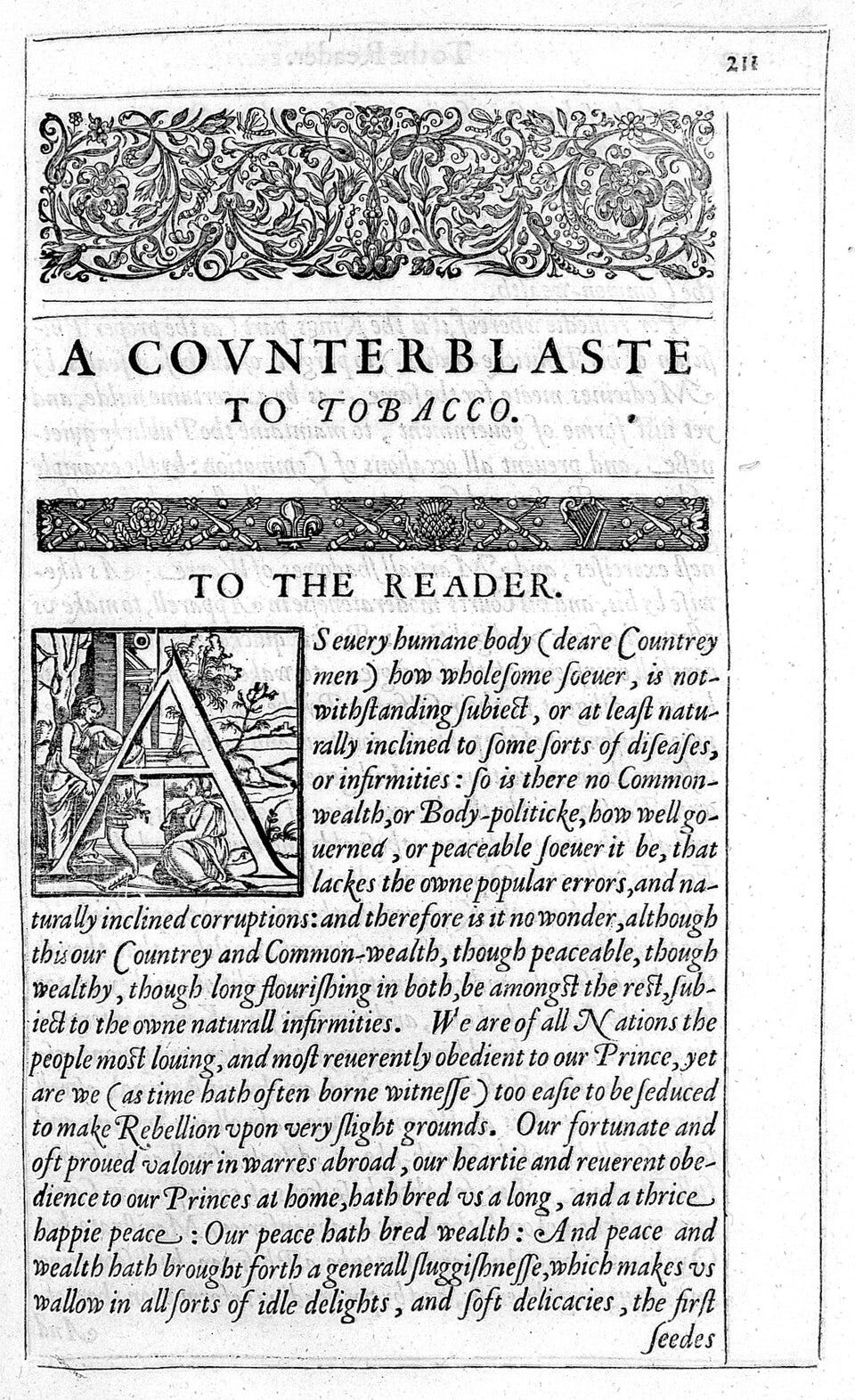
James I was the victim of a gay pederast in his teenage years and a very damaged person. In general, I think men who have a strong hatred of smoking are messed up one way or another (girls are different, they’re not supposed to like it). If you are one of those guys who starts manically coughing and gesticulating when someone lights up on the other side of the room, then you have my sympathy, but I have nothing other to say to you. However, the argument that even though smoking is totally awesome you still shouldn’t do it because it’s bad for you is a serious one, so we’ll start with that.
First of all, smoking* is genuinely extremely bad for you. It remains the gold standard for isolating cause and effect from correlational studies because the effect size is just that large. Reducing the prevalence of smoking* in society is one of the more effective public health interventions of the post-WW2 era. If you presently smoke*, then quitting is probably the single best thing you can do for your long-term health. All that is true and I don’t dispute it. I’m not some kind of crank or immature troll. You may be wondering why I put an asterisk next to ‘smoking’ though. We’ll get to it shortly.
The worst thing about smoking* is that it causes lung cancer. Here is a graph of lung cancer mortality in the United States over time.
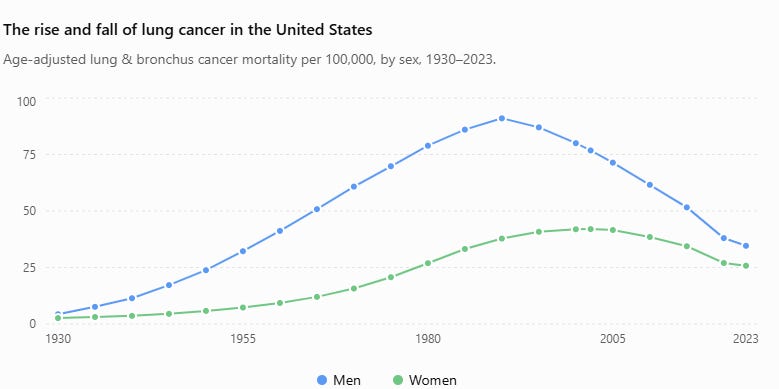
As you can see, the decline in lung cancer rates clearly tracks with the declining acceptability and use of tobacco in wider society. Conversely, the rise of lung cancer correlates very clearly with the rise of … well actually it doesn’t at all.
Tobacco has been widely used among Europeans since the 17th century. Among indigenous Americans, it goes back a lot further than that. The general consensus among both primitive and civilized peoples was that smoking was good for your health. That’s actually kind of odd because in some ways smoking is kind of obviously not so great. If you have a cough and you smoke, then you will in short order have a really bad cough. It also makes your skin kind of dirty. That’s not a big deal, you can just wash it, but it makes it interesting that here was a centuries-long consensus that overall it was good for you. Of course, people can be wrong, but, when they are, you need a mechanism to explain why.
The steep and fairly terrifying rise in lung cancer in the 20th century has no correlation at all with use of tobacco. However, it has an extremely strong correlation with smoking cigarettes.
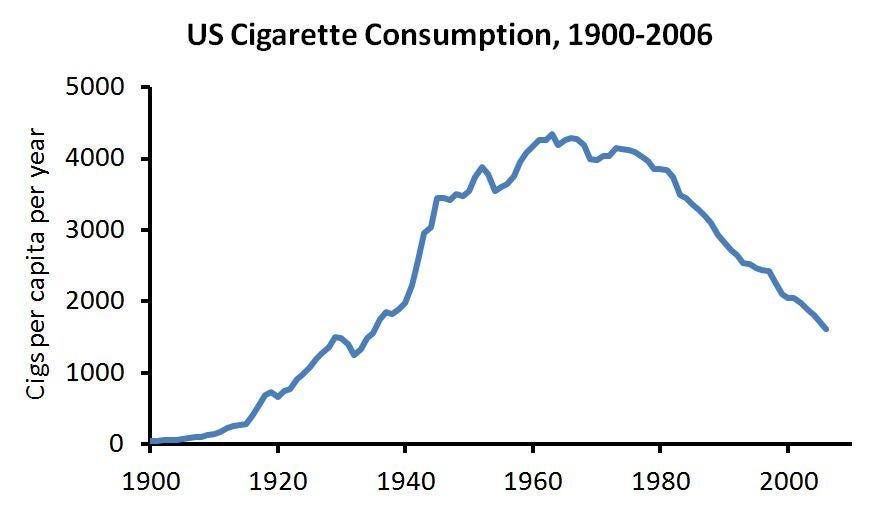
What is it that makes cigarettes more dangerous than smoking generally? The answer is largely that, with cigarettes, you can, and people generally do, inhale the smoke into the lungs. If you try doing that with a cigar or a pipe, you will probably literally fail and make a fool of yourself, but if you do somehow succeed, you won’t be trying it again in a hurry. This is why the invention of filters and ‘light’ cigarettes, once widely considered to be a healthier alternative for removing much of the tar, actually makes smoking worse for you. Here’s an old Vice magazine article with the goods:
Fifty years ago, tobacco companies started putting tiny holes in the paper filters in their cigarettes. Based on some dubious science, the companies claimed that these new “high-ventilation” cigs were healthier and smoother, pitching them as “low tar” and “light.” That kind of labeling was eventually outlawed, but the tiny holes remain—they’re now found in virtually every cigarette smoked today. Now, a new research review shows that not only do those tiny holes not make cigarettes any healthier, but they’ve likely contributed to a rise in a certain kind of lung cancer.
The cancer is called adenocarcinoma, and it occurs deep in the lungs. Today it’s the most common type of lung cancer, but that wasn’t always the case. Over the last 50 years, other types of lung cancer have decreased as smoking rates have fallen but, strangely, cases of lung adenocarcinoma have increased.
Researchers at the The Ohio State University Comprehensive Cancer Center and five other universities wanted to find out why. They pored through the existing literature—chemistry and toxicology studies, human clinical trials and epidemiological studies, and even internal tobacco company documents—and uncovered what they believe is the culprit behind the rates of lung adenocarcinoma.
Research shows that filter ventilation holes make the tobacco burn more slowly and at a lower temperature, which actually leads to relatively higher amounts of toxic substances in the smoke. Next comes a one-two punch: The filter blocks some of the addictive nicotine and the holes dilute the smoke with air, so some smokers compensate by taking longer, deeper drags to get more nicotine. The result? More chemicals getting forced deeper into the lungs where adenocarcinomas more frequently occur. Far from being a safer way to smoke, the filters (and their holes) actually make cigarettes more dangerous.
The Ohio State University Comprehensive Cancer Center – Arthur G. James Cancer Hospital and Richard J. Solove Research Institute
“Our data suggests a clear relationship between the addition of ventilation holes to cigarettes and increasing rates of lung adenocarcinoma seen over the past 20 years,” Peter Shields, a lung medical oncologist and deputy director of OSUCCC – James, said in a statement.
Why do people inhale in the first place? It’s because there’s a lot more permeable skin in the lungs than in the mouth, so more nicotine gets absorbed. But this is nevertheless an extremely disgusting practice. It’s like cutting a hole through your belly and jamming dinner directly into your stomach to get a faster hit. It is this practice which I above referred to as smoking*, but a better term is smooking, and it is that we shall use henceforth. Because doing this is both unsatisfying and highly addictive, the typical smooker does it 12 times a day, constantly assaulting their body for ever-diminishing returns.
So far, I haven’t actually said anything controversial in health orthodoxy, but here’s where it gets interesting. The obvious conclusion from this is that you should just not inhale. Smoke, don’t smook, but that is very much not the health orthodoxy. Let’s ask the internet:
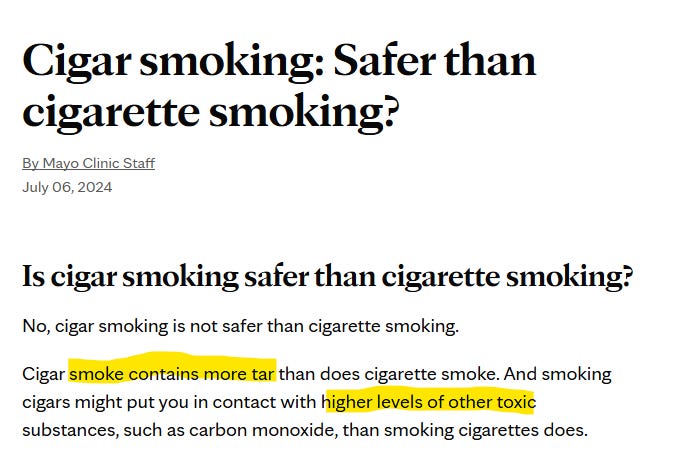
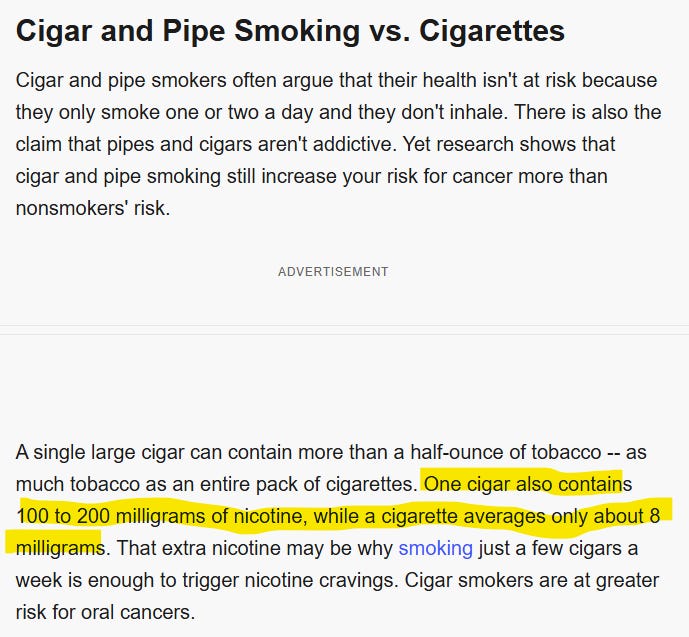
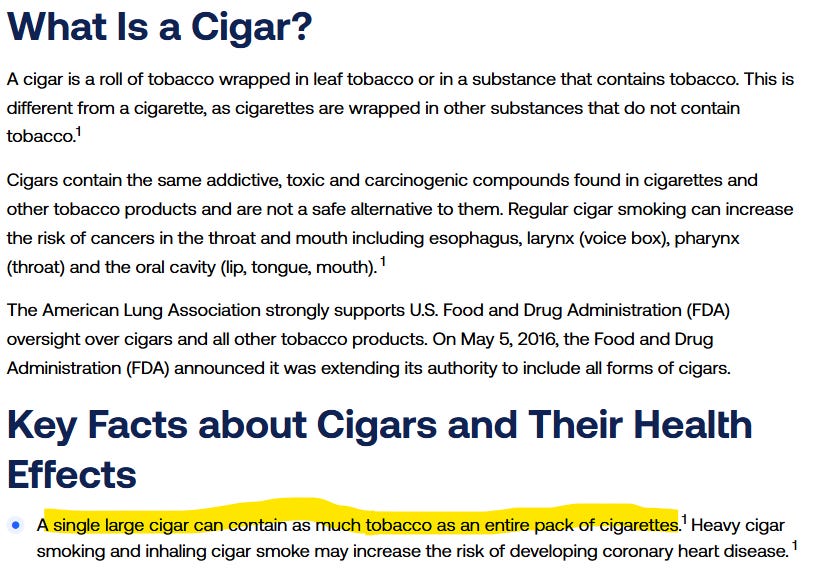
The general gist of it is this: yes, not inhaling is much better for you, but because cigars are so much stronger than cigarettes, it’s still bad for you. OK, fair enough, but you know what is not dozens of times stronger than a cigarette? A cigarette. Checkmate libs.
However, there is now a different type of snag: if you take an average cigarette and don’t inhale, it’s not fun. It just kind of tastes like you took some paper and floor sweepings, burnt them and sucked the smoke into your mouth, because that’s more or less what you just did. In other words, most commercially available cigarettes aren’t even made for smoking, all you can do is smook them. But all is not lost. American Spirit, Camel Yellows and, at a pinch, a Marlboro Red are eligible for smoking. Just rip off the filter, take the smoke in your mouth, let it sit for 5-10 seconds, and then push it out again, in smoke circles if you aren’t a spaz. It’s better to smoke a pipe if you have time for that, but these will do.
Is smoking in this manner still bad for health? Yeah to an extent, but it’s well within the range of activities about which a free adult should be able to choose whether or not to take the hit, because there are many benefits. First of all, it’s nice. Life is for living, not morbidly trying to stretch it out an extra week or two so you can have a few more minutes to lecture people about how they, too, should foreswear pleasures like some kind of giant longevity ponzi scheme (we’ll get back to that). Secondly, it boosts your brainpower giving you up to roughly the equivalent of a 6-point advantage in an IQ test. Thirdly, and most importantly, it decreases stress and, unless you do something really dangerous (like smooking), the best thing you can do for your health, and that of those around you, is to be less stressed.

A neat analogy is co-sleeping with a baby. Most reputable authorities strongly recommend against doing this because of a slightly elevated risk of suffocating your child. It’s true, there is an elevated risk. But what these studies don’t take into account is the elevated risk of crashing your car into a tree because you haven’t slept properly in four weeks, or getting divorced, or jumping off a bridge, or losing your job, or any of the other crazy things that happen to people when they are out of their mind from putting the baby to sleep fourteen times a night. You can cut the risk of co-sleeping down to pretty close to zero through various precautions (don’t drink, don’t do drugs, keep blankets far away from the baby’s face etc.), but there’s always a risk, and that risk is worth it. If you’re a billionaire who can afford a fleet of nannies and there are no tradeoffs, then it’s not worth it, but you’re not that.
Smoking is much the same way. Say you come home from work, and the baby has spent the last half hour dismantling the living room. You are exhausted and would rather put fifteen bullets in your head than tidy up two-dozen ripped-up napkins again. What do you do? Well, you could shout at your wife until she cleans it up, and she probably will, but slowly you hate each other that little bit more, and said baby has to grow up in a warzone. Or you could go outside and have a smoke. And then you come in and it’s not so bad. And if you want to tell me that’s assur, and I’m not frum then sorry I don’t care because I’m too busy having a smoke and it’s chill.
With that said, I think it’s good to have some rules to stop it becoming a bad habit. Here are mine:
No more than 2 cigarettes on any given day.
If I have a cold, complete ban until it goes away.
Once every 3 months, don’t smoke for a week to check I’m not addicted.
But you do you. What I want to finish with is something a bit more controversial. If a Jew wants something to illustrate the humane and decent nature of halacha he will generally reach for pikuah nefesh, the idea that saving a human life overrides even the most severe prohibitions in the Torah. And that’s true, it is beautiful, but over the past decade I have lived through two incidents of warped insanity justified by this very principle.
The first was Covid, when, long after the futility and absurdity of the whole affair was evident to any moderately thoughtful person, the most degrading and demeaning intrusions on human dignity were justified by appeal to the limitless obligation to schlep out the life of anyone who might be infected by someone who might be infected by someone who might be infected by me. I still remember vividly the wild eyes of the assorted people possessed as if by demons who felt they had the right to scream at a complete stranger because he wasn’t wearing his muzzle. And the whole time, Chassidim, precisely because they aren’t so into halacha, just ignored everything and it was completely fine. A few more people died than elsewhere, but still much less than at any other time in human history and it was worth it because life is for living.
The second, which I hope is starting to wind down, is the constant din of ever more outlandish calls for war crimes in Gaza and anywhere else the IDF is operating to save even one Jewish soldier, greeting each new piece of evidence that the IDF (and especially the IAF) is already doing everything short of deliberate murder (most of the time…) with even more crazed demands for more. למה יש מבנה עומד ברצועה? The only real response to this is ‘WTF is wrong with you?’, but the logic of pikuah nefesh (once you have established that it’s a ‘Jewish’ life and not a ‘human’ one to which it applies) is remorseless. It admits no claims of common sense; it doesn’t see the raised eyebrow. Any moral principle, no matter how beautiful, can become something ugly if it does not acknowledge a limit. It’s not just us. The evangelicals who demanded that Terri Schiavo be kept, not alive, but in a grotesque parody of life, who bounded through police barricades to squirt a water bottle into her gaping mouth, all meant well. They had an absolute principle to uphold.
The truth is that the battle for pikuah nefesh has already been won. There are exceptions - children with leukaemia, car crash victims - and they justify throwing a great deal of resources at them, but the average baby born can expect to get past 80. That’s plenty. I have lived long enough that a non-trivial number of people I grew up around are now dead; I have seen different ways of going out. I want to die of a heart attack. If there was some sort of way of ensuring that would happen rather than spending years sitting in my own shit until the nurse does her afternoon inspection, unclear on who I am or who these people are sitting around my bed, I would take it, even if it means shaving 10, maybe 20 years off my life. I am not Richard Hanania. I don’t have any kind of solution, let alone a simple one, to the novel moral problems thrown up by the unexpected triumph of medicine over the human condition, nor to the havoc it is wreaking on social institutions. I know suicide is assur. I can, though, at least, not pretend this change hasn’t already happened. To continue to priggishly demand that we do whatever it takes to live even longer is perverse. We won. Take the W, and kick back with a ciggy.

Appendix:
I can argue anything basically, but here’s the actual science. First from the National Cancer Institute:
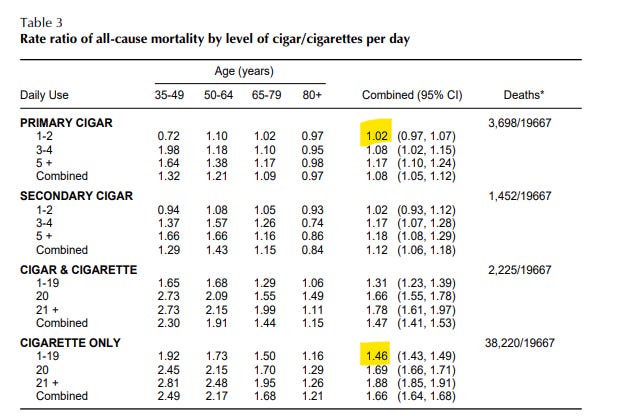
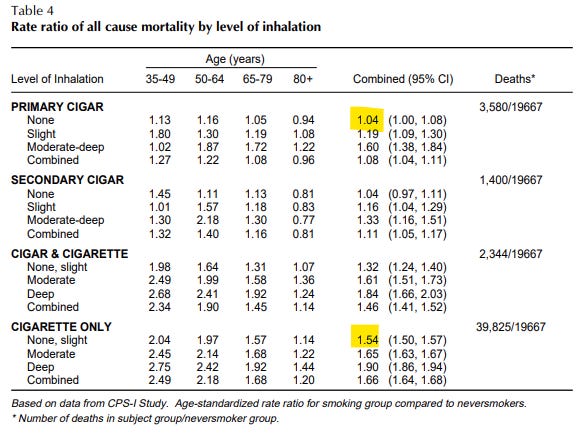
Smoking 1-2 cigars a day, or even smoking a larger number with no inhalation is basically not bad for you at all. It’s surprising that cigarette smoking without inhalation is actually really bad for you, but I’m not sure the data is really useful because 1-19 cigarettes is not a meaningful category. 19 cigarettes a day is a lot!
Here is the Surgeon General
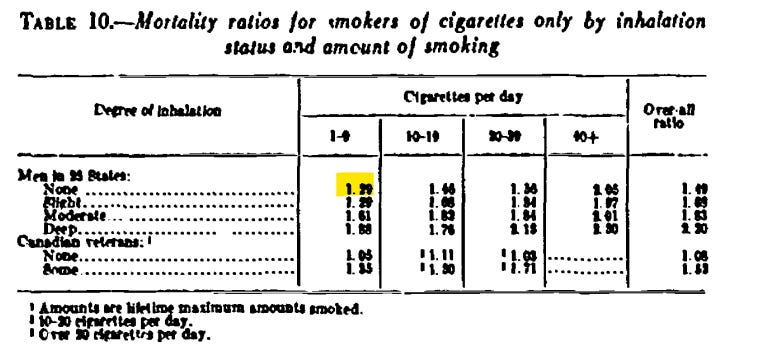
Nine cigarettes a day is still quite a lot, but this is still surprising given how harmless cigar smoking is. I can think of two explanations. The first is that people are self-reporting themselves as not inhaling when actually they are by accident. The second is that commercial cigarettes are just really bad for you because of all the other stuff they put in like the crunchy conspiracy theorists say. I must admit that the safe, science-supported thing to do is to only smoke cigars, but I don’t like cigars and they make me feel dizzy. צ’’ע.
I like my pipes, and typically am complimented on the sweet smell, as well as the style of my lighters.
Easy upshlug of this whole post: "Your love of the haflings' leaf has clearly slowed your mind."