I read this book, kindly lent to me by Hugo Billen (maybe subscribe, he’s a fren).
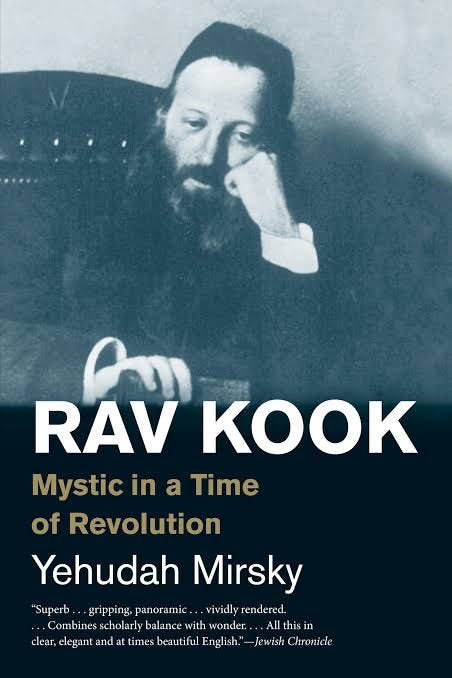
It’s a good book, well-written, fast-paced and thought-provoking. Mirsky does a good job of balancing his admiration for Rav Kook as a man (justified) and thinker (dubious), with his evident discomfort about how mad it all is, without making his editorial voice unduly intrusive. I recommend you read this book. Maybe even worth buying it if that’s what you’re into. Here ends the book review section of the article. Now for my thoughts.
It’s easy to mock Religious Zionism, and fun too. I think it’s also a great mitzvah, but I’m biased in the same way that the hilltop guys are biased when they say it’s a great mitzvah to burn houses. Regardless, it’s all too easy. There’s Motti Elon, who even by the standards of homosexual sex offenders is an off-putting person and somehow became their inspirational guru for a decade. There’s Kahana, there’s Scheinberg, there’s Tal, there’re the other ones who it was never proven so it’s improper to name names, there’s all the crazy stuff they said during Covid, there’s the way they get dumped on all the time by Charedim and just take it, there’s that thing where they try to do Chassidus and take away literally every good aspect of it (there’s a lot of that), there’s the extreme level of confusion about what shirts are designed to do. There’s a lot. But Rav Kook is different. At the time, everyone - except for the real scum of Meah Shearim - understood he was different, and, no matter what he said, Charedi Rabbinical leaders always emphasised that, as a man and a scholar, he was off limits. I think that’s right. I hadn’t realised that, as well as Shaul Lieberman ז’’ל, he was also the teacher of Binyamin Levin, who did as much for Jewish scholarship as any 20th century gadol. It’s a shame that Rav Kook’s plan for a genuinely rigorous yeshiva curriculum never got anywhere institutionally, but, even so, he more than earned his own gadol card. Taking him on needs to be done not only with kid gloves, but something more like awe. Obviously, I’m not the man to do it, but someone absolutely has to, because Kookism has to go, properly go. The absolute maximum status he should have is something like Avraham Abulafia. I recall once that I was in a Satmarer house, and he had a Rashba or something and had scratched out the מוסד הרב קוק logo on the spine with a screwdriver. At the time, I thought it very extreme, but I think it’s closer to the right balance than where we are today.
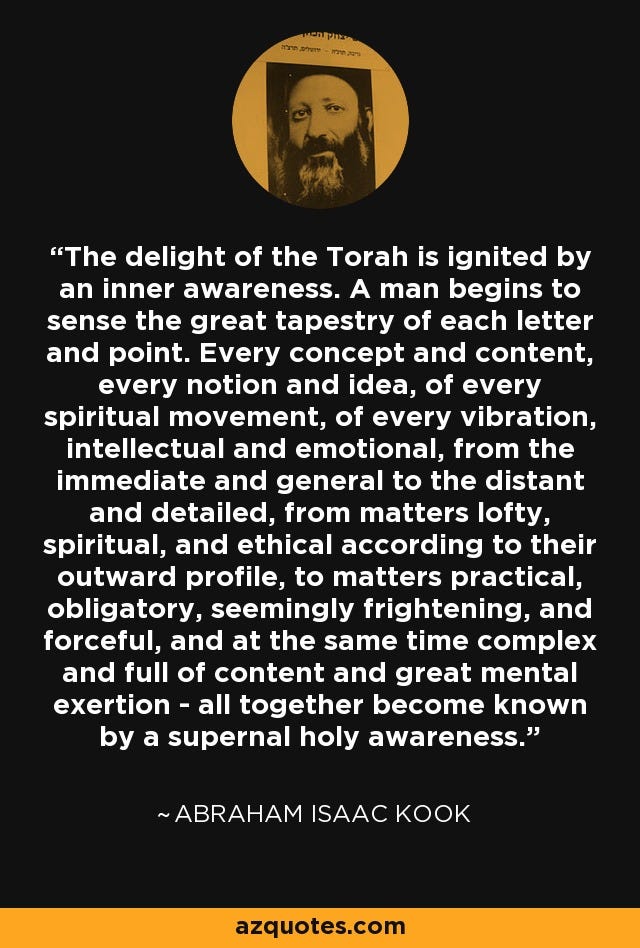
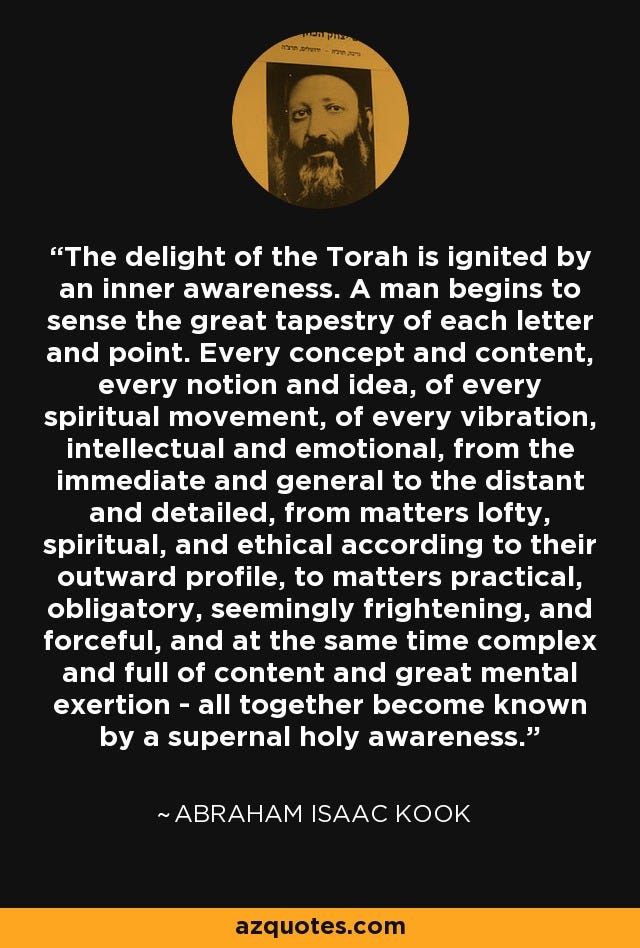
I guess It’s generally appreciated that Rav Kook had a messianic turn of thought, but what Mirsky brings out well is that his confidence (not hope) in imminent universal redemption wasn’t just some aspect of his philosophy that you can analyse along with the others, it was the whole thing. The reason why his philosophy seems to contain so many intractable contradictions is that it literally does, and deliberately so, because Rav Kook saw the messianic process as consisting of the resolution of those contradictions. In the absence of a messianic process actually existing, it is impossible to reconcile all of the different sides of Kookism, so it is strictly impossible to be an authentic Kookist. Those minority strains today that emphasise his humanism, his demand for the highest ethical standards, his boundless benevolence are no less authentic than the majority strains which emphasise the absolute obligation to impose Jewish sovereignty on holy soil, the ontological superiority of Jews to all mankind, and the necessity of teleological suspension of the ethical to achieve redemption. On the other hand, they are no more authentic either, and appealing to the ‘correct’ reading of Kook has no value beyond its ability to influence public perception, something that in practice seems to be extremely limited. The truth is quite otherwise: Kookism is a failed messianic movement. The attempt to keep it going after the messianic promises were not fulfilled inevitably involves, at the very least, pervasive intellectual corruption. In practice, it would seem to entail much worse than that. There is precisely one response to the work of Rav Kook that allows you to preserve your intellectual decency, and that is to say that he was wrong. Only after that are you permitted to start inquiring about whether there were some things about which he was right. This is an indispensable act of mental hygiene and very urgent.
Rav Kook’s big idea was that the great opposed movements of his era, to wit liberalism, nationalism, and religious traditionalism, all had aspects of a higher truth that would be unified in the messianic era. From liberalism he valued the freedom of the individual and the opposition to tyranny, from nationalism he valued the call to a higher good and the diversity resulting from each nation pursuing its calling according to its talents, and from religion he valued the reverence for the divine and the insistence on objective moral truth. He thought that, because the messianic process was inevitable, the weaving of these three strands into a higher combined truth was also inevitable. However, since the messianic process did not come, there is nothing inevitable about this process. It is just as likely that from liberalism you get shallowness and trash culture, from nationalism you get cruelty and the lust for conquest, and from religious tradition you get ignorance and narrowness of thought. That is, approximately, what is actually happening in Israel, certainly more so than Kook’s proposed synthesis. Kook himself, though a man of frenetic action, was not a successful institution builder. In that way, he was a type quite familiar to those who have spent any time in the utopian wing of Israeli religious-politics. Like all prophets of inevitable historical processes, he faced the difficult question of what role concerted human action actually has in these processes, and, from a practical perspective, he flubbed it. What he gave was a vision for others to take up later as Judea and Samaria miraculously (as it appeared) fell into our lap, Labour Zionism unravelled, and Mizrahi voters granted the Right electoral dominance. But these were all historical phenomena that Kook didn’t think about, let alone predict. Kookism, from its very beginning as an actual social movement, was a kind of cargo cult of an already failed vision, a fact that was substantially obscured by the fact that the man running the cargo cult was his own son.