

I have been reading Yehuda Mirsky’s biography of Rav Kook. I am appalled. People can believe whatever they want, maybe, I guess, if you want to be all lib about it, but these are not OK things to promote in public. There has to be some kind of baseline standard of not being an outright fruitcake to participate in national discourse, otherwise you might wake up 100 years later in a mental asylum. That there is an entire network of schools and yeshivos dedicated to promoting this otherworldly holyman’s deliriums (where Rabbi Doctor Natan Slifkin proudly sends his children) is in itself a national scandal. What is going on? I’m not saying that the members of the old Yishuv who subjected Rav Kook to daily harassment and violent provocations were right. I’m a big gay lib and against that sort of thing, plus Rav Kook was a holy and upright man and that should count for something, but maybe they were, like, directionally correct.
Anyway, that’s what I wanted to write about this week, but after our podcast the other week, Seth Ackerman recommended I check out a Palestinian writer from Gaza called Muhammad Shehada. So I checked him out.
FFS.
No, seriously, FFS. Why do I have to do this? I asked a while ago who the Palestinian NonZionism was. There were a few suggestions, but whoever it is pull your finger out, OK. I don’t want to do this. I was born with some kind of biological malfunction, call it hyper-Judaism, where I want to culture-of-critique my own culture, to point out that we’ve lost the plot, we’re walking off a cliff etc. I don’t want to do it for Palestinians because (a) I don’t know enough and (b) I don’t care enough. No doubt you guys are interesting to yourselves, and that’s as it should be, but you’re not interesting to me; you’re just proximate. But what can I do? I watched a video. It sucked and now I’m going to spend the afternoon writing about it. You, subscriber, are going to read it. It’s a sorry tale, but we’ve all made questionable life choices. Here’s the video.
It starts off with Bibi Netanyahu saying some ridiculous nonsense. The point here is that it’s wrong for Zionists to say ridiculous nonsense so as to demonise their enemies and legitimate war crimes. Agreed. However, the principle that ‘it’s wrong for Zionists to say ridiculous nonsense’ is a special case of the general principle that ‘it’s wrong for people to say ridiculous nonsense’. If you are Palestinian, then I want you now to pause and read the previous sentence again. I don’t want to patronise, but you (plural) brought this on yourselves. Either it’s wrong to construct a fantasy world of lies to let yourself off the hook for all the gnarly stuff you’ve done, or it’s not, but it can’t be wrong for us and not wrong for you. Think about it. If you do, you’ll find the logic impeccable.
Preambles done, we can now move on to the argument, which is that Zionists have always been as bad as they are today, it’s just that now it’s better documented. The argument is made by stitching together quotations. So, we’re going to go through one by one:
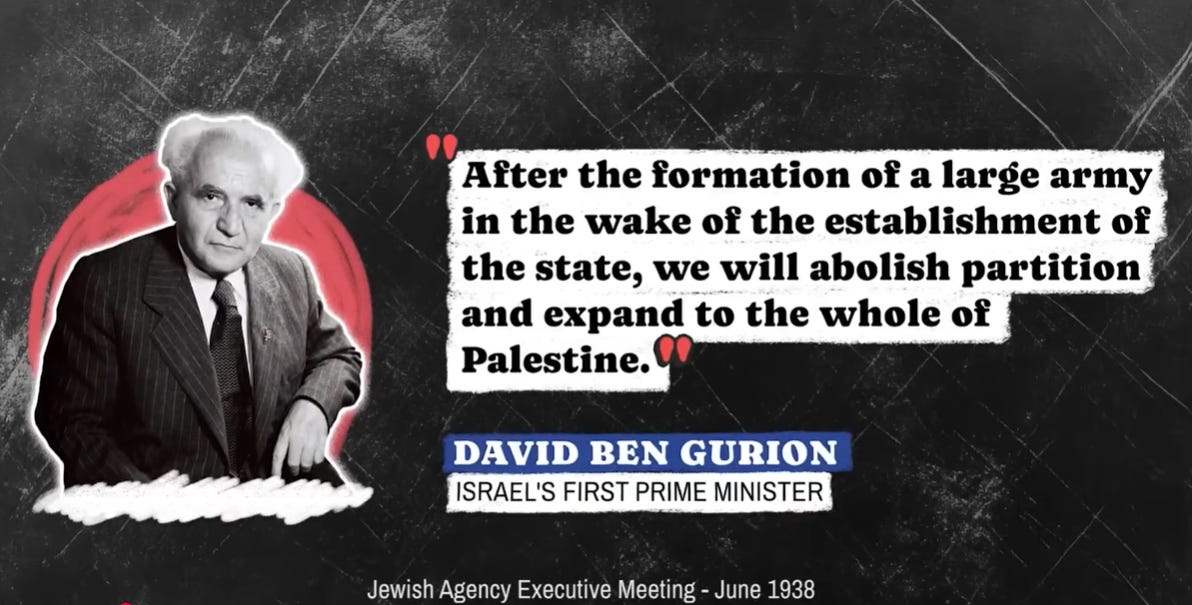
Everyone agrees that the Zionists accepted partition and the Arabs didn’t. The implication, though, is that the Arabs were justified in rejecting partition because the Zionists were only using it as part of a plan to take ‘all of the land’ and make it ‘empty of Palestinians’. The problems are threefold. The first is that Haim Shapira, a non-Kookian religious Zionist (today known as Erev Rav) immediately asked Ben-Gurion ‘by force as well?’ and Ben-Gurion answered, ‘Through mutual understanding and Jewish-Arab agreement’. Secondly, here is the partition the Zionist movement under Ben-Gurion decided to accept.
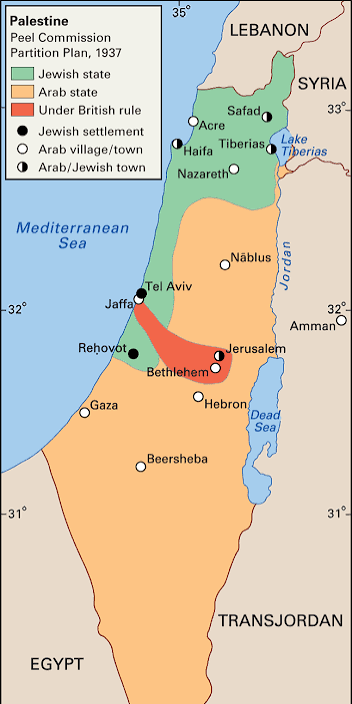
In response to a wave of terrorism and multiple atrocities, the British tacitly concluded that the Balfour Declaration had been a mistake (duh!) and offered the Zionists a joke country in a tiny minority of the originally promised territory, mostly in the worst bits, and not even fully contiguous. A large proportion of the Zionist movement wanted to reject the offer; after all, it was clearly not what they had been promised. Ben-Gurion, by contrast, thought that any state was better than no state. If the Zionist movement wanted proof of concept, so as to persuade regional and global opinion that Zionist immigration was to the general benefit, then it had to take whatever it was given and make it work. And what’s wrong with that?
However, the third problem is the weightiest. Let’s say Muhammad wasn’t lying and Ben-Gurion really had said ‘we’ll get a tiny country and then with our pimped-out army, we’ll take over the whole region, bwahahahahahaha’, what would that mean? In his articles and our conversation, Seth’s central proposition is that when Arabs do this, Israelis shouldn’t freak out. First of all, any leader who wants to make a deal will have to deal with rejectionists, and thus have to sell his compromise as a prelude to future expansion. Secondly, even if he’s not just leading them on, it doesn’t necessarily matter, because his choices post deal will be shaped by the incentive structure after the deal not (at least not solely) his long-term aspirations going in. So the rational thing for the Arabs to do in response to the Zionist movement accepting the Peel plan was to accept it as well, and give the Zionist rump country reason to be content with arrangements as they stood, instead of chimping out.
There’s another point here. If accepting a state far smaller than you want and believe you deserve as a basis to achieve more in the future is such an amazing strategy why not do it? The Palestinians have rejected a state three times since Oslo. I accept the argument that what they were offered was less than (a) what they would be accorded by a simple application of international law (b) less than most Palestinians are willing to accept (c) less than they deserve from an impartial perspective. OK, but so what? Learn from the winners.
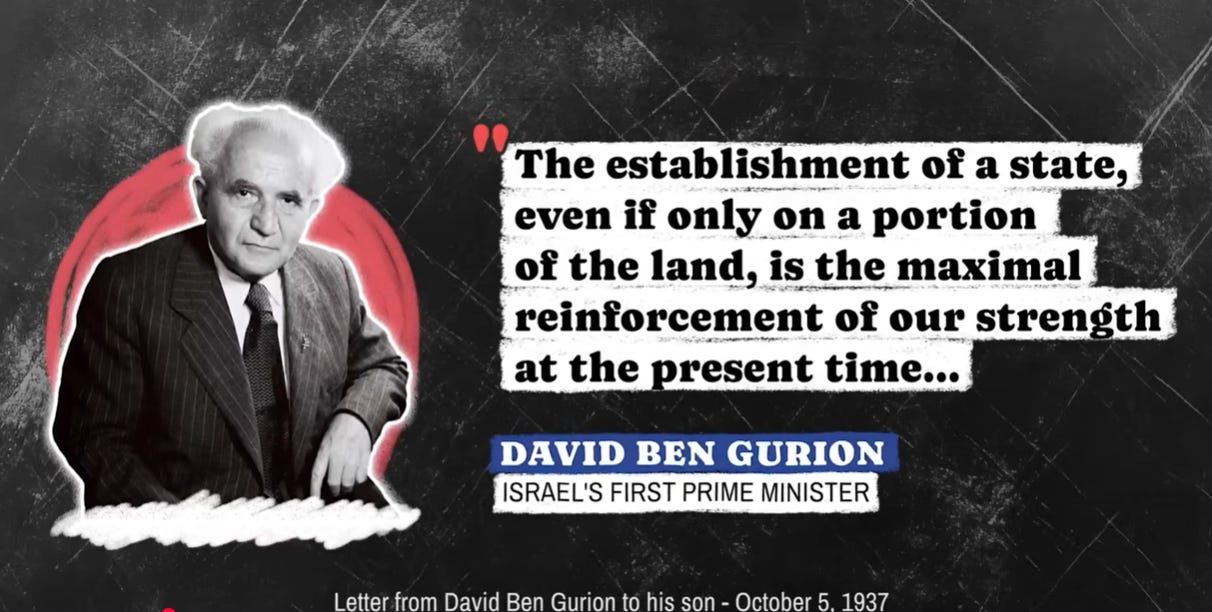
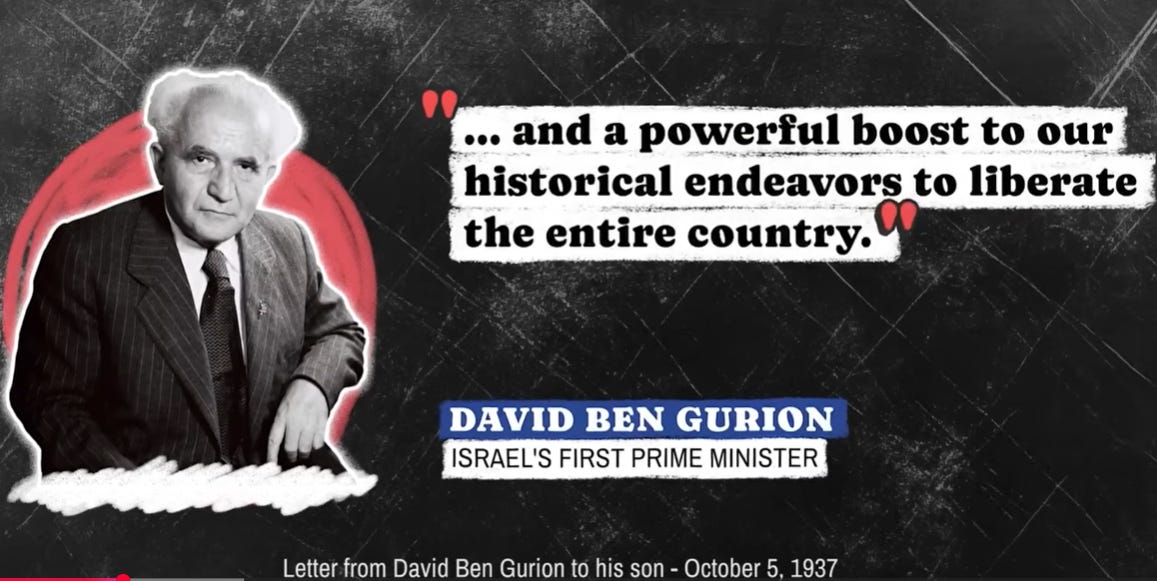
This is basically the same thing. Ben-Gurion continued:
We shall organize an advanced defense force... At that point I am confident that we would not fail in settling in the remaining parts of the country, through agreement and understanding with our Arab neighbors, or through some other means.
‘Or through some other means’ sounds a bit ominous, I guess. Lots of stuff Arab leaders have said sounds ominous, and heaven only knows what they were saying in private correspondence since they won’t open their archives. Again, Seth Ackerman is right: chill out.
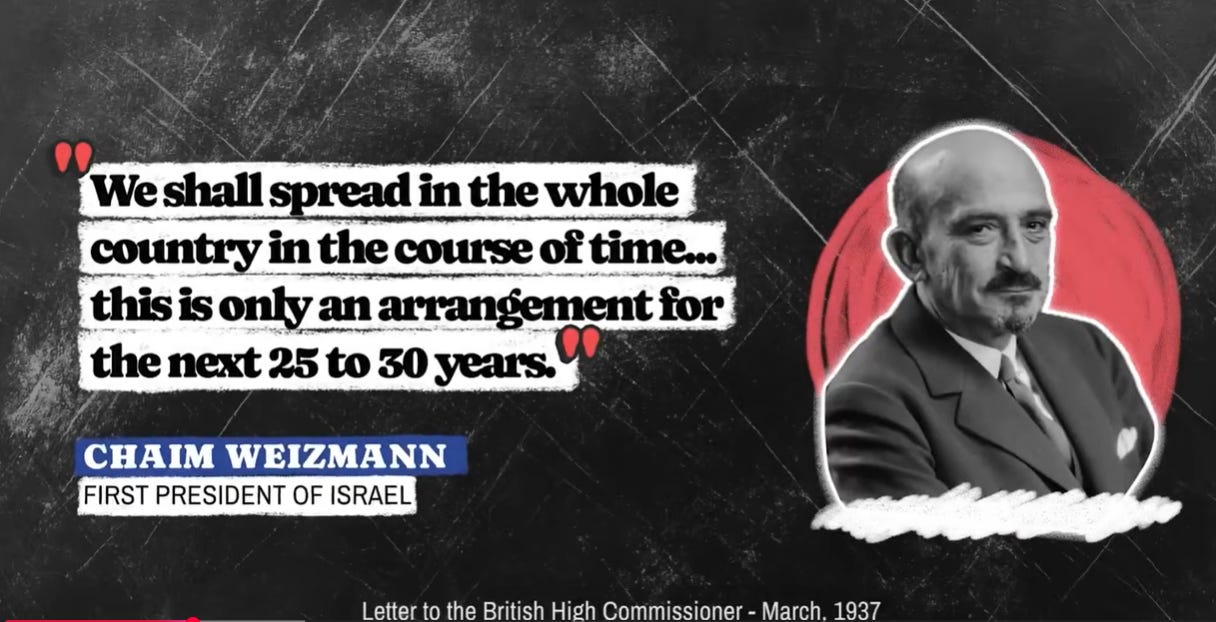
Again, same thing. So he wanted to. At the time, there were 8 million Jews in Eastern Europe, a large proportion of which, perhaps the majority, wanted to leave. Weizmann thought that in due course they’d come to Palestine, which is fine - right? - no human is illegal, but, in the meantime, he was content for Jews to work on their patch in the north for 25-30 years. Major no-brainer how Arabs should have responded to this. Now we move on to something a bit meatier.
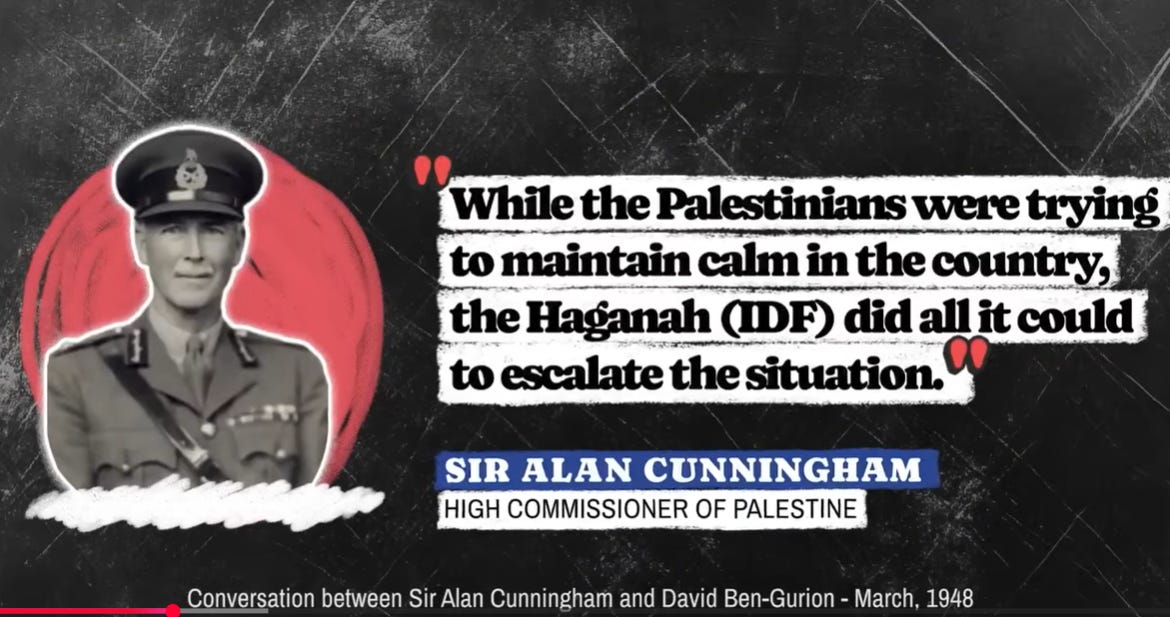
We’ve skipped ahead 10 years, and some things happened in the meantime that maybe are relevant. As is the case with many of the quotations here, it’s not a quotation, but a summary by Ilan Pappe in the form of a quotation, where in the endnote he says ‘this is what I feel he would have said’. I know Palestinoids think Ilan Pappe’s zany techniques are super cool, but they’re not. They stink; they make a mockery of the discipline of history; you degrade yourself and the human race at large by referencing him. I get that gentiles find Jews bewitching with our verbal tilt, but you can do better. Yes, even you. Further, Cunningham was speaking to Ben-Gurion, in order to try and make him rein the Haganah in, something that would have been pointless had he thought that Ben-Gurion was committed to provoking conflagration that would allow him to commit ethnic cleansing.
However, this is still a valuable piece of evidence if we make clear that by ‘Palestinians’ we are supposed to understand ‘the majority of the Palestinian leadership’ whom in Cunningham’s estimate wanted to avoid a civil war that they would get wrecked in. If by ‘Palestinians’ you mean ‘Palestinians’ though, then it would just be very obviously wrong since by March 1948 ‘Palestinians’ had conducted hundreds of sniper attacks, convoy ambushes, assaults of settlements, and sieges. Just a few weeks before, about 50 Jewish civilians were murdered in the Ben Yehuda street bombings. Of course, Cunnigham was entitled to his opinion about the overall strategy of the Arab leadership, but the implication of Shehada that Zionists were busy trying to goad Arabs in general into a war they didn’t want is false.
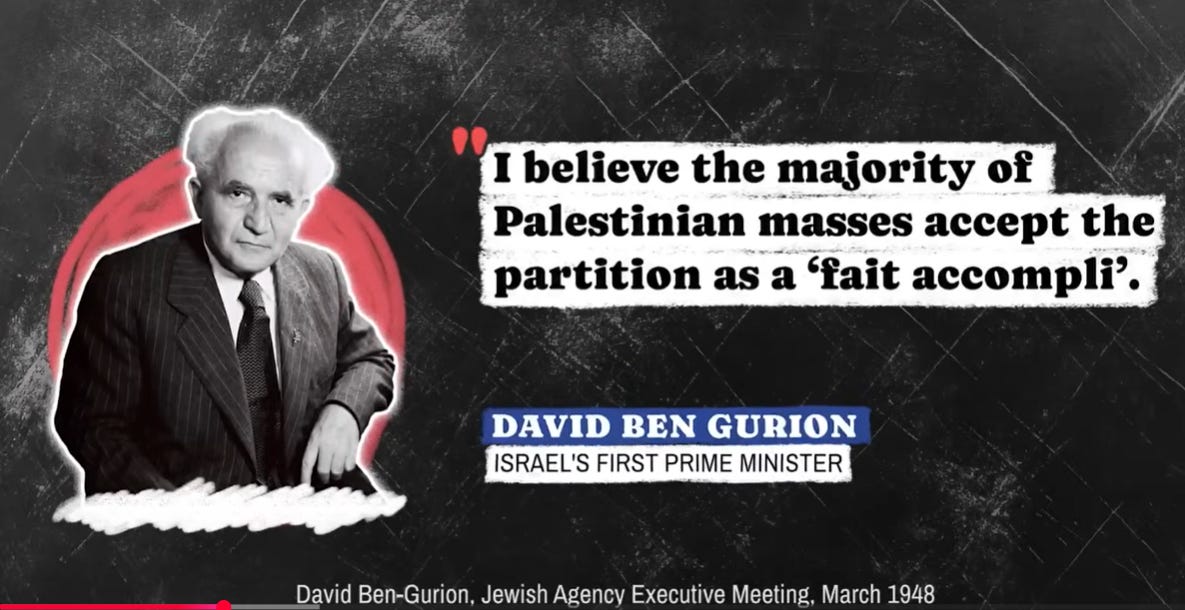
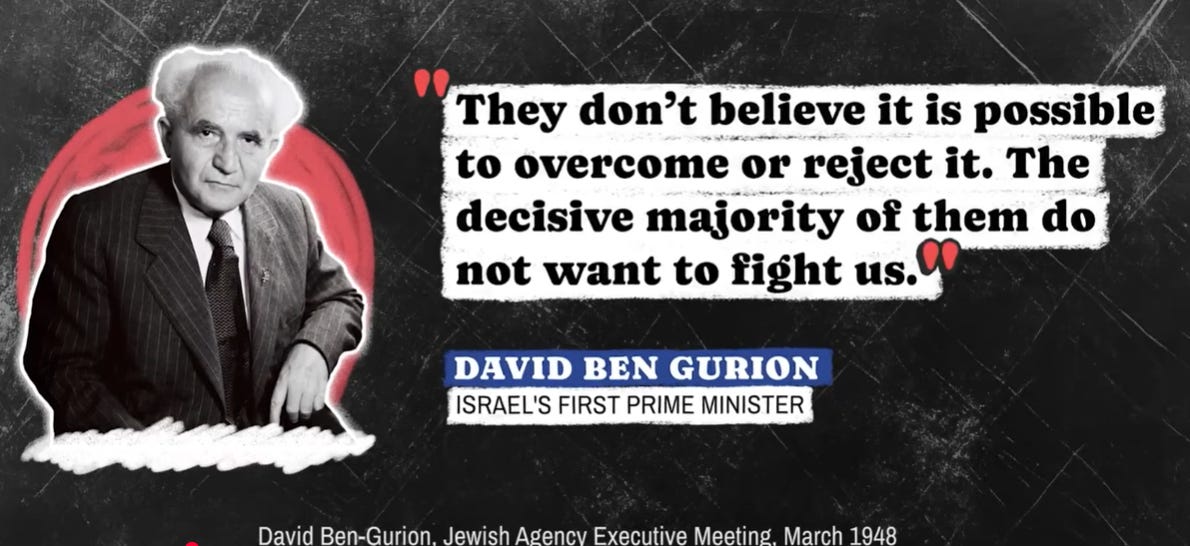
Ben-Gurion’s belief, which may or may not have been true, is that the Arab population at large was demoralised, and that therefore, it was possible to avoid war. OK So what?
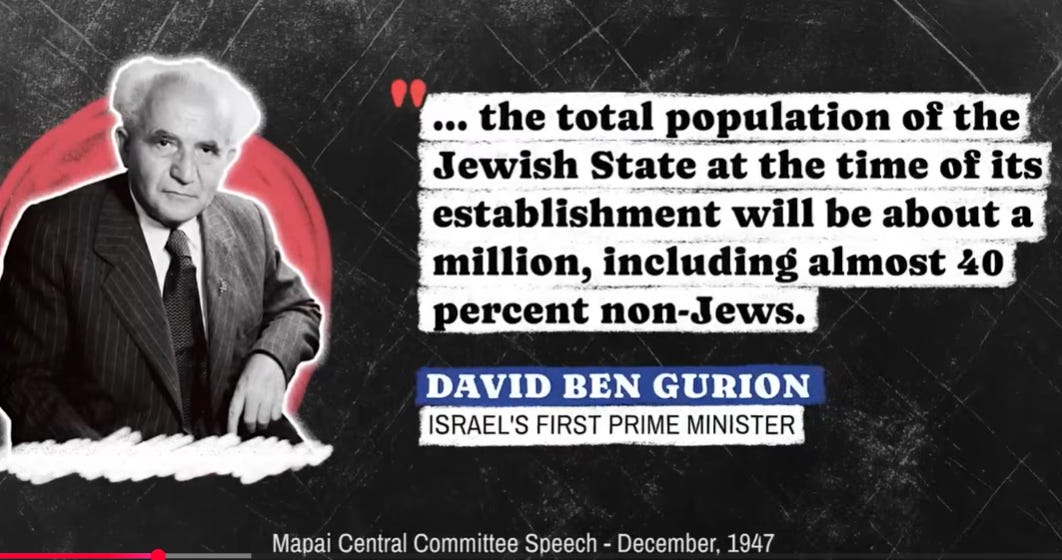
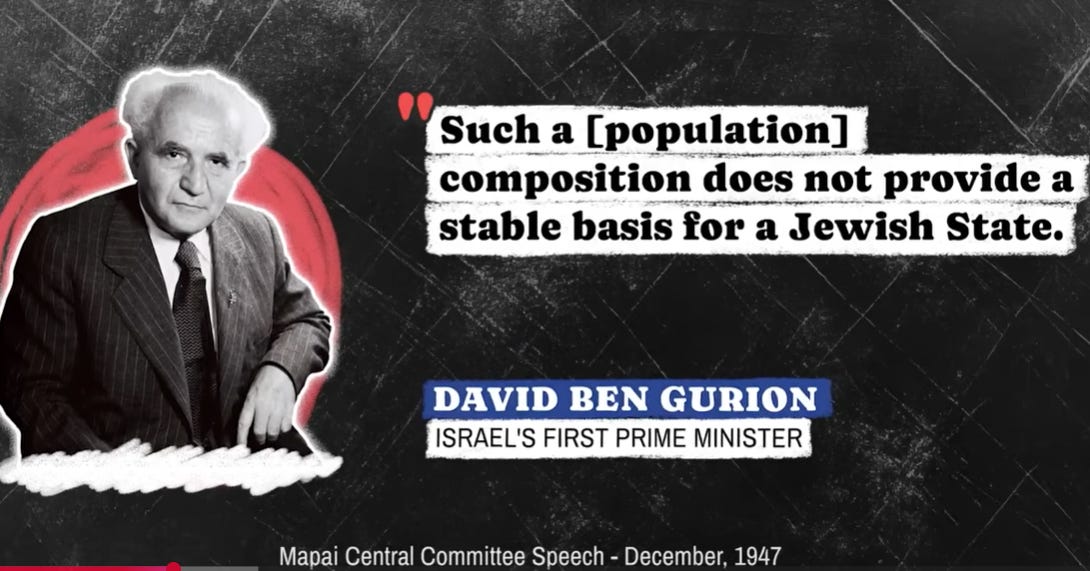
So, I guess this is supposed to be the ‘so what?’ This is what really bugs me. Ben-Gurion was a smart guy; he said smart things. Every time he said something smart, we are supposed to treat this as an aha! moment, rather than a chance to learn, to understand. The very quality of seriousness and realism is treated as some kind of irredeemable flaw. Ben-Gurion was talking about the UN Partition plan, which was substantially more favourable to the Jews than the Peel plan:
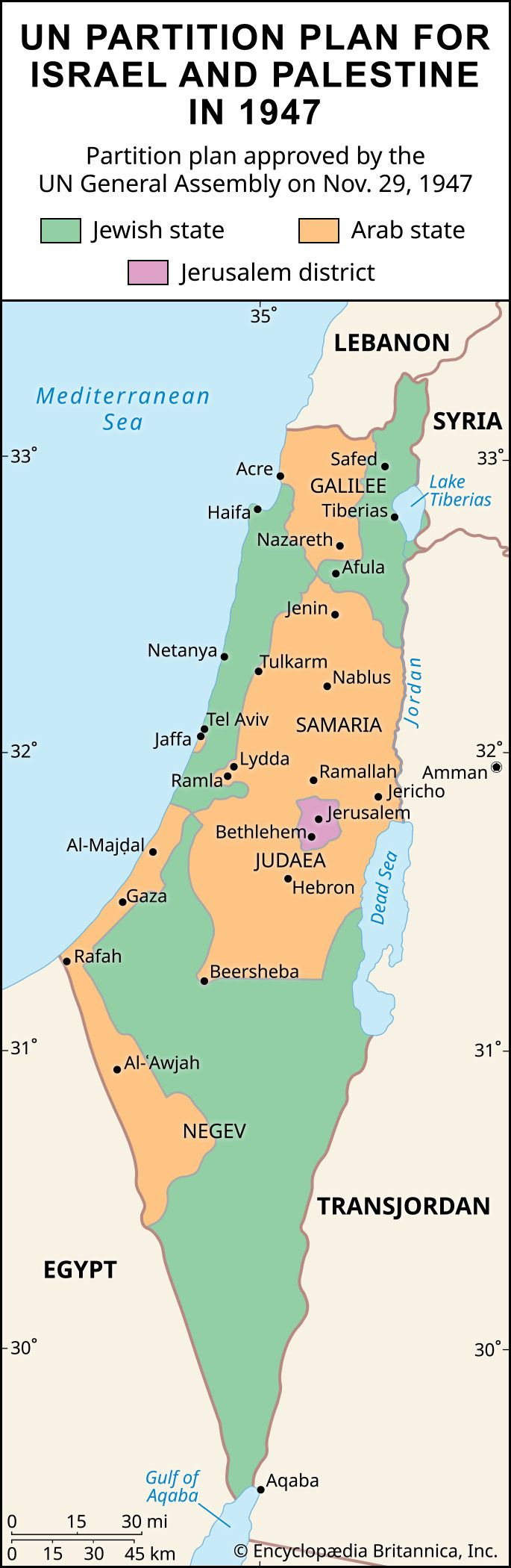
But getting more territory came at a cost: it meant the Jewish majority was weaker. Ben-Gurion was right: 60-40 wasn’t good enough for a stable Jewish state, you need 80-20. So what was the solution? Well, the source doesn’t say, but there are three options (1) add more Jews via immigration (2) offload some of the territory with Muslims in it and (3) offload some of the Muslims. (1) was undoubtedly Ben-Gurion’s policy; (2) wasn’t, though maybe he could have been talked into it. What about (3)? Well, if some Arabs could take a 10-minute drive from Afula to Jenin, that would be swell, but how to do it? Muhammad’s contention is that Ben-Gurion sought to engineer a war to make it possible. What’s the evidence?
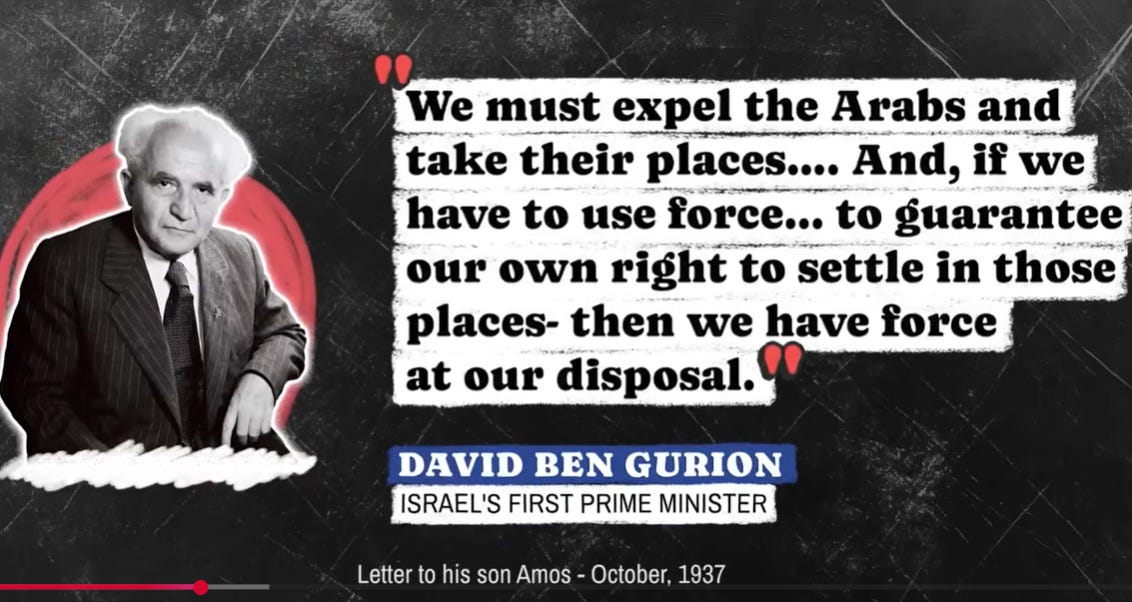
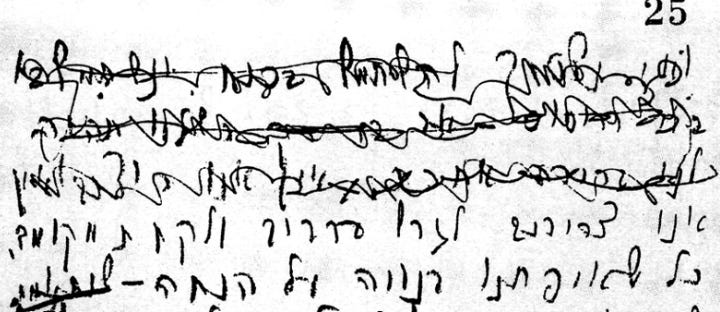
You’ll notice a lot of ellipses here. Ben-Gurion’s handwriting sucked,1 and there has been some debate about what he wrote in this letter, but the correct reconstruction appears to be:
We do not want to and we do not have to expel Arabs and take their place. All of our ambitions are built on the assumption that has proven true throughout all of our activities in the land [of Israel] — that there is enough room for us and for the Arabs in the land [of Israel]. And if we will have to use force, not for the sake of evicting the Arabs of the Negev or Transjordan, but rather in order to secure the right that belongs to us to settle there, force will be available to us.
So, completely different. As they say, if you had strong proof, you wouldn’t be using this.
There’s more to add though. Shehada here is taking us back again ten years to the aftermath of the Peel Commission, which did indeed recommend transfer as a way to create two stable states, one (small) Jewish one and one (larger) Arab one. While this particular source doesn’t prove anything, it is true that, in general, the Zionist movement, and Ben Gurion himself, was open to the idea. However, this has absolutely nothing whatsoever to do with Shehada’s claim of provoking a Civil War. To the contrary, the whole point of the Peel plan was to put an end to the conflict after the Arab revolt, by getting Jews and Arabs out of each other’s faces, and the purpose of transfer wasn’t to allow Jews to seize all the land, but to confine them to a quarter of it. And now it gets really stupid as we skip forward again 10 years.
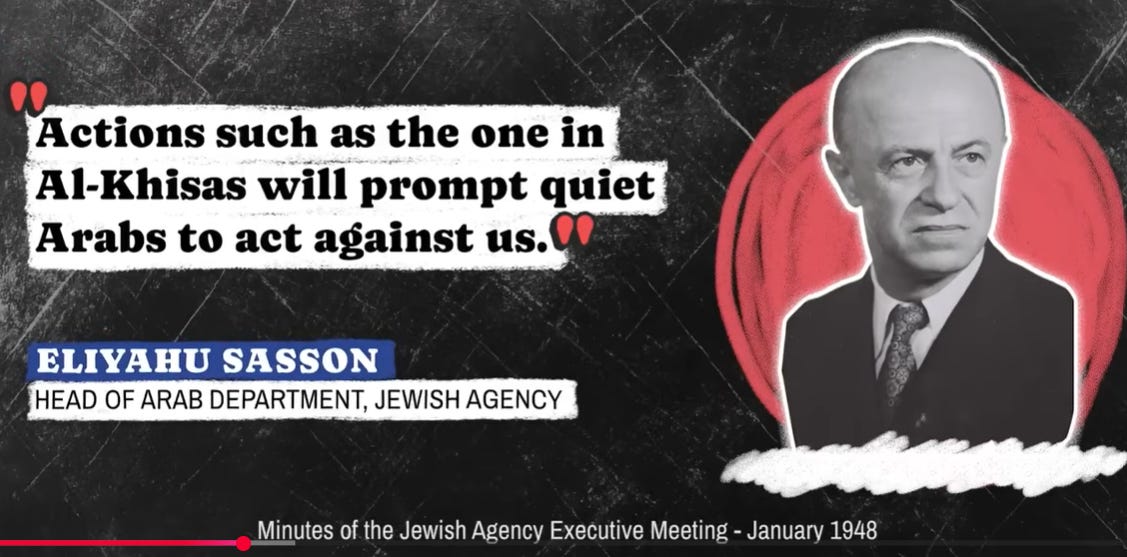
He did say this, but he said it in opposition to the Al Khisas raid. This attack (‘war crime’ would not be an unfair designation) was launched by local Palmach commanders in response to the murder of a Jewish man nearby. It was widely criticized within the Zionist leadership both on moral grounds, and because it would drive the Arab population at large to arms, which means that this was not their goal, but rather something they wanted to avoid.
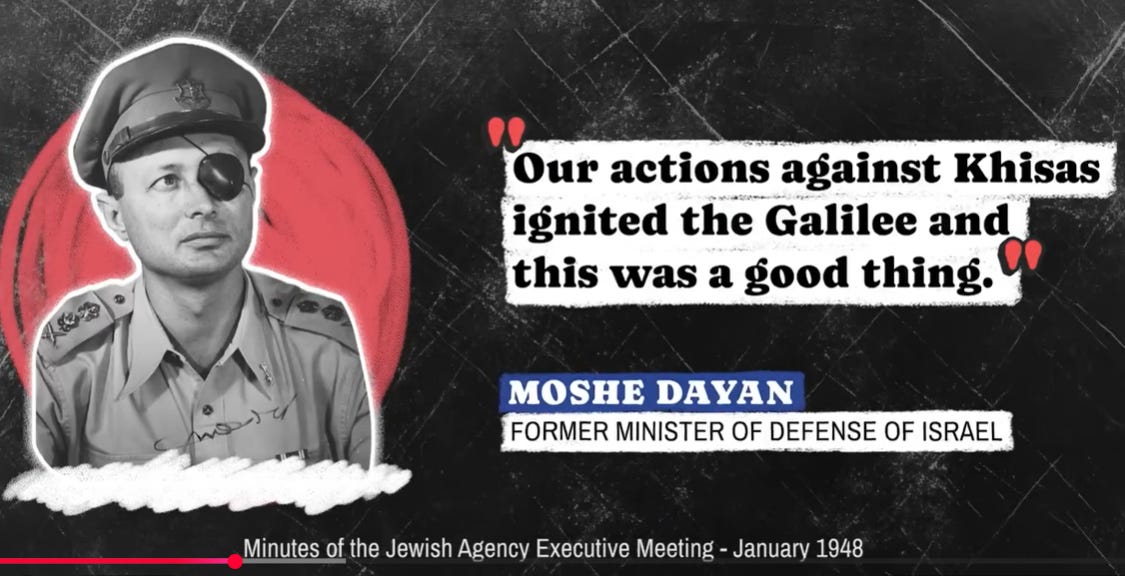
OK, but Moshe Dayan did want to provoke a broader war? Well, maybe. While the first quotation was a quotation, this is one of Ilan Pappe’s patented ‘I get to be Thucydides and make stuff up’ quotations. Assuming it’s an accurate summary of Dayan’s position, it means he was in favour of escalation in the Galilee, which doubtless he was since rolling the dice was his thing. Does it prove that the purpose of the escalation was to create conditions for ethnic cleansing, as Shehada claims, rather than trying to deal with the problem of Arab terror attacks through deterrence? No.2
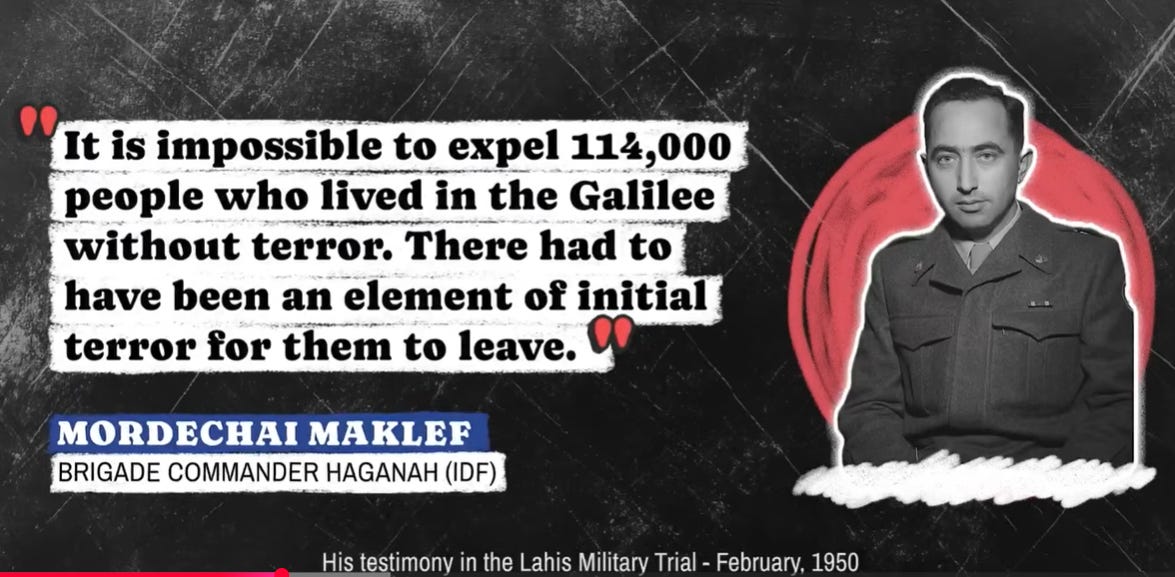
Now Shehada skips ahead to after the war is over and Shmuel Lahis is on trial for the Hula massacre. The trial is important as a rare example of evidence provided under oath about what Haganah units got up to over the previous 3 years. Maklef pointed out what is not under dispute, namely that atrocities were committed over the course of the war, and this caused civilians to flee. What does it have to do with Shehada’s ‘argument’ that Zionists had a crafty plan to pretend to be in favour of partition in order to provoke a war so as to ethnically cleanse all of Palestine? Beats me.
We’re only a third of the way through, so I guess this will be another series. Gosh, how silly this all is.
>I asked a while ago who the Palestinian NonZionism was.
You don't even need to restrict it to Palestinians. The Arab world does not have an intellectual culture and thus anyone who falls off the pro-Palestine boat will instead switch to an extreme pro-Zionism grift. Just look how many substacks there are, written by pro-Israel Arabs and exclusively read by Jews, that just recycle the oldest and most boring of talking points. If you supported Palestine for stupid reasons, you will support Israel for stupid reasons as well, because you have a low IQ. (This is also why ex-religious zealots are the most ridiculous subset of atheists).
If you are going by the simplest IQ based analysis (which I think it should be rejected, because at the smarter end, poor countries probably have a fatter tail), then 500 million Arabs with an average IQ of 82 vs. 3 million Ashkenazi Israelis with an average IQ of 112 is basically the same number of people with a Mensa level IQ. Intelligence is obviously not explanatory though, because the smartest Arabs tend to be more pro-Palestine than the dumber ones (who gravitate towards things like woke Sunnism over leftism).
The actual explanation is, since Israel has already won, there is room for intellectual dissent, since it does not hurt their movement significantly. Palestinians and their advocates realize that if try to adopt a more nuanced position, it will damage their cause. This applies to intellectuals, but it also applies on a more basic level. Even if you are anti-Hamas, you realize that condemning Hamas is ceding ground to your opponent and allowing their talking point to succeed. The real Palestinian non-zionism, if he is alive, realizes that he has nothing to gain by publishing his thoughts.
> I asked a while ago who the Palestinian NonZionism was.
Probably just Richard Hanania. Arabs at large are seemingly incapable of being self-critical and I don't think it can be explained away by IQ.
My pet theory is that its the infallibility of Islam somehow worming its way to the entire culture. If you can't argue for obvious things like 'interest is fine actually' and 'maybe it should be illegal to marry a 9 year old' without being labeled a heretic, then over centuries maybe this is the end result.
Judaism seems to have had the opposite effect.