

Sentiment toward Israel around the globe has crashed since October 7th. There are various different alarming graphs illustrating this.
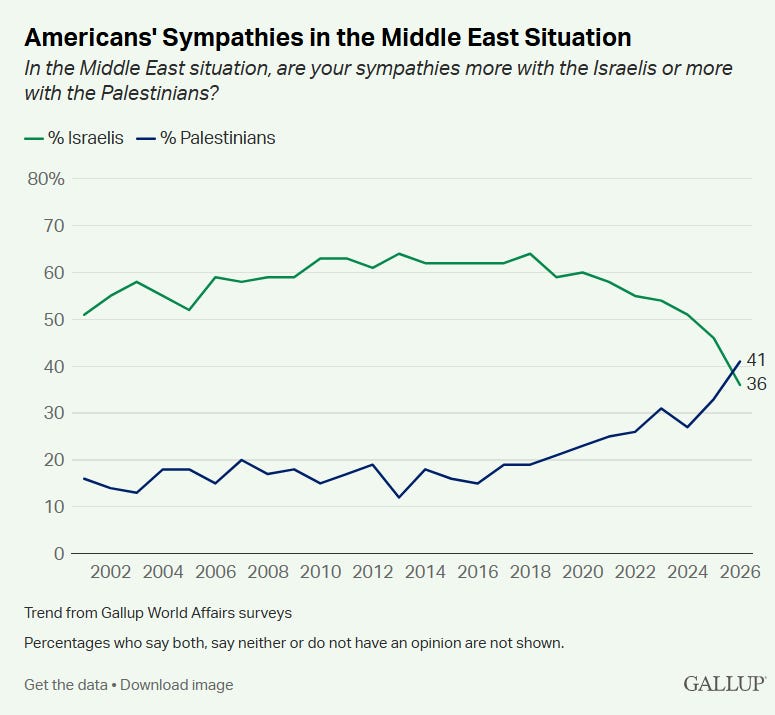
That’s from February, since when things have got worse.
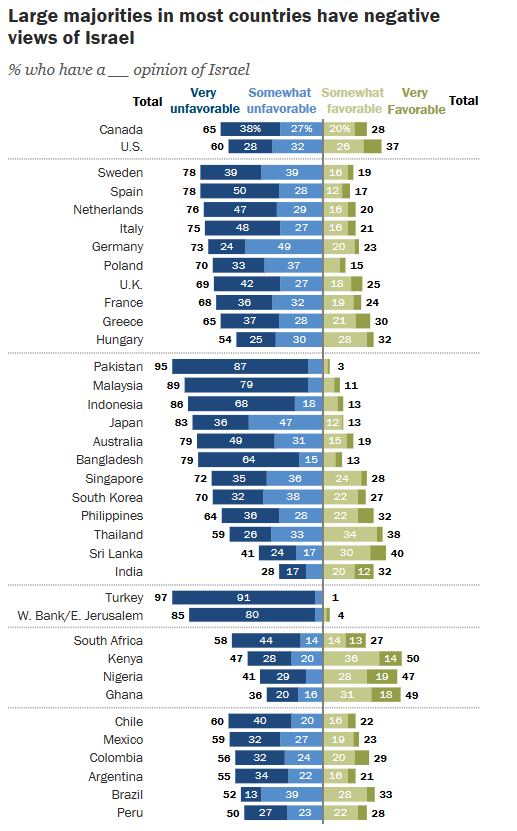
And all indications are that it will keep getting worse still. The simple explanation for this is that people around the world see news about Israel and then develop more negative views about Israel. Examples of this news include things like:
>10 Palestinians being shot while waiting for aid every day for over a month.
Settler militias, often visibly coordinating with IDF soldiers, or themselves wearing IDF uniform, on video raiding Palestinian towns and villages with the explicit intention of driving the residents out.
Members of the Israeli government publicly calling for war crimes.
Pictures of Gaza showing that most of it is rubble.
etc. If you saw news about [Country Name] and this is what you saw, then you’d probably have negative views about [Country Name]. However, if you know Jews, you will know that simply stating the above will generally inspire rage and sorrow, and, not infrequently, accusations of antisemitism. There are two lines of ‘argument’ that accompany this. The first is that criticism of Israel is motivated by antisemitism and antisemitism, by construction, is uncaused. Any sufficiently strong negative sentiment towards Jews is, also by construction, antisemitism, and so, as such, only ever reveals something about gentile societies, it never reveals anything about Jewish behaviour. Of course, they still have to explain why this recrudescence of antisemitism happened at the same time as the Gaza war, so you get something like the following:
I think for a lot of people, there has to be some kind of reason for all this antisemitism. “Oh, it must be Israel, it must be some sort of geopolitical conflict or dispute about territory.” But it sounds like what you’re saying is that there’s always been this kind of ambient antisemitism and that Israel just gave people an excuse, a justification, to finally let out this hate that had always existed—latent hate. I find that persuasive.
It’s hard to know what to do with this. On the one hand, it’s good we still have some smart, well-socialised guys batting for us; on the other hand, I think Rob Henderson is mostly enabling people who actually need a glass of cold water to the face. What does it mean for antisemitism to be ambient? Where in the brain of the masses did it lurk waiting for ‘permission’ to move from latency to actuality? How in heaven’s name is that persuasive?
I’ve done my best to explain what is wrong with this line of ‘thinking’, so I won’t belabour the point here. Instead, I’ll deal with the slightly less mystical version of the argument, which goes like this:
Much criticism of Israel is clearly insincere and motivated by pre-existing animus towards Israel or Jews, not the specific action or policy that is supposedly being criticised.
Since the criticism of any given policy/event is not motivated by this policy/event, it follows that the policy/event has no causal relationship to the criticism.
Therefore, there’s nothing Israel can or should do to lessen this criticism.
Now, this is, obviously, just really stupid. The relevant variable we’re concerned about isn’t what your critics say, it’s how many people they persuade. However, it is important to grant the premise. Regardless of what Israel does, it has and will have many inveterately hostile critics from multiple groups: (a) The Arab and Muslim world that see Israel as an illegitimate state birthed in crime and permanently stained by it, (b) leftists who see Israel as ipso facto in the wrong because of being the wealthier, whiter, and more US-aligned party in a conflict and (c) antisemites. The last group has long been a tiny minority despite the fervent insistence of hasbarists otherwise, and is still a small minority even today, but it makes no odds for the substance of the argument. However, again, obviously, it matters much less what motivates your critics than how much of a receptive audience they find. In a sense, I could stop the article right there, but, instead, I’m going to offer some intuition pumps1 easy thought experiments to make things clearer.
First of all, let’s posit a cartoonishly simple model in which public opinion concerning any given person is a simple combination of (a) true information about him and (b) false information about him, with the split between them being 50-50. So, if we turn to our old friend Barry, let’s say that, on a scale from 1-10 , where 10 is fully evil and 1 is not evil at all, his actual behaviour is a 2, but he has malicious enemies who spread lies about him day and night, depicting him as a 10. With the exception of those who know him personally and his enemies themselves, everyone just splits the difference, concluding that he is a 6. However, if his actual behaviour is a 6, then they conclude he is an 8. What this means is that even if you are genuinely the victim of completely malicious criticism that bears no relationship to your actual conduct, then your behaviour still partially determines how you are perceived. The only way to avoid such a conclusion is to make the obviously absurd assumption that your own actual behaviour does not contribute at all to how you are perceived, which is the sort of thing you literally are supposed to go to a shrink to talk you out of.
You might, however, still come away from that analogy with a somewhat fatalistic attitude. After all, relatively large changes in your behaviour produce relatively small changes in how you are perceived. If the best you can do is act with perfect virtue and still be perceived as merely average, then maybe it’s not worth the bother. That’s clearly not true, though, because look at the graph above. Islamists, lefties and Nazis have been saying Israel is very, very evil for a long, long time, and, nevertheless, until 2018, American opinion of Israel was still trending slightly up. The extra assumption we need to make our model approximate reality to any degree is as follows: to be effective, malicious propaganda needs to be within range of what it is depicting.
Returning to Barry, let’s say he is an ordinary guy: has a wife, kids, likes a drink on the weekends, and klotzes in front of the telly too much. You spread rumours about him that he cheats on his taxes, that he sometimes has one too many sometimes and smacks his wife, that he likes Coldplay, people might believe you. However, if you spread a rumour that he is a prolific axe murderer, then people don’t believe you. They don’t think ‘if there’s smoke there’s fire’ and update their view of Barry negatively, they just ignore this obviously fake information. To put it another way, your actual conduct provides a sort of anchor to how you are perceived. Hostile parties can push this in a more negative direction, but there’s a limit on what they can do because, if they try to push the effect size too far, then they achieve nothing at all.
What this means, concretely, is that the unhinged, over-the-top and libellous nature of anti-Israel polemic has traditionally worked in Israel’s favour. It’s not that no-one was exposed to this stuff (if you went through an American college campus, you could hardly have avoided it entirely), it’s that they encountered it and discounted it. At some level, the hasbara community actually understands this mechanism, which is why so much of their output has been dedicated to identifying and exposing the most obviously hateful and bigoted forms of anti-Zionism.
We can now push this a bit further. If you are the victim of sufficient unmerited hostility, witnesses to this hostility will sympathise with you more. When Bob Dylan became an evangelical Christian and got interested in Israel, he grasped well that this was an effective PR weapon:
To take a well-worn example, the unpleasant obsession of the UN General Assembly with Israel has been an effective weapon in winning over normie libs in the West who respond negatively to unfairness and bullying, while in the Security Council, where things actually matter, Israel enjoyed routine protection via American veto. Best of all, if you are sufficiently perceived as the victim of malicious criticism, people will start to discount even perfectly fair and accurate criticism, a tactic that hasbarists draw upon whenever they invoke antisemitism against statements that are clearly not antisemitic.
A bonus additional layer is that criticism from people who are themselves very unpopular causes neutral observers to update their opinion of you more favourably. If some rando accuses you of being an axe murderer, people will probably just ignore it, but if that person is a racist paedophile, then people will think you might be better than you look if such an awful person hates you enough to spread malicious libel. Luckily for Israel, its critics have been extremely unpopular. Nazis are, literally, the most unpopular people in the world; leftist activists are unpopular with about 70% of Americans; and Muslims made themselves very unpopular too.
The problem with all this is that this malicious, unhinged and thus ineffective criticism that actually makes you more popular can suddenly snap back in your face if you mess up sufficiently enough. No-one took seriously all that stuff about you being an axe murderer until you got messed up at the pub and beat up a guy who took your ashtray. If only you would have stopped kicking him in the head when he was on the ground and five people were trying to restrain you … but you didn’t and now people cross the road when you pass and youths graffiti axes on your garage. In the strict sense, it’s still very unfair. You don’t even own an axe, and there’s not a strong connection between axe murdering and drunken pub beatings, but you messed up, and anyone telling you didn’t mess up - to concentrate instead all the blame on your detractors - may pose as your friend, but is really your enemy.2
