

As we saw in the first instalment, modern Jewish history begins with the clown show of Shabtai Tzvi’s elevation to messiah. This event unavoidably represents the collapse of Jewish civilization because it was just so preposterously dumb. How dumb? I can’t belabour the point indefinitely, but here’s another example:
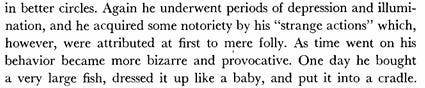
Jewish history since then is the attempt to put things back together again. As we said, it all ended in complete failure. What’s the point in even learning about it then? Maybe nothing. As I said before, I’m writing this because I would be writing it anyway; just under someone else’s blog like a sucker.
Before we can move on though, we have to understand what the Shabtai Tzvi episode actually was. It’s easy to say something like ‘mass insanity’, but that doesn’t explain anything. Why did everyone go insane all at the same time? The classic answer to this in modern scholarship, voiced by Gershom Scholem, is that it was the result of the spread of Lurianic kabbalah, which had primed the Jewish people for a messianic eruption focussed on spiritual rather than material or political freedom. Scholem’s thesis has since been widely criticised, but his critics are wrong and talking nonsense. The problem with Scholem’s thesis that Sabbateanism is a consequence of Lurianism is that it understates matters. It needs to be rephrased, and I will rephrase it, but first the important background material.
It is generally said that the Zohar was ‘revealed’ around the end of the 13th century. If so, that would put more than three and a half centuries between the beginning of Zoharism and the Sabbatean debacle. No-one who knows anything about Sabbateanism would presume to deny that it was a movement totally based on kabbala, which emphasised the authority of the Zohar above all texts. However, three and a half centuries gives enough space to look at Sabbateanism as a perversion, rather than a development, of Zoharism. After all, if Jews were studying the Zohar for hundreds of years without anything going too awry then the Zohar can’t be solely responsible for everything suddenly falling apart. It must, at the least, be Zohar + something else that is to blame. This whole framing is wrong though.
It is true that the deceiver, Moshe de Leon, started to claim in the 1280s that he was in possession of a work from the tana Rabi Shimon, sometimes under the name Zohar and sometimes other names, from which he would quote in his own writings. It is also true that the bulk of the book that would eventually be printed in Mantua 1558 was written by de Leon and his circle of Castilian kabbalists at roughly that time. However, there was no revelation of the Zohar at this point. What there were, rather, were rumours. When Isaac of Acre turned up after de Leon’s death and requested to see the book, it was not to compare it with his own copy, but rather to find out what was in it. Of course, the answer he received was that there was no such book and that should have been the end of it, but this did not stop kabbalists from trying to piece it together by collecting and collating whatever manuscripts of kabbalistic midrash they could find. The crucial thing to understand, however, is that this was a project carried out in the shadows, at most hinted at, not only to the general Jewish public, but even its rabbinic intellectual elite. Even this marginal activity largely fizzled out, and we find almost no references to this Zohar book in the years 1350-1450.
The revelation of the Zohar on a mass scale begins in Spain in the decades before the expulsion. The sources do not portray a clear picture, but this is not just a result of their paucity. The process seems to have been chaotic, lacking a rationale that its participants could have explained even had they wanted to. Strange things, unknown among the Jewish people for at least a thousand years, start to happen:
I have heard that it is written in the Zohar that no-one should not read [from the Torah] at all except one. And it is fitting to be concerned for its words if they are true, that which I have not seen written, but rather I heard it.
This is Rabbi Isaac Abuhav, the last great rabbinical authority of Castille who died in Portugal, one year after the expulsion, subordinating his judgement to hearsay and rejected the opinion of the legal decisors before him.1 A legal tradition that for a millennium had emphasised the subordination of divine inspiration to jurisprudence, and which had been based on the twin pillars of talmudic exegesis and received tradition was suddenly and without justification cast to the wind whenever the fancies and fantasies of the new book dictated:
The universal custom was to wear them [tefillin on Hol haMoed] until the times of the latter Rabbis who found in the book of the Zohar on the Song of Songs that one who wears tefillin on Hol haMoed is like one who cuts down the saplings, and they refrained from wearing them from then on.
In our days, great streams of ink have been spilt to obfuscate what happened, but the protagonists themselves felt no such qualms. After quoting Rabbi Abuhav above, Rabbi Yosef Karo adds ‘and I, the writer, have merited to find it’ before quoting a section of the Zohar. The attitude might be summed up in the famous verse ‘we will do and we will hear’. The process of finding out what the Zohar taught happened after its acceptance as a source of overwhelming authority; working their way through its contents to discover new laws was part of the point. No-one, even the greatest scholars, even pretended to be in possession of a received body of knowledge (kabbalah), rather they were engaged in finding new truths from this book, aided by ecstatic visions and heavenly messengers. In other circumstances, the fact that the revelation of the Zohar among Spanish Jewry had been swiftly followed by the total destruction of what had been for five-hundred years the pre-eminent Jewish community might have given some pause for thought, but what actually happened is that Spanish Jews spread around the Ottoman empire and used their knowledge of Zohar as part of their campaign to take authority and inveigle the Jews of North Africa and the Levant to abandon their traditions and become ‘Sephardim’.
Given the intense and self-conscious traditionalism of Judaism in normal times, the obvious question is how, during this period, the Jewish world accepted a revolution in its theology and ritual practice. A similar question is why, since, according to them, the Zohar had lain dormant and read only in secrecy since the Mishnaic period, it was now proper to spread its contents far and wide. The answer is clear and repeated by all those who were involved in this process: the Zohar was revealed because the messianic age was near, and the revelation of the Zohar was both a sign of this and a cause. Gershom Scholem in Major Trends distinguished between the essentially theosophical and theurgical kabbalah of the Zohar itself, and the Safed kabbalists who interpreted it as a doctrine of redemption. Even if we accept this, outside of the narrow realm of purely intellectual history, it substantially misses the point because Zoharism as an active force within Jewish history was a messianic movement. Here, for example, is Moshe Cordovero, often cited as the paradigm of the more rational quasi-philosophical form of kabbalistic speculation:
It means to say that this work will be hidden from the days of Rabi Shimon until the last generation of the King Messiah, when it will be revealed and possessed by all so they can study it. Therefore it was not revealed until our generation, and its revelation is one of the signs of the redemption.
Isaac Luria famously arrived in Safed just after Cordovero had completed his life’s work providing the first complete commentary on the Zohar and systemisation of its contents. Luria reinterpreted the whole Zoharic corpus again as a system of ‘rectifications’ leading to the ultimate rectification that would happen at the end of history. Scholem found in this new more thoroughly messianic kabbalah the explanation for the unprecedented Sabbatean messianic moment, and this is not false exactly, but it is also the case that Luria postponed the advent of a Zoharic messiah. Until his arrival, the Safed kabbalists, undisputed leaders of Zoharism around the world, thought themselves on the verge of fully plumbing the Zohar’s secrets. Luria taught them that they had, in fact, only been scraping the surface, necessarily pushing off the date of Zoharism’s culmination in messianic redemption.
Luria himself, after revealing his new layer of mystical secrets to his disciples, seems to have had some kind of pang of conscience or at least insight into what he was letting rip and instructed them to keep their silence. His chief disciple, Chaim Vital, kept to this stricture till his death in 1620, but another disciple (or pseudo-disciple, the debate remains open) had already extensively publicised a version of the doctrine in Italy by then. After Vital’s death, however, his students broke the ban completely and there was a flurry to publish anything and everything attributable to ‘the Lion’. A great portion of what was distributed has dubious relation to any doctrine ever articulated by Luria, and some of it was just random folklore and demonology. Whatever the case, however, in the three decades before Natan of Gaza’s vision, the last remaining obstacles, from the perspective of Zoharism, to the final redemption were loosed. The true hidden doctrine reserved for the last generation was spread around the world.
Had Luria not arrived on the scene when he did, it is likely that the messiah of Zoharism would have emerged in the 1570s or soon after (or, alternatively, Luria himself could have been that messiah had he lived longer). If so, the messianic explosion would have been much smaller because the spread of Zoharism was much more limited. In 1570, the influence of Zoharism among the Ashkenazim was still marginal (don’t tell the Faurists!) and they would have likely greeted a group of holy men they knew little about declaring the messiah with bemusement rather than rapture. It’s also the case that the Zoharist messiah would probably have been less of a weirdo because, whatever else Lurianism may be, it represented the elimination of any kind of baseline consensus understanding in Jewry that some things were off limits on the grounds of being freaky-deaky. But that is for next time. For now, I will close with an analogy.
In the 19th century, Marxism made a number of predictions. The proletariat of the liberal countries would be ever more pauperised, if not in the absolute sense, then certainly in its ownership of property. Its alienation from the means of production would liberate it from all local and national bonds of loyalty to be replaced with an international class consciousness. Economic slumps of increasing severity would lead to this proletariat seizing the means of production in the most developed countries from which the revolution would spread. The rationalisation of the means of production in the hands of the dictatorship of the proletariat would, by eliminating the contradictions of capitalism, lead to an immediate and dramatic increase in production. Want would end, the state would wither away, and humanity would be freed to playfully develop its capabilities.
Absolutely none of that happened. By the 1880s, at the least, the working classes in Britain began to enjoy sustained improvement in their standard of living, and, from then on, the welfare state relieved remaining pockets of deprivation enough to forestall political instability. The revolution happened not as a result of the natural progress of capitalism, but the exogenous shock of a world war. The working class of each nation, far from being internationalised, were so successfully indoctrinated into nationalism that they volunteered in staggering numbers to be shot for nothing much at all. The revolution happened in the most backwards country of Europe, if it even counts as such, and from there spread not at all, except by force of arms. Economic growth in the Soviet states was sometimes more and sometimes less, but always lagged behind the capitalist powers. Man was not freed either from want or subjugation; rather, barbarity not seen since the days of the Mongols was loosed upon the earth.
Marxists had two choices. One was to go along with what happened, that is to become Stalinists, and then whatever it was that Soviet orthodoxy said to be after Stalin died. This involved, naturally, drastic reinterpretations of what had before been Marxist doctrine. However, the alternative path of rejecting Stalinism also involved drastic reinterpretations. Whatever form of cope the anti-Stalinists chose, they had to depart from what Marx himself had said, because everything Marx had predicted had not come true. The goal of this intellectual endeavour was, while changing various specific elements of Marxist doctrine, to preserve its essential core, but this was not as easy as it sounds because, as insane wife murderer Louis Althusser pointed out, there’s an ‘epistemological break’ in Marx’s writings somewhere, i.e. he said a lot of different things that contradict each other. Oops.
The only correct thing for a Marxist to do after 1917 was to accept that Marxism had been empirically disproved and stop being a Marxist. Anything else required, at the very least, engaging in crimes against honesty and reason; often it involved crimes much greater than that. What was the correct thing for a Zoharist to do after the farcical collapse of their messianic movement? The correct thing to do was to admit they had been participants in a great lie. Anything less involved some kind of intellectual perversion. Both Sabbatean and non-Sabbatean kabbalah were reinterpretations in the light of what had gone wrong with the original vision. Both were equally legitimate, which is to say not legitimate at all. Neither can claim to be more authentic; authenticity from that point on was not an option.
In my view, correctly.
The simple fact that practically every follower of Lurianic thought in the time of Shabsai Tzvi accepted the theology he was presenting and recognized its main expositors as the legitimate heirs to the Arizal’s thought (including R Shmuel Vital btw. The fella from whom we have all of R Chaim Vital’s writings) should be sufficient proof that it was Lurianic thought, and by extension the Zohar, that allowed S”T to happen.
I don’t completely agree with your take on Kabbalah for other reasons, but this point shouldn’t really be a matter of dispute.
Feels strange to write about the background that enabled Shabsai Tzvi without any reference to Khmelnytsky or the Thirty Years' War.