

To read previous items in the series, go here.
The Emden-Eybeschutz controversy tore European jewry apart and is generally considered to be the moment that the aura of Rabbinic authority cracked, leading to the haskala and, in due course, mass secularisation, Bundism, Zionism, Reform and the rest. To briefly sum up what happened, Yonasan Eybeschutz was generally regarded as the pre-eminent genius of Ashkenazi Jewry, not only a master of Talmud, halacha (then demonstrated through the discipline of pilpul) and kabbala, but also with a unique talent for drush, the repurposing of materials from across the Jewish corpus for the purpose of homiletics and exhortation. Originally a rosh yeshiva and then dayan in Prague, in 1750 he was appointed, as befitting his stature, Chief Rabbi of Hamburg-Altona-Wandsbeck, the most lucrative position in Europe. Students from around the continent flocked to his yeshiva, the continent’s most prestigious and intellectually vibrant institute of Jewish learning.
One of the few Rabbis in Europe who was considered Eybeschutz’s peer was Rav Yakov Emden, who lived in Altona and, it is widely believed, was sore about having been passed over in favour of Eybeschutz. Rav Emden was the son of Rav Tzvi Ashkenazi, the semi-successful heresy hunter we saw in the last installment. Upon inspecting some amulets that Eybeschutz had distributed for women during pregnancy, Rav Emden claimed to have discovered Sabbatean allusions and demanded that Eybeschutz be fired and placed under some kind of rabbinical ban. The rabbinate of Europe was split on the question of Eybeschutz’s guilt, but it is fair to say that the majority were more upset with Emden for his extremism and insistence on airing the Jewish world’s dirty laundry before the gentiles. Eybeschutz was protected by the King of Denmark, but the Hamburg Senate was more sympathetic to Emden’s claims. In the end, Emden never succeeded in his campaign against Eybeschutz who died in his post in 1764, and the main result was to leave a bad taste in everyone’s mouth and the credibility of the rabbinical establishment in the gutter.
Among Orthodox Jews, the consensus is that Emden was wrong and there is a moderately strong taboo against suggesting otherwise. Among academics, the consensus is that he was right as to the facts, but a nasty person because what’s wrong with a little heresy here and there? We will deal with the last part in due course, but let us first deal with the factual part of things.
The truth of the matter is that there is no legitimate debate about this question whatsoever. All the evidence is on one side, and the arguments for the other side don’t make sense and actually point to the opposite. Let us review. First, for the prosecution:
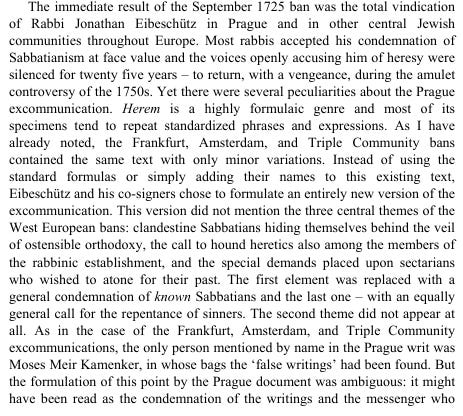
In 1724, an itinerant book-seller from the Sabbatean center of Żółkiew in Podolia, was arrested in Frankfurt upon suspicion of distributing heretical books to an underground Sabbatean network. Among the books discovered on his person were works attributed to ‘Jonathan of Prague’, most notably ואבוא היום אל העין, a genuinely bizarre kabbalistic cosmology full of graphic sexual imagery and startling theological assertions (we’ll get to it). There is no plausible candidate for ‘Jonathan of Prague’ other than Eybeschutz, and this was explicitly understood by the Sabbatean community of Mannheim who revered the book, the leader of which declared Eybeschutz divinely inspired. To this date, the only person apart from Eybeschutz that anyone has claimed to be the author of the tract was Jacob Frank, who was one year old at the time.
In recent years, the amulets identified by Emden have been inspected and it has been shown that Eibeschutz’s description of their contents that he provided to the authorities was misleading, and they confirm to Emden’s description.
Rav Emden was arguably the greatest sage of his generation, and, apart from ridiculous and impious slanders, no-one has been able to explain why he would put himself in physical and economic jeopardy over his Eybeschutz jihad had he not been on to something. Much less well known, however, is that Eybeschutz’s guilt was also affirmed by the only other candidates for gadol hador, namely R. Yehezkel Landau and R. Yehoshua Falk. Their differences with Emden were about how to deal with it. The Noda biYehuda favoured keeping the matter a secret because Eybeschutz was too powerful, well-entrenched and a genuine giant of Torah scholarship to be dislodged and trying to do so would only backfire on the prestige of the Torah in general. The Pnei Yehoshua took a middle position, and was willing to allow Eybeschutz to keep his position on condition of repentance, while Emden insisted that he was permanently unfit to hold any rabbinic position. It is true that many rabbis did affirm Eybeschutz’s innocence, but they all fall into the category of being (a) Sabbateans themselves (b) Eybeschutz’s students (c) nobodies or (d) all of the above. The only really great rabbi who thought Eybeschutz was innocent was Eybeschutz himself and affirming his innocence is tantamount to saying that the gedolei hador were clueless bigots.
Eybeschutz’s own son, Binyomin Wolf was not only a Sabbatean, but Jacob Frank’s main rival for leader of the Sabbatean movement in Europe. It is true that upstanding people can have sons going OTD, but it’s also true that the main predictor of religious identity is the one you grew up in. This is slightly more true than usual of Sabbateanism after the rabbinate started to crack down on it, which was well known to be passed down principally through families, in some cases for a surprisingly long time.
In the 1760s, there was a scandal when many of the students at Eybeschutz’s yeshiva were exposed as or confessed to being Sabbateans, and the yeshiva had to be closed.
Eybeschutz’s grandson converted to Christianity after, according to his testimony, reading a bunch of Sabbatean texts that had been passed down as family heirlooms.
Among Sabbateans, Eybeschutz was regarded as a fellow believer and their most esteemed intellectual. Of course, it’s possible that this was delusional on their part, like Religious Zionists today claiming the Vilna Gaon, but it’s simpler to say that they were correct.
On at least one documented occasion, Eybeschutz provided hospitality for Sabbatean pilgrims on their way to visit the court of Jacob Frank (specifically to pay homage to his daughter, believed to be some kind of goddess).1
Now for the defence.
It is argued that a great Torah scholar like Eybeschutz couldn’t have been a Sabbatean, but this is just ignorant nonsense. Accomplished talmudists who were Sabbateans include Nathan of Gaza, Raphael Mordechai Malachi, Herschel Tzoref, Yehuda heHasid, Eliyahu haCohen, Avraham Yachini, Moshe David of Podhajce, Avraham Rovigo and Elisha Shor. It’s true that Eybeschutz would still count as the greatest Sabbatean scholar, but, logically, someone would have to take that role. The assumption that Eybeschutz has passed some threshold of talmudic proficiency at which Sabbatean affiliation would be untenable is never justified or explained.
A related argument is that Eybeschutz couldn’t have been an antinomian because he devoted so much time to pilpul and obsessing about fine halachic distinctions. This argument is based on two complete misunderstandings. The first is that the extreme antinomianism of the Frankists was normative among all Sabbateans. In reality, many Sabbateans were known for their extreme piety and attention to halachic details. The Sabbatean movement contained a diversity of opinion on two questions: (a) whether antinomianism was something only the messiah engaged in or whether his followers needed to get in on the act too, (b) how far along the messianic process which necessitated/allowed antinomian behaviour had got. Clearly, Eybeschutz was a moderate Sabbatean, not a Frankist, though ‘moderate’ doesn’t mean quite what you might think it means, as we’ll see. The second, and even more important, point is that the antinomianism of the Sabbateans wasn’t like the ‘those laws are outdated and I don’t like them’ antinomianism of Reform today. Rather, it was based on a belief that the whole system of halacha is a set of tools for manipulating divine cosmic forces and that, as the nature of the cosmos changed with the advent of messianic redemption, then so must the appropriate tools.2 As such, a detailed knowledge of the law was a prerequisite for successful antinomianism. Some scholars have suggested using the term ‘hypernomianism’ to clear up this confusion.
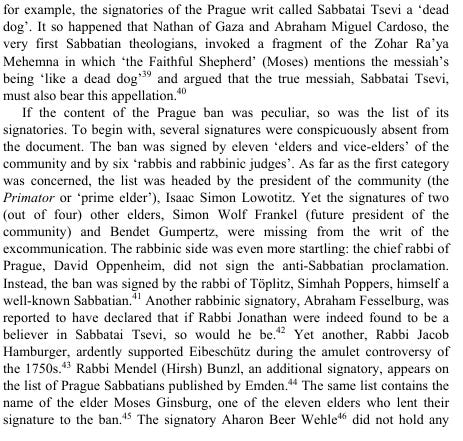
A key part of his defence, and the one relied on most during his own lifetime, is that Eybeschutz signed multiple bans and condemnations of Sabbateans. First of all, this isn’t any kind of argument at all. We know that Sabbateans often signed such bans. However, when we look more closely, we see that actually it’s evidence in the opposite direction. Astoundingly, out of those who co-signed Eybeschutz’s original declaration against Sabbateans, all but one whose affiliation can be demonstrated were also Sabbateans. Further, his ban has all sorts of weird language that at first sight looks just rambling and irrelevant, but actually turns out to be coded Sabbatean allusions.3
So, to repeat myself, there isn’t really an argument here at all. It’s just facts vs. cope. We’re not going to stop there, though, because the crazy truth is that Eybeschutz’s Sabbateanism wasn’t even the weirdest thing about him, not even close. His aforementioned tract ואבוא היום אל העין does contain affirmations that Shabtai Tzvi was the messiah who redeemed the world, though these are relatively subtle and possible to miss if you read quickly. More to the point, however, it contains the following startling claims:
From the perspective of the Ein Sof, the creation of the world is a form of defecation.
Out of the Ein Sof proceeded a trinity composed of Atika Kadisha, the god of Israel, and the Shechinah.
Atika Kadisha is Esau, and thus the Christian god.
The god of Israel engaged in intercourse with Atika Kadisha as the feminine partner while unconscious, and their union created the Shechina, with which it mates as a male partner.
Atika Kadisha interacts with the world, via the Shechina, though pure kindness, but because this kindness is expressed without sexual union it destroys everything in its path. To save creation, the god of Israel then castrates him, and he becomes inert.
The god of Israel should now engage in ongoing sexual union with the Shechina, but, alas, he is asleep and also impotent, so therefore instead he … check the footnote if you really want to know.4
His son, the messiah, was created through his urine, because you can still urinate in your sleep.
The job of the messiah is to receive the ejaculate of Atika Kadisha so as to stop it destroying everything, which task he achieves by apostatizing. He then is to have vigorous intercourse with the Shechina, but without taking her virginity, which he does by the ahem, well … have you heard of the Silver Ring Thing?

I could go on but I think that’s really enough.5 It is not surprising, then, that the Noda BiYehuda had this to say about the work:
This book is that of a complete heretic, who does not merely cut down the saplings, but who uproots and destroys the very fundamentals of Jewish faith… I did not find such heresy even among all the religions of the Gentiles that ever existed…The tract is by one who plotted evil against Hashem and plotted wickedness and it denied the providence of the Ein Sof… He denied the entire faith of Judaism.
Now, that seems fair enough, but, remember, the Noda biYehuda’s position during the Emden controversy was, functionally speaking, pro-Eybeschutz!

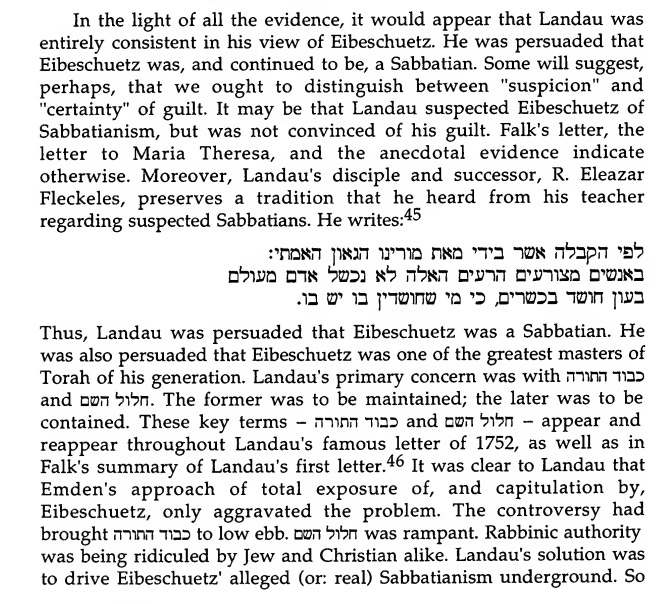
In short, the Noda biYehuda believed that things were so bad that the most famous and revered scholar of the generation above him was worse than any gentile pagan, and thought there was nothing he could do but try and keep a lid on it. Looked at from a merely sociological point of view this was an absolute, unmitigated disaster. The enemy, the very worst kind of enemy, had risen to the top of Judaism’s hierarchy. However, from an internal religious point of view, it was even worse. The Torah is first and last a weapon against the perennial human urge to idolatry, but Judaism had contracted an autoimmune disease and the Torah itself had become the occasion for the most insane form of idolatry6 to ever be conceived in the history of mankind (allowing for a bit of poetic license and the Noda BiYehuda’s lack of detailed knowledge of Central American history). Becoming a great Torah scholar was, now, not only fully compatible with being a fruitcake with a brain full of sewage, the one was in some sense the condition for the other.7 Judaism, in short, was broken. Only one avenue remained to fix it.
Though I don’t think it can be really be considered evidence, another piece of relevant information is that Eybeschutz studied at Prossnitz in his formative years. While the head of the yeshiva there, Rabbi Meir Eisenstadt has no black marks on his orthodoxy, the town was a center of Sabbateanism, including the famous whackjob and messianic candidate Yehuda Leib. An analogy would be a student of Volozhin yeshiva becoming a Zionist.
[EDIT: since writing this, I subsequently learned that actually Meir Eisenstadt did, in fact, have a fair few black marks against his name:
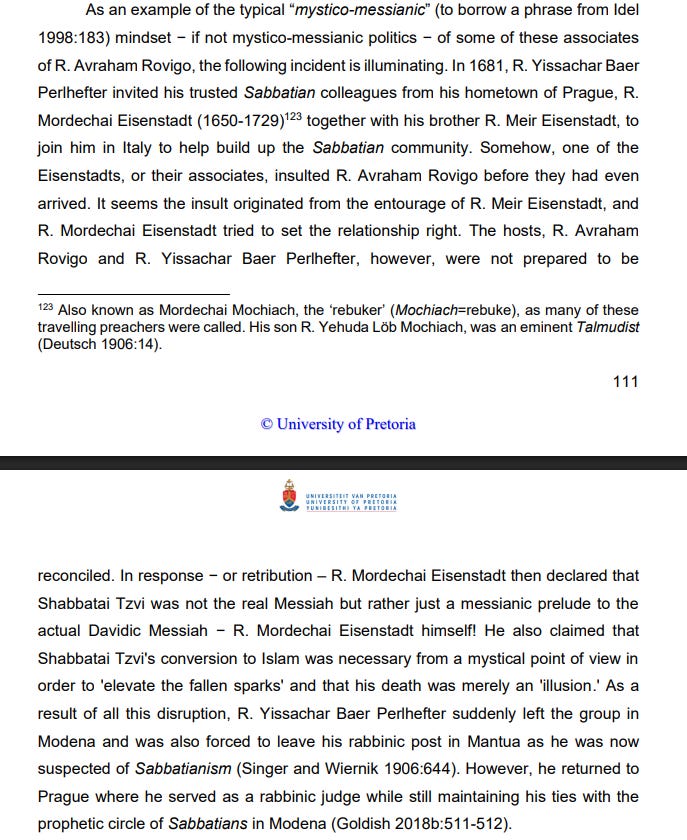
Yelp. It’s always worse than you think].
Another line of inquiry is comparing ואבוא היום אל העין with Eybeschutz’s collection of kabbalistic writings published as שם עולם. In general, there are many point of commonality, with differences being explicable in terms of the difference audience for the two works, but also Eybeschutz’s views developing as he got older. However, this awaits proper study.
One might with some justice query whether Shabtai Tzvi himself possessed such knowledge, but his believers certainly thought he did.
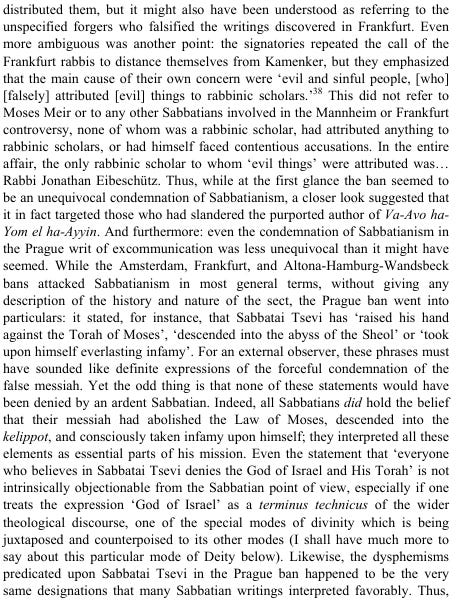

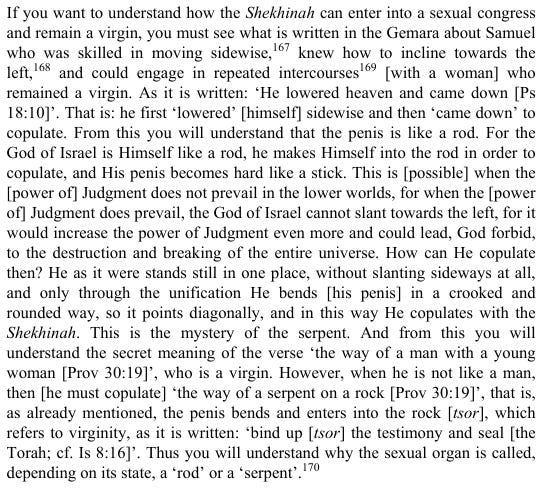
For more details, consult either the Hebrew edition, David Halperin’s English translation, or this useful introduction (this is also helpful).
If you bring up that midrash I will come to your house and kill you, BN.
On the first page of the tract, Eybeschutz excuses the graphic content that is to come on the grounds that תורה היא וללמוד אני וצריך. Of course, this is an allusion to a certain famous talmudic passage, but it’s also a brief summation of his religious philosophy. This is what Torah - Torah in its most elevated, true, and profound form - is.
I should add here that, while I don’t think anything written by Eybeschutz should be considered part of the Jewish canon in any way whatsoever, there is no gainsaying the fact that his knowledge of Jewish sources was impeccable and that he was not in any ordinary sense malevolent or deranged. To the contrary, he was respected by both Jew and gentile alike for his sharp intellect, good manners, and general decorum. The text, despite its manifold lunacies and depravities, is actually free from the neurotic demonology and other repulsive features that particularly characterised the most degenerate genres of kabbalistic writing. He wasn’t Zoharism gone wrong; he was Zoharism gone right.
This is crazy. I have heard many people talk about this who support Emden and they don’t know any of this stuff!
Great stuff. I remember learning about this controversy in high school. Back then, I was pretty convinced De Leon made up the Zohar, but Tanach and Talmud was from God.
Now I don't think any of it's from God, but Kabbalah still seems much more wack and inauthentic to me.