

In part (i), we started looking at Muhammad Shehada’s video in which he weaves quotations, deceptively edited quotations, paraphrases of quotations, quotations without context, and literally fake quotations, all without regard for chronology or even just the general idea of explaining the relation between evidence and analysis, to paint the following picture:
(i) The Zionists wanted to conquer all of Palestine and empty it of its Arab inhabitants.
(ii) The Zionists accepted partition in 1937 and 1947 as a pretext to achieve the above. The Arabs rejected partition because they knew this was the Zionist plan.
(iii) The Arabs did not want war. They opposed partition, but their plan to oppose it was [honestly, I have no idea what he even wants you to believe here, but he doesn’t say anything].
(iv) The Zionists provoked the Arabs into a war, then used the war to ethnically cleanse the Arabs.
In the next part of the video, he shows how part (iv) happened. Shehada briefly discusses four massacres/expulsions at Tantura, Safsaf, Haifa and Deir Yassin and then, as if in some kind of sadomasochistic attempt to make clear that he considers his intended audience to be cognitively challenged children, declares, ‘Do you need more evidence on who was the oppressor and who was the victim? Because there is. All of this was the result of direct orders from David ben Gurion’.
This is a claim that literally no-one defends. Even Shehada wouldn’t defend it if he had to actually go back and trace his steps explicitly rather than relying on thought association and his audience being dopey. There’s been a good deal of debate about how much Ben Gurion knew about the various atrocities, how much he approved of them, and how much they were the result of local commanders executing what they had been given to understand was central policy. Those who ascribe to Ben Gurion a relatively high level of guilt seem to have the better of the argument, but the reason why there was a debate at all is precisely because there are no ‘direct orders’. And that’s concerning atrocities committed by the Haganah. It’s not even conceptually possible that he ‘directly ordered’ the Deir Yassin massacre committed by the Irgun and Lehi; that would be like claiming Yasser Arafat ‘directly ordered’ the Entebbe hijacking. What proof does Shehada bring for his astonishing and obviously untrue assertion?
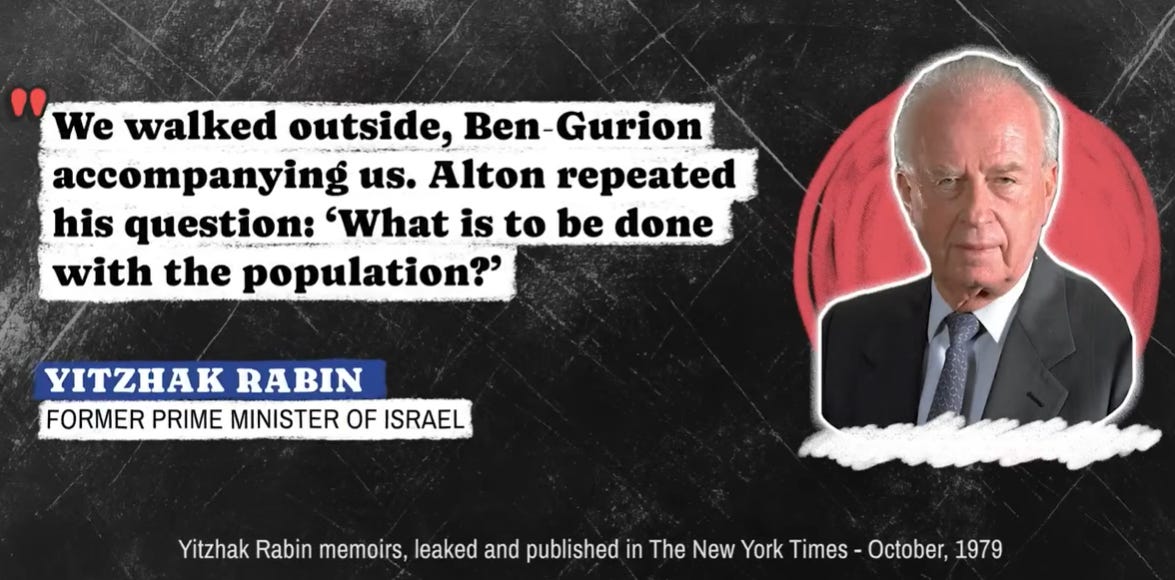
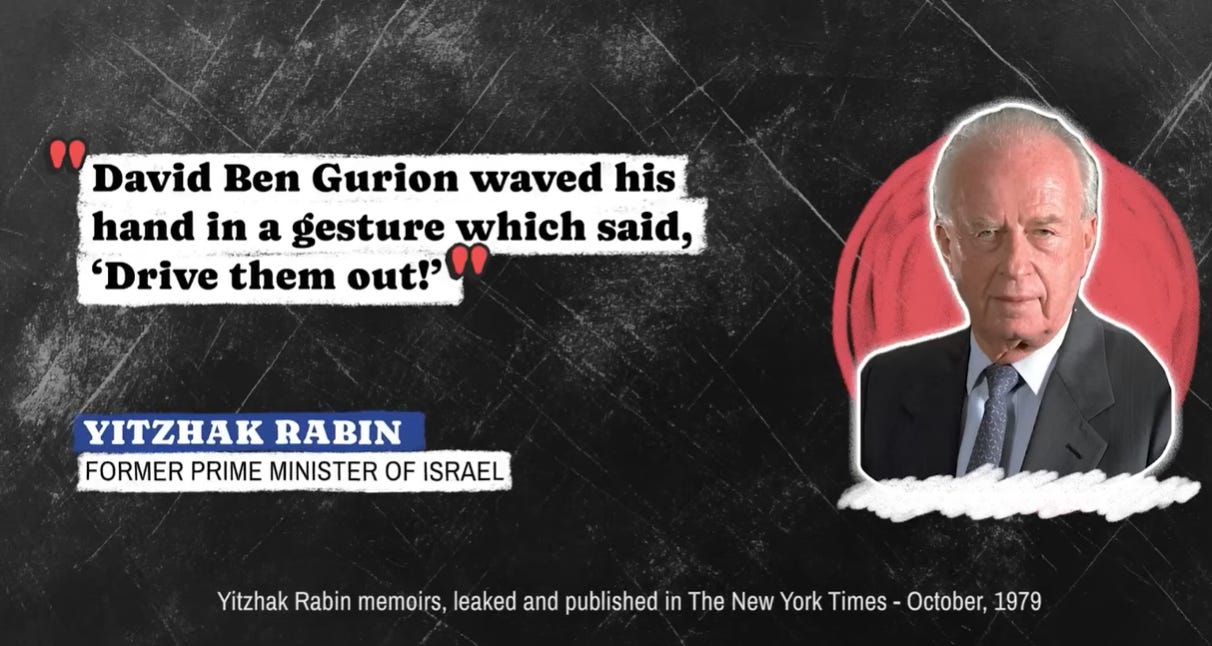
This is the piece of evidence usually presented as the smoking gun, which is a good tipoff that that there’s no actual smoking gun. I’m inclined to think that the extract from the memoir is real (there’s some debate about it) and that Rabin correctly interpreted Ben Gurion’s gesture. However, this concerned what was to be done about the cities of Lod and Ramla, cities that were at that point under siege by the Haganah and about to be conquered.1 There is no evidence, even of the hand-gesture sort, for a general policy of expulsion.2
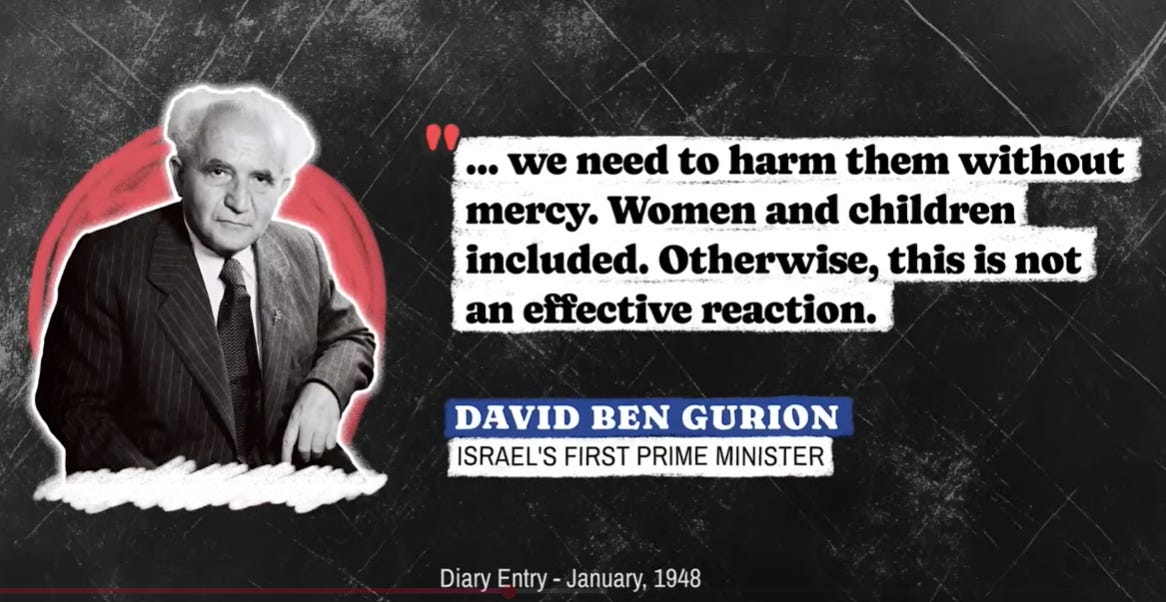
There’s a whole bunch to say about this. First of all, the full quotation is:
There is a need now for strong and brutal reaction. We need to be accurate about the timing, place and those we hit. If we accuse a family, we need to harm them without mercy, women and children included. Otherwise, this is not an effective reaction. During the operation there is no need to distinguish between guilty and not guilty
Which is pretty bad, but a bit different. Secondly, it’s a matter of dispute whether Ben Gurion is recording his own opinion here, or summarising Yigal Allon’s arguments during a meeting held by the Zionist leadership following the Al Khisas massacre in which different figures argued for and against the policy that had led to it. Thirdly, again, this was not about a general policy of expulsion, still less a general policy formed in advance, but about how to respond (it’s right there in the quotation) to certain Arab attacks that the Haganah had no other way to prevent.
However, I feel a bit Joseph Cohen now. ‘You say the IDF has bombed fourteen gazillion innocent children this week with cluster missiles, but actually it was only seven’. The truth is that if you want to make a case against Zionism, the War of Independence is kind of a layup; you can just say this:
(i) As a result of the war, the Zionists ended up with significantly more territory than they were awarded in the partition plan, which was already somewhat generous based on prior demographic realities.
(ii) Getting a Jewish supermajority in this expanded territory required a major population transfer, well in excess of the numbers envisioned in the Peel plan.
(iii) In many cases, this population transfer was achieved by terrifying the population into fleeing, sometimes by committing atrocities that would have been regarded as outrageous crimes long before Geneva Conventions.
(iv) Even in cases where the population fled to avoid fighting, they should have been allowed to return home when fighting ceased, rather than penalised for doing the right thing. To the contrary, the government continued pushing Arabs into the West Bank and Gaza even after the war.
(v) Both during and afterwards, the Zionist leadership shamelessly lied about all of this, and, because of sympathetic media, their lies were widely believed in the western world for many decades, and in some holdouts even today.
So why not just stick with that and dispense with the need to lie and say ridiculous things? You’d think it was out of a desire to portray Zionism as a uniquely evil and irredeemable political movement (though Muhammad Shehada supports a 2-state solution supposedly). I think that’s wrong though, the more important motivation (and one we Jews, at least, must be able to empathise with) is to dinduise the Palestinians, to absolve them of all guilt, to ‘make clear who is the oppressor’, but, much more importantly, who is the victim.
The problem with this is that, by anyone’s standards, the Palestinians have done some incredibly gnarly s**t. They did it, substantially on camera, three years ago, and they’ve been doing it in various forms for decades. Rashid Khalidi’s way out of this is to label the Balfour Declaration a declaration of war, after which everything is self-defence. However, that only works because Khalidi is willing to admit that mistakes were made during this defensive war, something he is happy to do because he has family beef from way back with the Husseini clan. Shehada doesn’t want to do that, so his only way out is to pin everything on 1948. However, just as history didn’t start on October 7th, it didn’t start then either. Though he is deliberately vague about many things, Shehada isn’t vague about his overriding moral principle: the side that starts the massacring is the one in the wrong, and whatever the other side does is resistance. OK then.
April 1920. Following incendiary speeches during the Nebi Musa festival, crowds of Arabs attacked Jews in the Old City of Jerusalem, killing 5 and wounding over 200.
May 1921. Following false rumours that Jewish immigrants were attacking Arabs, riots started in Jaffa and spread around the country. 47 Jews were killed in all, with British troops stopping the riots before more died.
August 1929. A wave of riots around the country was sparked by claims made by Al Husseini that Jews were trying to take the temple mount. The worst massacre happened in Hebron, where 67 Jews were murdered, often in appallingly brutal ways, without consideration of their Zionist affiliation (which most didn’t have). In the country at large, a total of 133 Jews were killed.
April 1931. The Black Hand organisation, formed by Sheikh Izz al-Din al-Qassam, ambushed and murdered three members of kibbutz Yagur.
April 1936. Members of the Black Hand stopped cars on the road between Nablus and Tulkarm and shot 3 Jews, killing two of them.
April 1936. Arabs rioted in Jaffa, killing 15 Jews and causing around 12,000 to flee.
April-October 1936. Attacks on Jews around the country killed 80 Jews.
August 1937. Arabs burst into a family home in Tzfat and murdered four family members, three of them children.
November 1937. Five JNF workers are ambushed and murdered by Arabs.
March 1938. Arab gunmen shot at Jewish passengers travelling between Haifa and Tzfat, killing 6.
June 1938. Arab gunmen attacked the settlement of Kiryat Haroshet, killing 3.
August 1938. Arabs kidnapped three members of a Jewish family living near the town of Atlit and murdered them.
October 1938. Arab militants attacked the Kiryat Shmuel neighbourhood of Tiberius, attacking civilians indiscriminately and killing 19, nearly half of them children.
For good measure, in 1947, when Shehada says the Arabs ‘didn’t want war’, but were being goaded into it by Zionists, we can cite:
November 1946. Arabs attacked Neot Mordechai, killing 2.
August 1947. Arab gunmen attacked a cafe in Tel Aviv, killing 5.
November 1947. Fajja bus attacks.
December 1947. Jerusalem riots.
And when war broke out for real, the Arabs committed their own massacres, many fewer in total than the Zionists, but more per town captured. It wasn’t, shall we say, for want of trying. We can note here that the Haganah (literally ‘the defence’) was created following the Nebi Musa riots and the Irgun was founded after the 1929 massacres. Transfer, as an idea outside of a diary entry here or some crank letter there, entered Zionist discourse following the waves of atrocities in the mid 1930s.
Of course, if Shehada was to acknowledge it at all, he could point out that the nearly 40 years of violence before the War of Independence against the Jewish community of Palestine had been committed by ‘Arabs’ and not ‘the Arabs’ (though in some cases, even that’s a bit of a stretch), but then you would have to acknowledge when the violence he describes was committed by ‘Zionists’ and not ‘the Zionists’. We’ll deal with that in the next installment.
Parenthetically, most of the Arab residents were not exiled from Palestine, but rather to Ramallah and the surrounding area, a one-day walk.
The evacuation of Ramle happened without a massacre. In Lod, there were two massacres, though there is still debate about their extent and how much they were part of legitimate military operations.
This is part of a broader trend in left-wing social justice politics that categorizes everything into the simple binary of oppressor and oppressed, perpetrator and victim. The oppressor can have no understandable motives, no real grievances, and no legitimate claims. The victim is portrayed as simple, pure, and blameless. He can do no wrong. The oppressor is held entirely responsible, while the victim is denied any agency. The type of simplistic thinking comes from intelligent people who, in their sophistication, have determined that nuance is immoral. Attempts to gain deeper understanding or nuance are seen as cruelty towards the victim.
The Palestinians will never tell an ugly truth when a hideous lie would suffice instead. Let's not forget either that there are plenty of Palestinian refugees and Arab leaders who expressly said they were not expelled and that the population was told to leave:
"We will smash the country with our guns and obliterate every place the Jews seek shelter in. The Arabs should conduct their wives and children to safe areas until the fighting has died down."
-- Iraqi Prime Minister Nuri Said, quoted in “Sir An-Nakbah” (The Secret Behind the Disaster) by Nimr el-Hawari, Nazareth, 1952
"The Arab Exodus …was not caused by the actual battle, but by the exaggerated description spread by the Arab leaders to incite them to fight the Jews. …For the flight and fall of the other villages it is our leaders who are responsible because of their dissemination of rumors exaggerating Jewish crimes and describing them as atrocities in order to inflame the Arabs ... By spreading rumors of Jewish atrocities, killings of women and children etc., they instilled fear and terror in the hearts of the Arabs in Palestine, until they fled leaving their homes and properties to the enemy."
–- The Jordanian daily newspaper Al Urdun, April 9, 1953.
In listing the reasons for the Arab failure in 1948, Khaled al-Azm (Syrian Prime Minister) notes that “…the fifth factor was the call by the Arab governments to the inhabitants of Palestine to evacuate it (Palestine) and leave for the bordering Arab countries. Since 1948, it is we who have demanded the return of the refugees, while it is we who made them leave. We brought disaster upon a million Arab refugees by inviting them and bringing pressure on them to leave. We have accustomed them to begging...we have participated in lowering their morale and social level...Then we exploited them in executing crimes of murder, arson and throwing stones upon men, women and children...all this in the service of political purposes...”
-- Khaled el-Azm, Syrian prime minister after the 1948 War, in his 1972 memoirs, published in 1973..
Even if you don't believe this narrative, to not mention it at all is pretty (typically) dishonest.