

Arab parties did very well in the recent elections. Predictably, the absolute worst people on earth who do nothing other than think of the stupidest possible thing to say in any given circumstance have dubbed this an ‘electoral jihad’, ‘electoral terrorism’ or ‘electoral October 7th’. So I’m going to say some things, but first, I’m going to clear up some basic points. There are four Arab parties, they are:
1. Hadash
Strictly speaking, Hadash is not an Arab party, it’s a communist party that rejects the concept of ethnicity as a basis either for a political party or a country. Its origins are in a breakaway faction of the majority-Jewish Maki party, and, while the split in1965 correlated with ethnicity, it wasn’t predicated on it. To this day, Hadash has a Jewish MK and perhaps 15% of its support is from Jewish voters. What makes Hadash an Arab party is two things. First, it is explicitly committed to anti-Zionism as a founding principle and, as such, has refused to form electoral pacts with any Zionist party, including Meretz. Secondly, after the introduction of the 3.25% electoral threshold (intended to remove the Arab parties from the Knesset), it has chosen to run as part of the Joint List.
Hadash’s attitude to nationalism is the usual leftist one. Jewish nationalism is illegitimate and so Israel must become a state of all its citizens, with no ethnic favouritism, for example, in immigration policy. Palestinian nationalism, however, is completely fine because [balloon] and, thus, Israel should withdraw from the occupied territories to allow for the creation of a Palestinian state. The two-state solution is one Arab state and one state for everyone. Given the de facto nature of Hadash as an Arab party, this obviously amounts to a policy of self-interest disguised in the language of universalism, a bit like the traditional politics of the Jewish diaspora toward nationalism in general and Zionism in particular.
The core voter base of Hadash is wealthy, educated and secular Israeli Arabs, disproportionately of Christian extraction. It has the highest proportion of PhDs of any party in the Knesset. It is especially strong in Kafr Yasif, Nazareth and Haifa. The core of the party, Rakeh, is Marxist-Leninist, and really Stalinist though it prefers not to emphasise that these days, but from the formation of Hadash in 1977 it has adopted a big-tent policy of including leftist anti-Zionist factions in a united electoral front. Its previous leader, Ayman Odeh, explicitly denied being a communist and identified as a social democrat. Nevertheless, the party (at any rate its communist core) does have some moderate tanky leanings, most notably expressed in supporting Assad during the Syrian Civil War, an extremely unpopular position among Palestinians in general.
While Hadash is the correct name for the party, it is generally known by its Arabic supporters as Al Jabha (‘The Front’)
2. Balad
Balad stands for ‘National Democratic Alliance’ in Hebrew, and the acronym was chosen because it also means ‘homeland’ in Arabic. Even so, Arabs call it Al-Tajammu (‘The Assembly’). It was founded in 1995 to represent the Palestinian nationalist perspective among Israeli Arabs. This was the culmination of a process of ‘Palestinianisation’, which began with re-establishment of ties between Arabs on both sides of the Green Line following 1967 and was facilitated by the relaxation of restrictions on Israeli Arabs travelling abroad and participating in wider Arab culture. If you know about Arab nationalism, you won’t be surprised to find out that the founder was a Christian with a PhD in philosophy from a European university called Azmi Bishara. This was all pretty stupid though. In the 1930s, you could be forgiven for thinking that Arab nationalism was going to revitalise a backwards region and allow ethnoreligious minorities to integrate themselves into cultural dominance. By the 1990s, though, Arab nationalism was a failed experiment, in an advanced stage of circling the drain, so what were Balad on about? Beats me.
Like Hadash, Balad advocates for the abolition of Zionism and full equal rights for Arabs while also creating a separate Palestinian state, so therefore one state for me and one state for us. It’s also kind of borderline communist, and led by highly educated atheists like Jamal Zahalka. That’s what Hadash already is, though, so what’s the point of Balad, and who votes for it?
The answer to the first question is that it dispenses with the universalist rhetoric and commitment to Arab-Jewish cooperation of Hadash and just advocates Arab interests on the grounds of being Arabs. More specifically, it just hates Israel a lot more and supports armed resistance against it. Its aforementioned founder, Azmi Bishara, had to flee the country after investigations were opened into his passing information to Hizb’Allah during wartime. Its most famous MK has been Haneen Zoabi, who took part in one of the Gaza flotillas and just generally ran her mouth all the time about how great terrorists were. In answer to the second question, it draws disproportionately high support from the mixed cities of Ramle, Lod, and Jaffa, which is not a good thing at all, and helps explain why the latter two were the center of the riots that gave Israel its first fully right-wing government. Unlike Hadash, Balad supported the opposition during the Syrian Civil War, though this led to an old-school pro-Baathist faction called Kifaḥ to break away. This faction accuses Balad of being Qatari dominated, and, indeed, Bishara, lives in Qatar.
3. Ra’am
Ra’am stands for ‘United Arab List’1 in Hebrew, and is called Al-Muwahhada (‘The United’) in Arabic. As the name implies, it was founded as a union of two parties in 1996. One of these, the Arab Democratic Party, was created by an ex-Labour MK, in order to provide a third way between participation in Zionist political parties and Arab rejectionism, namely pragmatic advocacy for explicitly Arab interests. Its partner was the southern branch of the Muslim Brotherhood in Israel which had split from the northern branch over (a) supporting the Oslo Accords (b) participating in Israeli elections and (c) just generally being a bit less mental.
In its early incarnation, Ra’am was a big mess. Its first leader, Abdulmalik Dehamshe, was apparently confused about what political pragmatism is and spent his time in the Knesset trying to be a Muslim version of Balad, supporting suicide bombings, kidnappings and rocket attacks by Hamas. After three elections with him as leader, the party got one seat.2 He got the top job mostly because he was a lawyer with a degree and, unlike the above parties, Ra’am didn’t have a big pool of that. Since then, two things have happened. The first is that, gradually, the Muslim Brotherhood faction came to dominate Ra’am, which is now generally recognised by supporters and opponents to be essentially an Islamist party. The second is, counter-intuitively, that the political approach of the accommodationist Arab Democratic Party became dominant. The combination of these two factors has made it by far the most popular Arab party, and the ability to pursue both goals simultaneously is the achievement of its leader Mansour Abbas.
Abbas is a representative of the wasatiya (moderation, balance) school of Islamism that has separated from the mainline Muslim Brotherhood over being less obnoxious and psychotic and being concerned about not driving countries into the mud the second they take them over. Its equivalents abroad are Zamzam in Jordan, Al Wasat in Egypt and the Movement of Society for Peace in Algeria. The difference is that, while all of these parties support armed resistance to Zionism, Mansour Abbas’ version says that the specific application of wasati thought in Israel is that Muslims should accept they lost, and bargain for their rights through the political process.
Mansour Abbas is an Islamist in every sense of the word, meaning that he seeks to promote a trans-national Sunni orthodoxy that is oblivious or hostile to local custom, doesn’t get bogged down in madhab quarrels, and seeks to raise standards of sharia observance. To gauge how superfrum he is, here’s a picture of him with his wife:
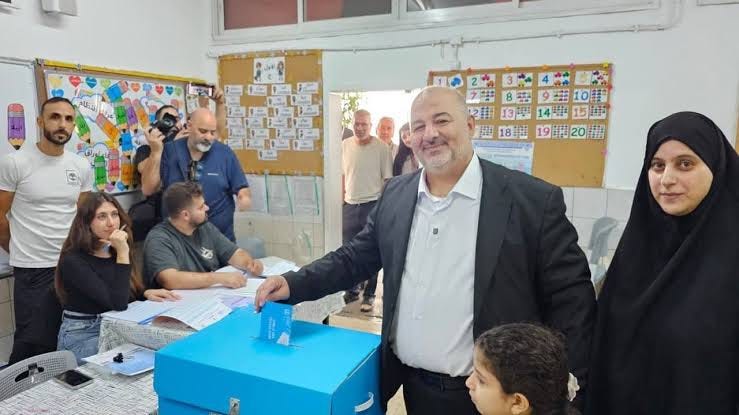
This is, I think, what a lot of American supporters of Israel think Palestinians look like, but you rarely see one dressed like this. Generally, hijabs are colourful, and those who wear them, if they are anything above dirt poor, have a fancy handbag and makeup on. A black jilbab with no adornments is rare. What Mansour Abbas is doing is inverting the traditional role of Islamism in Palestinian politics since Izz ad-Din al-Qassam, the Syrian itinerant preacher who wandered around MENA condemning bid’ah, and then told Palestinians that they would be able to kick out the Zionists if they got serious about Islam. This is the playbook that Hamas used to turn Gaza from a communist to a strict Muslim stronghold. Instead of that, Abbas preaches that if you go to Mosque five times a day and don’t go to shrines, then you can get a good job as a security guard and Israel won’t bulldoze your roof extension.
Right-wingers in Israel will point out that various members of Ra’am are not as, ahem, cooperative as Abbas, and see their participation in the political process as jihad by other means. This proves the exact opposite of what they think. Islamism existed in Israel before Abbas, and Islamism will exist in Israel after him. The question is will it be the kind of Islamism that has a principled commitment to peaceful relations between Arabs and Jews and opposition to political violence, or the opposite? In as much as the State of Israel has a choice in the matter, it is only by boosting or undermining Abbas and others like him. Even if he was just pretending - a thesis that is absurd in the light of available evidence - it wouldn’t really matter because, if you pretend to be something long enough, you become it.
The real problem with Ra’am is actually something different. Here is a picture that was going round on election day of a queue of people waiting to vote in their desert stronghold, Rahat.
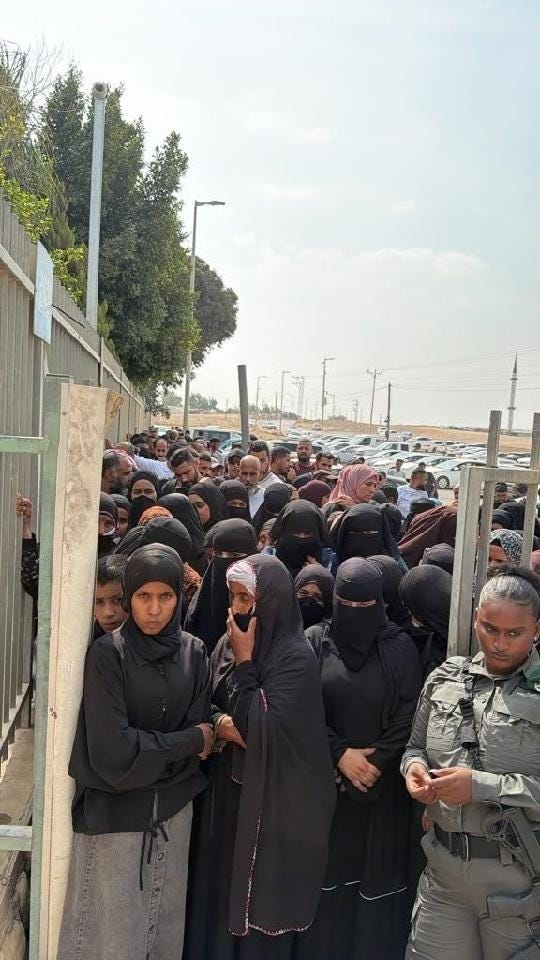
Now, I am opposed to racism, OK, no-one’s going to buy that, but I am very much, indeed viscerally, against attempts to incite communities against each other through incendiary words and images. But I don’t like this, I don’t like this at all. That is a rising tide of colour if ever I’ve seen one, and I don’t want it in this country. Googles how many people there are in Rahat. 77,997? Wait, that’s the figure from 2024, now it’s 83,668. WTF?
The thing about this image is that it doesn’t just look like a hostile foreign country from the perspective of Israel, it looks like a hostile foreign country from the perspective of Palestine. As mentioned above, you see a lot of hijab around here. When I lived next to Jabel Mukaber, I would also periodically see chador-type things. However, I can recall seeing a woman in full niqab precisely one time, in a clinic in Jerusalem. I don’t know what she looked like, obviously, but her husband was some kind of wigger LARPer, probably from Luton. Who, then, are the people in this picture? Bedouin.
One of the many paradoxes of Israeli politics is that rightists love nothing more than to claim that Palestinians are from somewhere else, but the Arabs here who genuinely are from somewhere else are the ones we have the easiest time getting on with. Many Bedouin join the army (you can see an example in the bottom-right corner), and are typically uninterested in, and sometimes even extremely hostile, to Arab and Palestinian nationalism. I used to have a semi-regular smoke outside school with a Bedouin security guard, and he liked nothing more than to regale me with stories about his Givati days and advocate for annexing large parts of Lebanon and Syria in time for the coming global economic crisis. I could kind of smile and nod though that, but it got a bit much when he started getting into Zamir Cohen videos.
The problem about the good Arabs, though, is that, well, they suck. Of course, there are good and bad ones distributed on a bell curve, but the bell curve overall is not in a good place. If your neighbour is a PLO-supporter, then he’ll probably be pretty decent and maybe will show you up by keeping his garden in better condition than yours. But if your neighbour is a Bedouin, then you should probably just move. The whole south of Israel is full of tales of business owners who had their establishment burned down because they couldn’t keep up with multiple Bedouin protection rackets, or people who have been run off the motorway by 12 year-olds on quad bikes, or whatever this nonsense is.

Mansour Abbas is not Bedouin at all, and nor are most of the top-ranking Ra’am politicians, but the party has been particularly successful in organising among southern Bedouin and is deeply embedded in society there in roughly the same way Hamas is in Gaza through social services and religious/educational institutions. The basic problem we have with Bedouin is that there are too many of them, and there are more all the time. TFR is estimated to be between 4.7, and population growth is 3.7% a year. This is down from earlier levels [!], but still very high. In principle, the Ra’am agenda of economic advancement and embourgeoisification could help with this, but matters need to be expedited somewhat, and you don’t need a lot of training in game theory to see that Ra’am might not be on board with population control for their electorate. So, this is a real issue, but the whole jihad thing is totally fake and the actual opposite of the truth.
We should say something briefly here about Ra’amGate, the claim that voters were given pre-paid cards to buy petrol or envelopes of cash to incentivise them to go out and vote for Ra’am. Some general context is in order. The first is that laws against improper electioneering in Israel are habitually and publicly broken and nothing happens. The most egregious examples are of public officials who are legally prevented from campaigning doing so anyway and using public funds and resources in the process, especially on behalf of Shas, though Smotrich’s party did a lot this time too. It’s also the case that, as the last votes were being counted, one of the final updates was an extra seat for Ra’am at the expense of the Joint List, so these extra votes probably didn’t even change the proportion of Arab representation, let alone the election overall. Nevertheless, the understandable instincts of the libs to pooh-pooh the whole thing in response to the open mendacity of rightist demagoguery is wrong. It’s indicative of the general lawlessness and Third-Worldism in the Negev and sooner or later (sooner is better), this needs to be dealt with. It will require the same general level of cruelty employed by Ben Gvir but, of course, exercised for the pursuit of constructive goals, not petty sadism.
4. Ta’al
Ta’al stands for the ‘Arab Movement for Change’ which is also what it’s called in Arabic, but that doesn’t matter very much what it’s called because Ta’al is not really a political party, but the vehicle for one politician: the man, the legend, Ahmed Tibi.

Tibi is by far and away the most popular politician among Israeli Arabs, and that is most fundamentally because he represents them in a way that none of the Arab political parties do. He is a Muslim, not a commie weirdo, but not excessively into it and definitely not into transnational Islamist revival. He’s against LGBT rights, but not in an obsessive prurient way. He is a proud Arab, but also speaks fluent, indeed beautiful, Hebrew, and is known for memable clips of him smacking down cretinous Israeli politicians. He values education (he frequently compares favourably the Arab emphasis on education to the illiterates of Otzma Yehudit), but as a tool of professional and economic advancement not studying German philosophy like a gaylord. He’s still buthhurt about 1948, but he doesn’t want to fight it all over again, and he definitely doesn’t want to live in some kind of shithole Arab country. One famous story really sums up how he exemplifies how he represents both the id and superego of the Israeli-Arab middle class:
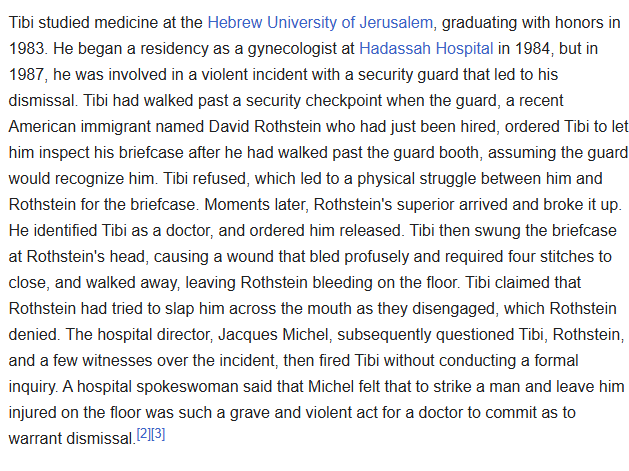
This is what every Israeli Arab who isn’t a dumbass or a nutcase (and let’s not beat around the bush, there are plenty of those too) really wants: to do well at school, get a good job where you are respected by elite hilonim, and then smack upside the head the dumb Mizrahi who lords it over you because he lucked out by being on the same team as Ben Gurion and Einstein. This story isn’t completely perfect because the security guard was some doofus American oleh, but it’s good enough.
Officially, Ta’al’s ideology is a watered-down version of Balad’s and one of their former, Osama Saadi, MKs made an arse of himself on election night by getting overexcited and dedicating their victory to Palestinians (as if anyone who voted even knew who he was in the first place). What Tibi really represents, though, is something more basic: the desire to not be considered a second-class citizen and a foreigner in the place where you are from.
General considerations
As R. Zachary Truboff points out in a recent article, the desired end result of Jabotinsky’s Iron Wall is that the Arabs would realise that they had lost and make a bargain. I think Jabotinsky was a sophist with even less foresight than the average Zionist leader who unleashed horrors upon the Jewish people because he wouldn’t accept that the Zionist leadership were just better than his crew. However, in this, at least, he was right.
There are two types of people whose interests lie in lumping together the ‘Arab parties’. The first are overt enemies of Israel who delight in pointing out that it is a fake democracy that refuses, on principle, to integrate a fifth of its population in the political process. The second are also enemies of the state of Israel because they wish to replace it with something else, a really Jewish state, and part of their roadmap to getting there is to escalate conflicts with Arabs on both sides of the Green Line until a conflagration occurs that necessitates desperate measures.
I’m not saying that in a critical way exactly. I think this country is dumb and I’m not patriotic at all. If I believed it could be replaced with something better, I’d be totally up for it, but since the option on the table is replacing it with something much worse that will flame out in justified infamy to the eternal disgrace of our nation, I’m in favour of keeping the current thing going. Plus, I live here. Israel would be better off if all the Arabs went to the moon, but they aren’t going to, so we have to figure out a way to get along.
With that in mind, the correct take on the Arab party question is as follows. Balad is an illegitimate party that should not exist and no relations with it should be entertained, including any sort of tacit support of a government from the outside. Hadash is also illegitimate because it is a Communist party, and thus supportive of the most destructive and murderous ideology of the modern era. If it wants to become a social democratic party interested in giving money to dopeheads and promoting sexual deviancy then that would be different, but it has to actually do that first. Ra’am is in every sense a legitimate partner and is actually preferable to most of the Zionist political parties. At the very least, there is no rational reason whatsoever for a Zionist to consider it worse than UTJ just because it’s Muslim. The main issue is whether it will cooperate with or obstruct plans to deal with Bedouin overpopulation which, in due course, will become an existential problem. It should be actively enlisted to promote more peaceful relations with the broader Arab and Islamic world.
The real prize, however, is Ta’al. At the moment, they are no more partners than Balad and Hadash, for the simple reason that they ran together in the Joint List. If Tibi wanted, though, he could run on his own, and, with a good campaign, he might get 5 seats and leave the dirty commies in the dust. If he wants to be the man who can admit his team lost and lead mainstream aspirational Arab Israelis to make a deal that protects their dignity within a stable state of Israel, he can do it. Will he? No, I don’t think he will. He doesn’t have much direct incentive and, though he’s a cool dude, he’s kind of a jerk and not a plausible candidate for a self-sacrificing brave leader. Should Jews try to make it as easy for him to do it as possible? Of course they should, unless they just want to burn it all down.
Not to be confused with the Joint List, which presently includes all the Arab parties but Ra’am.
They ran on a joint slate with the now-defunct Mada and got 2 seats together.
Israeli Arabs seem to ge caricatures of American Jews in the sense they blatantly advocate for "ethnostate for me, multiculturalism for thee" with no self awareness.
Balad and Oztma should be made to sit next to each other in the Knesset.