

A little over a year and a half ago, Eyal Zamir was appointed Chief of Staff of the IDF by Yisrael Katz following the retirement of Herzi Halevy who had presided over the disaster of October 7th. At the time, the Right was very happy with his appointment. Zamir was believed to represent a break from the IDF elite who were, depending on precisely who you asked, beholden to a debunked kontzeptzia, mired in defeatism, or actively treacherous. Best of all, Zamir is of mixed Yemenite-Syrian extraction, so free of evil white blood taint, and the grandson of an Irgun paramilitary fighter. Here is Channel 14 bimbo celebrating his appointment.
As it turns out, appointing Zamir didn’t solve all the army's problems, and, in fact, Zamir has spent much of the last 20 months falling out with the government about their being retarded clowns. This might show that, despite what frumthot might tell you, actually the State of Israel operates under real constraints and it can’t just blow through all of them by being more brutal. On the other hand, it might just demonstrate that the dEEP sTATE is more devious than you first thought.
Be that as it may, what got her so excited were the ‘very important words’ of the Chief of Staff showing that he had returned the army to the ‘distilled morality of the Jewish people’, namely ‘he who rises to kill you, rise up first to kill him!’ in place of Asa Kasher’s IDF Code of Ethics. Very based and Torahpilled. Here she is making a similar point with some chucklehead colleagues:
Can we repeal the 19th yet? But in fairness, it’s not just her. The belief that by returning to this foundational maxim we can solve our geopolitical issues is quite widespread:

So now we are going to nerd out. First of all there is no such phrase as הקם להרגך השכם להרגו in any Jewish source, the actual one that appears in the Talmud is אם בא להרגך השכם להרגו, roughly ‘if he has come to kill you, rise up to kill him’. You may well say that is a distinction without a difference, and perhaps that’s so, but we’ll get to that in due course. First: nerding.
The primary Talmudic passage appears in Sanhedrin 72a. It concerns Exodus 22:1, which teaches that a ‘tunnelling’ burglar can be killed without the homeowner incurring legal liability. The Talmud presents the explanation of Rava, according to which a burglar who enters a house to steal knows that the homeowner will fight him and therefore is assumed to be willing to kill him. Thus, in the absence of information to the contrary, the homeowner is simply acting in self-defence ‘if he came to kill you, kill him first’.
This phrase appears in three other places in the Talmud. In Yoma 85b, the passage is quoted as part of a larger discussion of the scope of pikuah nefesh, the obligation to protect Jewish life even at the cost of violating other laws in the Torah. The two other mentions are in the context of stories. In the first, a piece of homiletic exegesis, David tells King Saul that even though he has the right to kill him as a rodef (pursuer) under the principle of אם בא להרגך, he withheld himself out of admiration for his modesty. In the second, Rabi Sheila kills an informant on the grounds that he will bring about his death at the hands of the gentile authorities. This is one of those talmudic passages that goes in the ‘morally dubious’ bucket, for more than one reason. My take on this particular one is that it’s a story, certainly composed many centuries after the events it purportedly describes (different manuscripts vary to an unusual degree regarding the details). It got into the Talmud because of reporter’s bias and you’re not supposed, perhaps not even allowed, to read a great deal into it beyond a general vibe that Rabbis have the smarts to make it in dog-eat-dog world. Certainly, the extreme antipathy between Jews and proximate gentiles it describes is unedifying, but it takes two to tango with these things. With that said, Rambam codifies into law pre-emptive killing of informers, with qualifications, based on this passage.
You may ask what this has to do with military tactics and ethics and the answer would be ‘nothing’. The connection, however, is made in a certain respect in a later midrashic collection, Midrash Tanhuma. The midrash here seeks to answer a question that arises out of the first Talmudic passage we cited above. The logic of ‘if he has come to kill you …’ requires no particular explanation, but the language of Rava there is ‘The Torah says “if he has come to kill you…”’. Where, though, does the Torah say this? You might say that the question is misprised and based on a sort of over-reading. I would also say that, but it’s not a crazy question to ask. The Midrash’s answer is that it is derived from God’s instruction to make war on the Midianites in Num. 25:17-18’, ‘attack the Midianites and strike them for they are attacking you’. This is a neat example of how later midrashic exegesis works, smoothing over gaps in the edifice connecting scripture and Jewish law while drawing connections between apparently unconnected material to pleasing effect.
This passage is copied over into two later medieval collections, Bemidbar Rabbah and Yalkut Shimoni. The reason, however, this phrase became well known has little to do with midrashic use either inside or beyond the Talmud Bavli. It is a function of Rashi including it in his commentary on Ex. 22:1, faithfully recording its primary talmudic meaning. Because of the status of Rashi’s commentary, even only moderately educated Jews would have come across this pithy expression dozens of times over their life (it helps that it’s relatively near the beginning of the parsha). In his 1919 Treasury of Parables and Aphorisms, Israel Hayyim Tavyov quotes the phrase and points to Rashi as the reason for its popularity.
Now for the Zionism
We now skip ahead to the Arab Revolt of 1936-9. The goal of the leadership of the insurrection was to pressure the British into restricting or stopping entirely Jewish immigration from Europe, which was then spiking because of increasing persecution of Jews, principally, but not exclusively, in Germany. The goal of the Zionist leadership, by necessity, therefore, was to keep the doors to Jewish immigration open, a decision that was not in their hands, but in the British. The policy they logically adopted in the face of Arab attacks and terrorism was known as Havlaga, ‘restraint’. The idea was that, by sticking to defensive actions and maintaining the moral high ground, they would be in the best position to persuade Britain to maintain the current policy.
Havlaga was criticised by the Irgun on three grounds. First, they argued that the longer violence continued, the more incentive the British had to give in to their demands. Only through establishing deterrence could Arab violence be put to an end in a timely fashion, minimising the chance of a change of policy. Secondly, they argued that Britain had originally supported Zionism because they wanted a strong ally in the Levant, and that only by going on the offensive could the Yishuv show itself to be such an ally in embryo. Thirdly, they argued that if the Arabs were gaining political leverage over the British by means of terrorism, then they, too, could gain leverage by doing so. Where did they get these arguments from? Well…
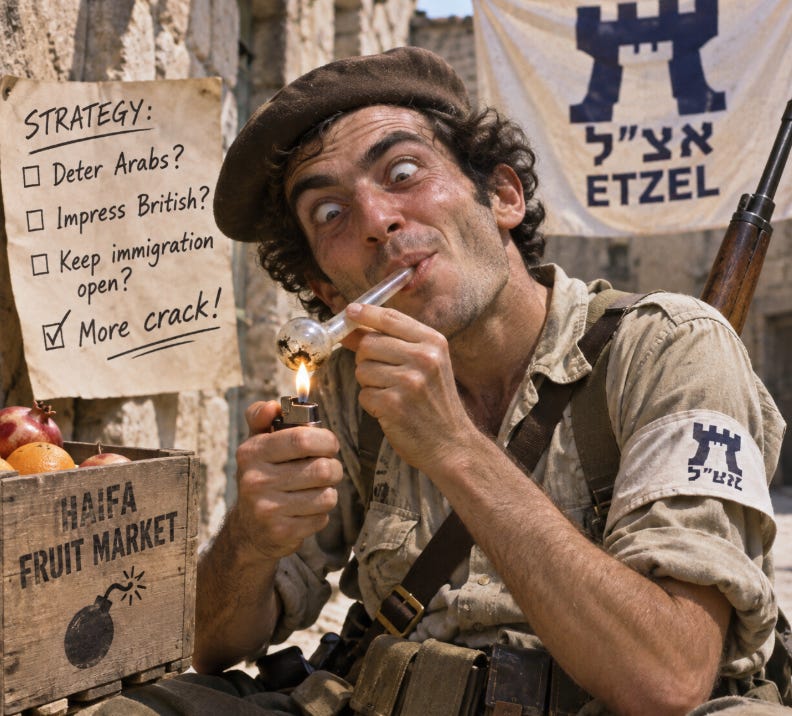
OK, maybe that’s a bit unfair. It is true that Arab terrorism was giving its political leadership leverage over the British authorities and it’s true that the longer it went on, the more leverage it gave them. The 1939 White Paper explicitly acknowledges that Britain was changing its policy because armed resistance made the old policy untenable. The problem is that Irgun’s violations of the Havlaga did not shorten or quieten the Arab Revolt, in fact they prolonged and inflamed it. By way of understanding why that was, here are the Irgun’s most notable actions:
On 14th November 1937 (‘Black Sunday’) Irgun fighters around Jerusalem opened fire on random Arabs, killing 10 people in total.
On 6th July 1938, Irgun explodes a bomb in the Haifa fruit market, killing 21 people.
On 15th July 1938, they set off a bomb in the old city of Jerusalem, killing 10.
On 25th July 1938, a second bomb is set off in the Haifa market, killing 53.
As we have discussed before, the most cherished conceit of rightoid Zionists is that they understand the Arab mentality better. By sheer coincidence, this means that they can indulge their basest instincts and commit murder. Whoopee. In reality, though, Irgun actions did exactly what you would expect if your brain isn’t riddled with cancer and AIDS. Many Arabs in Palestine did not support the revolt, or supported it some general way but didn’t like the leadership, or supported it and liked the leadership but wanted to stay on the sidelines out of concern for their personal safety. Whereas effective targeting of revolt participants and rewards for those who did not participate could certainly help in pacification, just murdering random Arabs predictably led to a huge surge in support for the rebels, and increased participation. Following Irgun’s terrorist campaign, Arab insurgent activity and non-cooperation with the authorities exploded, and the British lost control of much of the country in late 1938, leading the British to conclude they had no choice but to capitulate to Arab demands. Nice job. But you felt big when the bomb went, boom, right? No bugman are you.
As for the strategic stuff, Britain’s interest in Palestine was mostly motivated by concern for control of the Suez Canal. Zionism gave then the excuse to control the area as facilitators of a Jewish homeland, but now Zionism was becoming more of a hindrance than a help, both because it was making Palestine ungovernable and because it was damaging relationships with Egypt. In other respects, British interests were inexorably moving against Zionism. Oil was discovered in Iraq in 1927, in Bahrain in 1932 and in 1938 in Kuwait and Saudi Arabia. The Arab world had hit jackpot and every imperial power needed to start making nice. The main reason the British had got involved in 1917 in the first place was to keep the Rothschilds and other financiers sweet when they were broke from fighting WW1, but what were the Zionists going to do exactly, go back in time and cancel the loans? The only real argument that the Jews of Palestine had going for them is that Britain had made a commitment and the Jews were a good bunch having a rough time (now an even rougher time) and deserved being thrown the bone of Palestine they had been promised. Fortunately for opponents of Zionism within the Foreign Office, the Irgun had demonstrated that actually Jews were basically as trashy as Arabs, but ruder, more annoying and with no oil and crap coffee. The Irgun policy was premised on the idea that what the British really wanted was an army of militant settlers who could put the natives down with prejudice, but (a) that’s just something they dreamed up while cracking out and (b) even if the British did want that, how does blowing up a fruit market establish proof of concept?
One persistent tic the Jewish leadership in Palestine had is that they felt the need to justify hard-headed realistic policy as a great feat of heroic self-denial and submission to lofty ethical truths. There is merit to this because armies fight better when they are convinced of their righteousness. The broad consensus across Israeli society over its first decades that it was justified in its wars, a consensus burned up by M*****m B***n in his mad Lebanon adventure, was above all a strategic asset. The downside, however, is that, if you are gaslighting yourself into thinking you are the most moral army, people might start asking questions about whether there might be some delta in being only a moderately moral army. Better, they may suggest that there is an alternative morality that lets you win more and, since they have no shame, they will say it is a Jewish morality. Before you know it, you’re doing something very stupid.
Anyway, we sort of got off track here a bit. Or maybe we got on track, I don’t know, I think maybe more readers like this than the nerd stuff. Let’s start tying it together. While Irgun were clowning around and disgracing themselves, their nation, and the Yishuv they existed in a parasitical relationship with, there were also elements within the Hagana which wanted to pursue a more aggressive policy. Some of these were followers of Avraham Tehomi who had helped establish the Irgun in 1931 and then returned to the Hagana, leaving the Irgun a purely revisionist organisation. In a fascinating document from October 1936, the Haganah journal, Mahane, published anonymous internal critics of the Havlaga policy.1 In two of these pieces (neither very well argued) which essentially make the same case as the Irgun was making at the time, but without it just being a pretext for acting like killer baboons, the phrase הקם להרגך השכם להרגו is cited as an ‘old Hebrew proverb' justifying the abandonment of restraint and being less picky about identifying specific perpetrators during reprisal attacks (this did, basically, become Hagana policy as the Revolt worse on and then in the civil war a decade later).
What was going on? Well basically, the Yishuv was composed of people who had left their Jewish heritage behind, but instead of assimilating into some other culture, just kind of assimilated into themselves, concocting a weird blend of half-remembered catchphrases from Cheder, folk Marxism and a general wholesome hardworking, circle-dancing vibe. No-one was going to check if you got your ancient Hebrew proverbs right or not.
I’ll end with a funny anecdote. In 2016, when Israel’s degeneration was at a much less advanced stage, there was a debate about whether IDF soldiers in the West Bank have to fulfil their internationally recognised obligations as a military occupying power or whether they can just waste anyone who they think might be a threat. In reality, IDF soldiers have always been basically immune from prosecution unless they kill someone on the floor on camera, and even then they get 9 months, but this was not good enough for the Right. The phrase הקם להרגך was being bandied around a lot and then Chief of Staff, none other than Gadi Eisenkot said you can’t run military policy on slogans and have to strike a balance. Various rabbis and politicians responded with outrage at this blasphemy. It’s not a slogan, they declared, but foundational Jewish ethics. Here’s the funny thing though, whereas secular Eisenkot cited almost the correct version (he modified it to הבא להרגך), they quoted the fake Israeli formula, הקם להרגך. Here’s Smotrich babbling on about it in the Knesset.
It’s getting on, so I have to sum up. What to say? What is there to say? I say the same thing every time. You know what I’m going to say. What is this s**t? What are we even doing? I think we can do better than this, if only because I think anyone could do better than this. OK, not anyone, but Igbo could I’m sure. We beat Igbo, no? Do we actually want to just trample our religion endlessly into the mud until it is nothing more - and nothing less! - than an object of morbid horror to any person of any degree of intellectual seriousness or moral refinement? It’s a cliche because it’s true that we have a rich and complex tradition. How to apply that tradition to modern questions is a rich and complex task. Maybe, we could try? Make an effort. What does אם בא להרגך tell you about contemporary military strategy? Quite likely not very much, but if you think it does, at least do remedial homework: check up what it says and what it means and make an argument. The Talmud doesn’t say that if someone is plotting to rob you, you can go to his house and shoot him, or shoot some other guy in his house, or blow it all up with an F-35.
One more thing. An action of the Irgun during the Arab Revolt that I didn’t mention above was an attempt to blow up a bus of civilians with a grenade by Shlomo Ben Yosef near Rosh Pina. For his troubles, he was arrested by the British and executed, a harsh punishment for mere attempted mass murder, but one in keeping with their policy at that time towards Arab rebels. Ben Yosef became a martyr in the Irgun tradition, which for some time, and quite likely for some time to come, has become the governing tradition of Israel. There are at least 21 streets in Israel named after him and about half a dozen memorials. His actions are typically justified by the words הקם להרגך (though, heaven forfend, we should say this is just a slogan with infinitely plastic semantic content, then Shmuel Eljiyahu would get mad). Like the Palestinians, we have a hard time saying that our terrorists are terrorists. It’s not terrorism if it’s resistance. Like the Palestinians, our terrorists use our weakness and narcissism to subvert and hollow us out, to set whatever we have that is good to the purposes of something foul. Like them, we take pride more than anything else in the righteousness of our victimhood and are incapable of understanding that we are hacking away at ourselves. And like them … As I said, I always say this. You’re probably getting tired of it by now.
" there was a debate about whether IDF soldiers in the West Bank have to fulfil their internationally recognised obligations as a military occupying power or whether they can just waste anyone who they think might be a threat. In reality, IDF soldiers have always been basically immune from prosecution unless they kill someone on the floor on camera, and even then they get 9 months, but this was not good enough for the Right."
It's stuff like this that makes me question your facts in areas I know less about. While it's true that prosecution has been rare, the picture painted here is at odds with what I have heard from people who have actually served, which is that rules of engagement are taken quite seriously, and petty discipline is used to enforce them (which is consistent with few real MAG prosecutions). Let's leave Gaza out of it for a moment, since you are talking about 2016. I just don't think this is an accurate picture at all.
The online right love to tease leftists for their metaphysical belief in "Magic Dirt". And maybe it's true that Magic Dirt doesn't exist, but it sometimes strikes me that some of your countrymen are doing everything within their power to prove its opposite exists—benighted dirt.