

To read previous items in the series, go here.
The origins of the Chassidic movement are clouded in mystery. This is not an unusual thing historically, but it is unusual for something that happened in Europe (more or less) in the 18th century. We know, indeed, a great deal more about the origins of Frankism, despite it being an underground movement whose members were committed to secrecy both for practical reasons and as a matter of principle of sorts. There are eras where an industrious historian can eventually read every source there is to find, but even for a backwater like Podolia, by this point there is ample documentation for most topics you might be interested in researching (unless it’s something gay like women’s textiles). However, for Podolia’s most important contribution to global culture, we got bupkiss.
That we know little of the family background of the Ba’al Shem Tov (henceforth the Besht) is not in itself so irregular. People weren’t good on ‘Early Life checks’ back in those days, though, as a rule, important Rabbis came from rabbinical families that were careful to record and publicise their lineage. That we know nothing, or at any rate nothing that isn’t obviously fanciful, about the Besht’s intellectual influence is absolutely weird. According to Chasidic tradition, he received his teachings from a certain ‘Adam Baal Shem’, head of an underground pietist society and, in addition, by means of direct revelation from Ahiya the Shilonite.1 That these claims are fantastic barely needs to be said, but what does need to be said is that the origins of Chassidus are not just shrouded in mystery as a matter of fact; they have been deliberately shrouded.
The creation of a fictional origin story for the movement took place in multiple stages. It began in earnest with the publication of Shivchei haBesht, a collection of tales modelled on the (in)famous Shivchei Ari, which had, a few hundred years prior, been substantially responsible for elevating Lurianic Zoharism to authoritative status before most people had even had a chance to check what was in it. A second important episode was the ‘discovery’ of the Kherson documents purportedly containing original letters to and from the Besht as well as other early Chassidic luminaries. One common theme of these histories is that they emphasise something unknown from contemporary sources, namely the Besht’s energetic opposition to Sabbateanism and the ability of he and his followers to successfully identify and reject texts with Sabbatean origins.
Let us start, though, with what we do know. First, the followers of the Besht were not the first in early-modern Europe to identify themselves with the appellation of hassidim. There were preceded by the following groups.
The leader of the Sabbatean aliyah which established a community in Jerusalem was Yehuda the Hasid and his followers were called Hasidim.
The Sabbatean community of Mannheim, to whom were delivered Yonasan Eybeschutz’s tracts prayed together at the Chassidim Schule the leader of which was called Yishaya the Hasid.
The closest pupils of Avraham Rovigo, a wealthy Italian Rabbi whose household beit medrash became perhaps the main center for the dissemination of Sabbatean literature into Europe, were known as hassidim.
Yonasan Eybeschutz’s inner group of disciples in his yeshiva, which had to be closed after the discovery that they were learning Sabbatean texts, were called hassidim.
To pile on examples, though, is to miss the point. The term Sabbateans used to identify each other was ma’aminim (believers) vs. kofrim (deniers), and the term they used to identify fellow Sabbateans who were really into it was hassidim. This was even the term used for the followers of Jacob Frank before they got big enough to merit a more sectorial designation. This seems counter-intuitive to people today because to be a hassid is to go above and beyond the letter of the law, whereas Sabbateanism is known as a theology of ‘redemption through sin’. As we have explained, however, Sabbatean antinomianism is better understood as ‘hypernomianism’, the idea that adherence to the letter of the law was, in the throes of the messianic era, just not enough anymore. The Sabbatean calls to acts of extreme piety and penitence and the targeted violation of the law for theurgic purposes were not in tension with each other, but two aspects of the same thing: a rejection of the Rabbinic ethos of submission and moderation as inadequate for the new era. Those who took upon themselves the burden of a new higher and more demanding law for the incoming universal sabbath were naturally known as the ‘pious ones’ regardless of where precisely they lay on the Sabbatean spectrum of holy sin as a practical matter.
The second thing we know is that when the followers of the Besht started to become known around Europe, the ‘new hassidim’ as they were called by their opponents, were identified as a recrudescence of the Sabbateanism the Rabbinical establishment had spent the last 50 years trying to snuff out, with mixed, but slowly increasing success. This assessment was based both on the fact that the heartlands of the new Hassidic movement (Podolia and Volhynia) were the most stubborn Sabbatean strongholds, and also the strong resemblance they saw between the two. As we shall see, academics over the past two decades have converged upon the view that this was a mistake borne of small-minded bigotry and petty elitism on the part of talmudic scholars, aghast at the possibility that anyone might be having a bit of fun. More strangely, this is the view of orthodox Jews today, though they refuse to articulate it as such.

However, the hypothesis that the Rabbis knew what they were talking about neatly solves a problem in Jewish intellectual history. We know that the hassidim caused a revolution in European Judaism, but where did they get their radical ideas from? The answer that revisionist historians have converged on is essentially the same one Chassidim believe themselves: the Besht was vibing out in the woods, and it all came to him bang! and these new doctrines just happened to be perfectly designed for a proliferation among Ashkenazi Jewry worn out from being so dry and boring. However, if we look at the novel doctrines of the Beshtian movement, we see that almost none of them are, in fact, novel at all. By dint of apparent coincidence, they are all doctrines that we have seen developed by the Sabbatean theologians as they dealt with the apparent collapse of the messianic movement that Zoharism had heralded:
The state of complete cleaving to God can only be achieved by the true tzaddik whose soul is specially bound up with divinity from creation. However, other Jews can achieve a form of this devekut by cleaving to the tzaddik himself since, despite his divine soul, he is nevertheless a man to whom other men can cleave.
The true tzaddik must go through periods of acute spiritual turmoil in which he wrestles with the forces of evil, undergoing ירידה לצורך עליה (a doctrine found absolutely everywhere in hassidic literature).2
God is not the remote and austere lawgiver of the Geonic-Maimonidean tradition, but something else in a way that has been hitherto hidden from the masses
The kabbalah is not a doctrine reserved for a select few to be studied in secret, but can and must be spread to the masses as part of redemption.
The dourness of Judaism since exile (emphasised perhaps to an excessive degree in Ashkenazi tradition) must now be replaced with overt joy and enthusiasm.3
There is, of course, one very major difference, and that is the role of the person of Shabtai Tzvi himself. There were various Chassidic figures who saw it as part of their role to rehabilitate the divine sparks in the Sabbatean movement, and we will look more closely at that in a future installment, but there were certainly none who saw him as a messiah in any meaningful respect. This transformation was ably described by Scholem:
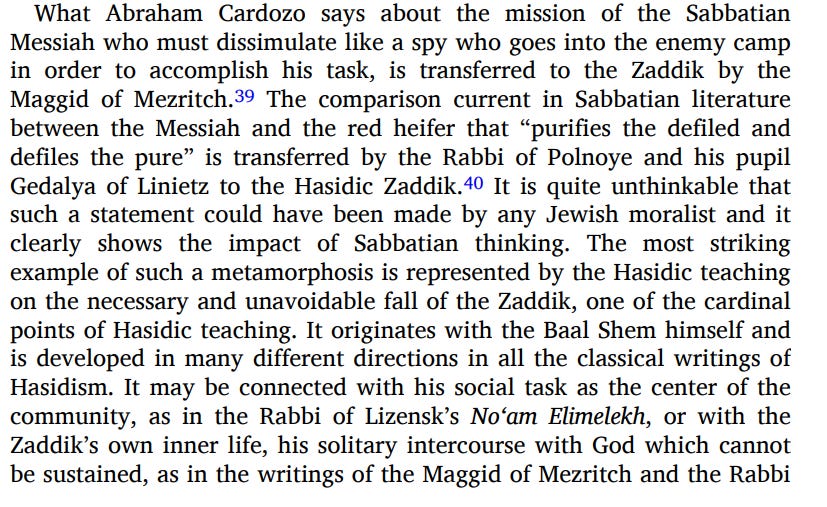
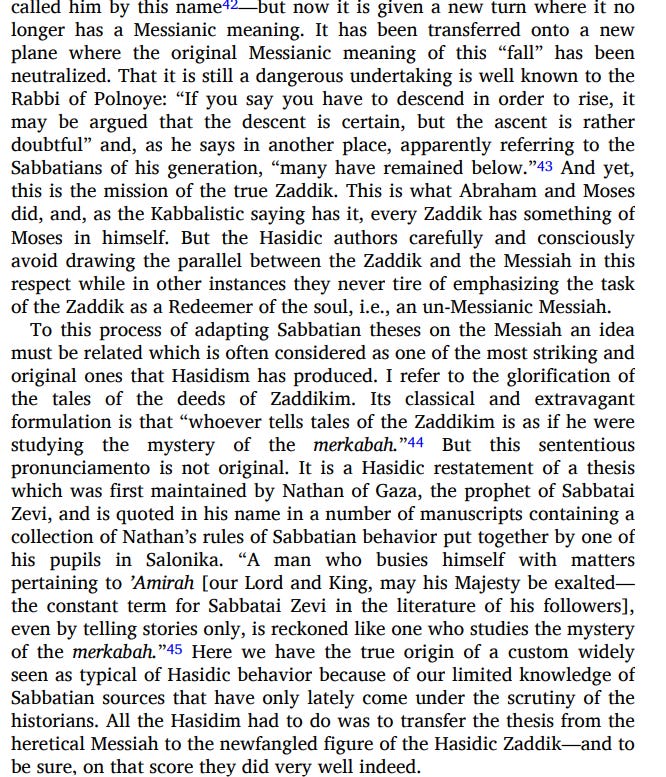
All we really need to add here is that the demotion of Shabtai Tzvi from his place within the general complex of Sabbatean theology was not something the Besht initiated, but rather something he completed. We have already seen that in the most ‘profound’ text of the Sabbatean movement, ואבוא היום אל העין, Shabtai’s role is severely diminished, and this was true also of Frankism. While the paradoxes of his personality and the obvious failure of his movement to bring about national redemption were doubtless a great spur to the development of Sabbatean theology and spirituality, Shabtai Tzvi was also a deadweight on the movement, an element of absurdity whose incongruity only became more acute the more time passed and nothing happened. Jacob Frank’s desperate push for redemption right now was one way of dealing with this, but the Besht hit upon something much better: Sabbateanism without Shabtai Tzvi, the decentralisation of tzaddik-worship so it could function as a vibrant and growing social movement.
Objections
As mentioned, Gershom Scholem figured this all out when he delved into long-suppressed knowledge of Sabbateanism and found that the innovations of the Hassidic movement weren’t actually innovations at all. There are two main criticisms of his approach. The first is that it’s grossly offensive because Sabbateans were bad and Hassidim are good, or, to put it more precisely, Sabbateans were violating Judaism whereas Hassidim uphold it. We’ve already dealt with this, but to repeat: the Frankists were not representative of Sabbateanism generally, but its most extreme offshoot. The Sabbatean mainstream was consistently opposed to violation of the law as a practical matter for most adherents. R. Emden and others made a serious strategic error in overplaying (and often most likely fabricating) the antinomian behaviour in the fringes of the movement, which became a legitimating device for the movement at large: since they aren’t being fed pig by a hooker on Yom Kippur, they’re not really Sabbateans; it’s not so bad.
In as much as Sabbateanism at large really was antinomian, so is the Hassidic movement. It is not necessary to get into what goes on even today in parts of Breslev, though nor should it simply be ignored (as it shamefully is today by our religious leaders). It is well known, practically a cliche, that the Hassidim, for example, placed devotion and emotional intensity in prayer above things like being particular about stipulated times for prayer or the prohibition on dancing on the Sabbath. That this is not seen as antinomian today demonstrates nothing more profound than that the Hassidim have been very successful. Despite this behaviour plainly contradicting the law, it’s not seen as actually wrong. Well, guess what, when Sabbateans contravened the law, they didn’t think it was wrong either!
There is, however, an additional argument currently in vogue in academia, which is more … complicated I guess. Here are various quotations from Hassidism: A New History.
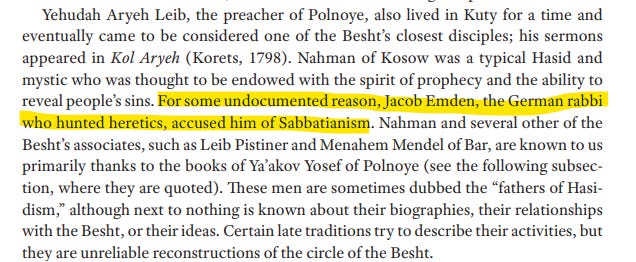
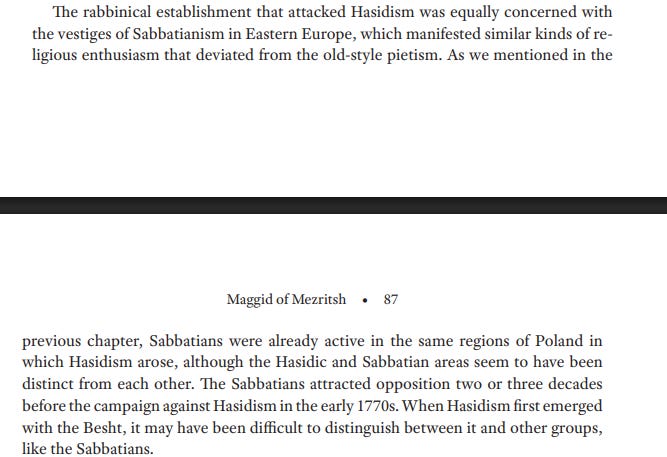
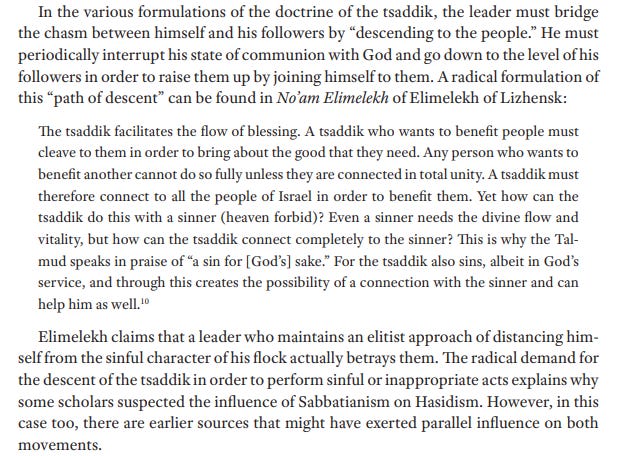
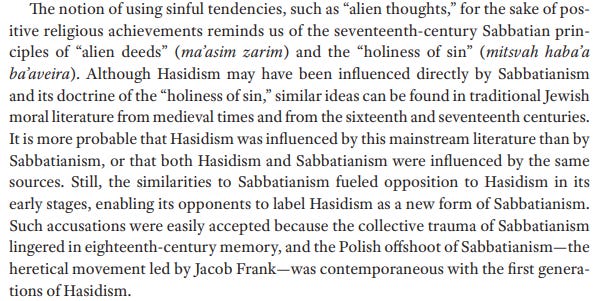
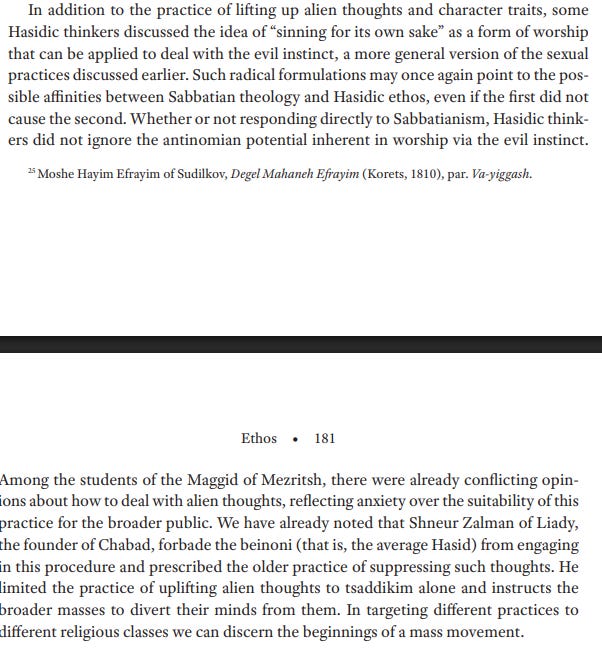
So basically, ‘nu-uh’, ‘you can’t prove it’ and ‘look a balloon’. In as much as there is any argument I can find, it’s that distinctively Hassidic ideas all have antecedents in pre-Sabbatean kabbalistic texts, but this is just basic incomprehension. Sabbateanism is Zoharism; Zoharism is Sabbateanism. Sabbateanism wasn’t a perversion of Zoharism or an alien intrusion, it was an attempt to continue and develop Zoharic religion following the crisis that Zoharism had, by its own internal dynamics, brought itself to. What was inauthentic, in fact, was anti-Sabbatean kabbalah, which sought to simultaneously uphold the sanctity of 200 years of Zoharic tradition while repudiating its culmination. If Sabbateanism eventually solved its problems by transforming into Chassidus, then it is entirely to be expected that it could find the germs of its doctrines in earlier texts.
What, then, is the proper way to think of the issue? Readers will, I hope, be familiar with Moldbug’s Puritan hypothesis, that is to say the assertion that Leftism is Reformed Protestantism. Many readers of Moldbug, especially those who see in his writings a devious attempt to protect Jews from blame, have attacked him on historical grounds, but while Moldbug certainly oversimplifies and cuts corners, the core historical argument is not controversial. It is a commonplace of historical discourse that modern progressive movements evolved out of radical Protestantism. Moldbug’s argument was not historical, but analytic: to say that Protestantism became something else when it became leftism is to implicitly accept the truth claims of one or the other. If we zoom out, though, the distinction between ‘religion’ and ‘ideology’ is conventional and, if used unreflectively, misleading. Protestantism certainly evolved under selective pressures, but to understand it properly we should see it not as a new thing, but the same thing with new features.
It’s an argument you can take or leave, but, in as much as it works, it works even better here. First of all, Protestantism is still a thing, and distinct from Leftism, sometimes even opposed to it. This represents a good, if not conclusive, argument for looking at the matter in terms of speciation. However, there is no Sabbateanism per se today, except for a few LARPers maybe. Either Sabbateanism has ceased to exist, or it exists today as Chassidus. Secondly, the history of Leftism is an extremely complicated process, with dozens of different vectors, and it is a matter of some argument whether Protestantism is even the most important input. In the case of Chassidus, however, it doesn’t seem terribly complicated at all. The Besht, as even Aryeh Kaplan admitted, took his ideas from Hershel Tzoref and completed the process of stripping Sabbateanism of its obsolete content, allowing it to take off. The other inputs, in as much as they exist at all, are all pre-Sabbatean.
If you’ve been paying attention over the course of the series, you figured out a few episodes back that I was going to say this. However, some people aren’t close readers, so probably someone is angry right now. In part 13 or 14, I’ll cheer you up somewhat, but in the meantime, I’m going to close with something nice.
