

I like Aryeh Deri. First of all, he is a race realist. You might question this assertion, but check out Shas’s election videos:
The man behind this stuff does not need to binge-read articles about bell curves and factor analysis to understand what it means to have an IQ of 80, like I imagine other people do instead of just being a normal human being. He just gets it. He knows exactly what to say to make people who struggle with the 'how would you feel if you hadn’t had breakfast?’ question go and vote so that, election after election, proportional representation go brrr. Some snooty people don’t like this. They find open, unabashed electoral appeals to the dull-witted viscerally revolting in their gut and then they come up with reasons like ‘it makes a nonsense of the concept of the Knesset as a deliberative chamber’ or ‘this will lead to escalating levels of corruption and vote farming until all institutions of state are gutted from the inside’. Look, you’re not wrong, but I say don’t hate the player, hate the game.
At this point some literal moron will be typing out a comment along the lines of ‘well if race realism is so true, how come Aryeh Deri is a genius?’. First, no-one cares what you think and, secondly, this is super-basic.
Anyway, the second reason I like Aryeh Deri is that he’s a filthy liar. He’s constantly saying mad, baboon nonsense, but he doesn’t believe a word of it, and we have proof. What Aryeh Deri really wants to do is steal and, because he loves stealing, he wants a dynamic 1st world economy to steal from, which means he does his best to put a spanner in the works of the policies his voters demand, then tells them to vote for him because God/Maran (does it make a difference?) says to. In short, he has the decency to be a hypocrite, which, in the current circumstances, is not something to sniff at.
However, with all that said, Aryeh Deri is a criminal, an unrepentant criminal perpetually on the lookout for new crimes, the very definition of אוהב כסף לא ישבע כסף. Even in Israel, you have to keep a lid on this kind of stuff, if only for form’s sake, which is why in due course every mayor in this dumb country will be in prison. Aryeh Deri got caught multiple times, and in 2022, in order to avoid prison he agreed to resign from the Knesset and not seek office. Then the election came and gave a ‘fully Right Wing’ government its first ever majority without some pesky Kahlon figure ruining everything, and Aryeh Deri asked for his old job of Interior Minister back. Bibi agreed, but the SECULAR GODLESS AND UNDEMOCRATIC SUPREME COURT said that ‘umm, you can’t promise to leave politics to avoid prison after being convicted a second time and then literally the next ****ing year become a government minister” (I’m paraphrasing). In giving this ruling, the court leaned on the controversial ‘reasonableness doctrine’, according to which they can order the government not to do really messed up stuff based on ‘because I said so’.
Then things kicked off. For decades, various figures on the Right had been demanding and/or promising judicial reform. The first fully Right-Wing government had a number of priorities, such as securing Israel’s borders (grade A), combatting crime (grade A+), and giving Israel dignity on the global stage by teaming up with based right-wingers (grade A+++ with cherries on top). Somewhere in the mix, though, was supposed to be judicial reform. Aryeh Deri would have been the main figure trying to delay and water down proposals for reform, but instead he got on board, and the government went full blast until October 7th.
A criminal lawyer
Israel’s constitution (in the Aristotelian sense of the word) is quite irregular for a modern state. First, like only six other countries, it has no document codifying the division of powers between different branches of state (a ‘constitution’ in gaylord). Second, like five other countries, it is a parliamentary system (with an almost purely ceremonial presidential office) in which executive power is wielded by whoever can command a majority in a unicameral legislature. Third, it has one of the most pure form of proportional representation in the world.1
Left alone, this would be a recipe for pure chaos, giving each government that could cobble together 61 seats limitless power to do whatever it wanted, and then the next one would have limitless power to reverse it. In the first two and half decades of the state, this was a substantially theoretical issue because the country was ruled by the same party, with political debate being primarily a matter of internal debates between more and less hawkish descendants of Borochov. However, the government screwed up with the Yom Kippur war, and Menachem Begin cheated by breaking the gentleman’s agreement not to openly campaign for Mizrahi votes, raising the spectre of electoral anarchy-tyranny. Begin confirmed suspicions that the untrammelled democracy thing was not a great idea by causing skyrocketing inflation and launching a disastrous invasion of Lebanon and into the breach stepped Aharon Barak who basically declared that, in the absence of a written constitution, whatever he said was the constitution.
The status of the judiciary in Israel is genuinely quite unusual. The Supreme Court picks new members itself (though there has been more Knesset input since 2008). It can strike down any law it wants based on incompatibility with certain ‘basic laws’. These basic laws were passed many decades ago when the secular ashkenazim owned the country. When the government tries to pass new basic laws, the Supreme Court tells them they can’t, while reserving the right to interpret existing basic laws creatively. When that doesn’t work, it leans on the ‘reasonableness doctrine’. Large areas of law usually considered in other countries to be political questions outside of the purview of judges, are considered justiciable. In short, Aharon Barak said, ‘yes it’s very nice that you are the majority, but I don’t want to live in a third world country, so get bent’.
To sum up, you can certainly take the weird things about the Israeli Supreme Court and, by completely ignoring the context, find enough material for Anglo cringelords who can quote Antonin Scalia and blabber on about ‘judicial activism’, but the key impetus for judicial form in the real world was to remove restrictions on the ability of ethnic machine politicians to commit crimes with impunity. However, it wasn’t just that. The Right is united in its opposition to judicial over-reach, but each faction has its own reasons, which we will now review.
Bibi Netanyahu
Bibi, like Aryeh Deri, has not traditionally been in favour of judicial reform, but switched sides for personal reasons. Some background here is required, and I will pull out my old hat as the internet’s most fanatic Bibi supporter. Netanyahu’s personal politics are defined by two belief systems, which, to put it mildly, exist in a certain tension. First, he inherited from his nutcase father a grim belief system, in which history is a perpetual zero-sum struggle between national groups, and the Jews exist in perpetual enmity with everyone else. The purpose of Israel is not, as Zionists (including the right-wing ones) traditionally had it, to transcend, defeat or, at least escape from antisemitism, but simply to continue the struggle from a place of strength, to have a gap of a few hundred years in the ‘history of Holocausts’. Secondly, he’s a generic cringelord neoliberal who believes in free trade and economic development through peaceful cooperation and the division of labour. Because Zionism was a dumb idea that was implemented spectacularly well, Netanyahu’s odd combination of beliefs proved to be the perfect combination for a state that needed a way to muddle through the mess it had gotten itself into without flaming out in the search for a solution.
Bibi’s ideology allowed him to take lemons and make passable lemonade. On the one hand, the state had a whole bunch of secular ashkenazim. If it was just left up to them, it would be the highest human-capital nation in the world by a country mile, but they would just endlessly shoot themselves in the face by lurching from socialism to la-la-land peacenikism to whatever weird thing they’d alight on next. On the other hand, there were the MENA Jews who were immune to all this nonsense, but if left to themselves would just be slightly-above-average Middle Eastern country, which would not be wealthy or strong enough to win out in the numbers game against the Arab world. Bibi’s solution was basically this: the MENA Jews would vote for him, and he would implement standard Chicago-school monetarism to put the Ashkenazism to work making bank, allowing Israel to develop into an economic, technological, and military superpower. If the MENA Jews started demanding he did something they wanted in exchange for their votes, he would just say some variation of ‘look, a balloon!’ and, in the meantime, he’d just kind of bob and weave through the fraught geopolitical environment until something came along to increase his freedom of action, or, failing that, forever.
It’s important to understand that, given the context, this plan worked incredibly well. I think Israel sucks, but GDP doesn’t care what I think:
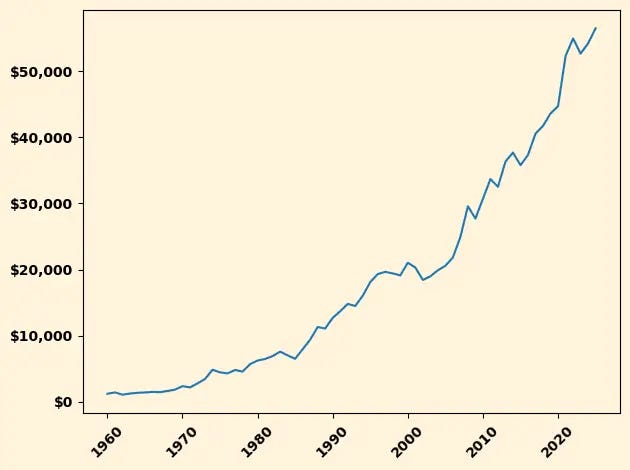
Sure, there were various issues with how sustainable this was in the long-term, but the main issue is that the secular Ashkenazim were going progressively more round the bend about Bibi crushing them in one election after another and so, they, too, decided to cheat. Technically speaking, Bibi is clearly guilty of various misdemeanours, but his voters don’t care. Most of them admire criminality. Every country has things that are technically illegal, but are de facto decriminalized because too large a proportion of the country are OK with it to make police action feasible. That’s how it is with Bibi’s various petty gifts and favours secured for his crazy wife and dickhead son. It’s obvious that picking Bibi’s indiscretions from the millions of similar offences was actually a politicization of the legal system. Likud without Bibi is just a collection of the worst and most depraved people in the world that probably couldn’t even run an election campaign without someone stealing all the money, so the Left figured if they knocked out Bibi they could win an election after trying everything else and failing. The problem is that, technically speaking, they were in the right: a crime is a crime, and ‘everyone else does it too’ isn’t a defence.
Bibi’s real attitude to the Supreme Court has traditionally been one of silent gratitude. The chief objection that principled right-wingers have about the Supreme Court, namely that it improperly removes political questions from electoral politics and makes them the domain of judges was exactly what he needed. Since his governing philosophy was ‘don’t do anything dumb’, which amounts to ‘don’t do anything’ since all the options are dumb, any state institution that tied his hands and gave him plausible deniability was a gift. Even better, when it was election time he could turn to his voters and say ‘look at these snooty European atheists who look down on you and consider you unfit to participate in government, vote for the European atheist who condescends to you. Aren’t Moroccan cookies yummy?’.
It was a true win-win, but, after exhausting all other options, Bibi realised that his only serious option for resolving his legal woes was getting the Knesset to pass a law saying ‘the Prime Minister has criminal immunity’, but the Supreme Court said it would just strike down any such law, and so Bibi decided that he was now pro judicial reform.
The Charedim
The Charedim want judicial reform for a simple reason. Since the 1952 agreement between Ben Gurion and the Chazon Ish, Charedi men have been exempt from the mandatory draft on the condition that they are studying Torah, or pretend to be studying Torah, or come from a family in which the expectation is pretending to be studying Torah. As the Charedi community has ballooned, an exemption originally given for 400 students now applies to something in the region of 70,000 young men, a number that continues to expand exponentially.
Since the late-1990s, the Supreme Court has become increasingly restless about this situation. The draft-exemption has never been codified in law, and the Court has, following repeated orders to rectify this system, gradually adopted the position that the exemption is therefore illegal. However, at the same time, the Court has also strongly indicated that any law that does formalise the current arrangement by giving a blanket exemption based on unverifiable membership of yeshivot from a particular religious community will be struck down as a violation of ‘basic laws’ guaranteeing equal treatment before the law. In other words, despite it having consistently passed the test of electoral politics, the Supreme Court wants to abolish the draft exemption by judicial means.
This would perhaps sound like a case of judicial over-reach except for one important fact: opinion polling consistently shows sky-high approval for ending the blanket Charedi draft exemption, with support never dipping below 65% and sometimes getting as high as 85%. In other words, no matter how many times the Right says that הרוב קובע, in this case of judicial over-reach, the Supreme Court is acting to promote the view of the majority against an electoral system which, for better or worse, systematically promotes committed and organised minorities.
For my part, I think the draft exemption is mostly a good thing, and certainly should not be abolished. The masses want to, but the masses are asses. No-one very much cares what I think, but it also seems obvious to me that in forcing the issue, the Left has allowed Charedim to slot their extremely unpopular stance of not contributing and being massive parasites into a broadly popular policy of ‘judicial reform’, which is dumb. If they were smart instead of dumb, they would instead suggest a law allowing an exemption to anyone willing to sign the following statement: ‘as a believer in Orthodox Judaism, I follow the opinion of all the great Rabbis that any involvement in Zionism is a grave moral and halachic offense, and therefore I cannot serve in the Zionist army’. The Charedim would feel mighty embarrassed, but they’d have no choice but to go for it, and the Right Wing alliance would collapse, making it basically impossible for them to form a government ever again.
Religious Zionists
Religious Zionists object to the Supreme Court mainly because it places obstacles in the way of settlement expansion. These guys have spent a lot (a lot) of time thinking about how to get more houses with Jews in them built in the West Bank and beyond, and they have the following objections to the Supreme Court’s treatment of the issue:
Well-funded foreign NGOs constantly trawl through records to show that some patch of a new settlement development is actually the private property of Abdul Mustafa, illiterate camel farmer, and bring armies of lawyers with the intention, not even of securing compensation for the supposedly aggrieved party, but simply obstructing construction. This is gaming the legal system for political purposes and the Supreme Court knows it and lets them get away with it.
Records of land ownership in the West Bank are a giant mess, but the Supreme Court takes ownership titles at face value.
Under the Palestinian Authority, it is illegal to sell land to a Jew on pain of death, and even in Israeli controlled areas and East Jerusalem, there is a constant threat of vigilante violence. This means that sales have to be conducted in secret, and it is easy for Arabs to subsequently deny they happened, but the Supreme Court makes no allowance for this.
All this is true enough, as far as I can tell, but anti-settler NGOs raise the following points, which are also true.
Despite the overwhelming opinion of lawyers around the world, and counsel the Israeli government itself has received, that all settlements violate international law (including conventions Israel has signed up to) under the prohibition of settling the civilian population in territories under occupation, the Supreme Court ignores this in toto and treats West Bank property disputes as just like any other area of property law.
Many settlements are built on land that the state originally confiscated on security grounds, and then reallocated for settlements. This is obviously cheating, but the Supreme Court looks at each act in isolation and waves it through.
The State of Israel recognises the right of Israelis who have claims to property in the West Bank and East Jerusalem that was expropriated in the War of Independence, but rejects outright Palestinian claims on a vastly greater amount of property they lost in Israel during the same war. The Supreme Court enforces the law on this basis even though it’s basically impossible to justify on rational grounds.
Overall, it’s pretty clear that the Supreme Court is trying to do its best to arbitrate difficult disputes in difficult circumstances, while in fact, being relatively restrained in not overriding political decisions. Regavim has a whole bunch of cases they are outraged about, and B’Tselem has a whole bunch of cases, and they are both justified depending on what set of normative assumptions you bring to the table. What the Supreme Court is really doing is just its job, namely trying to apply the concept of law to a particular sphere of human interactions. No ideological party is ever happy with the application of law as such, because the nature of the thing is to dissolve great narratives into a large number of individual disputes, some of which go one way, some of them the other. Maybe it’s silly to apply the law to a kind of cold warzone, it certainly feels pretty silly a lot of the time, but that’s kind of the point: to keep it a cold warzone. Maybe you think that you have more to gain than to lose from turning the war hot, but maybe you’re wrong.
Other stuff
To sum up, the different factions of the Right converged on opposition to the Supreme Court for reasons of their own, turning sectoral and unpopular issues into one meta-issue that commanded the support of a broad majority (and also bamboozled centrist dipsticks open to abstract argumentation). There are some other issues with the Supreme Court, but they are mostly total nonsense. One area of contention is its general stance in favour of restraining the IDF. Right-wingers are bombarded daily with social media telling them about how brave soldiers are endangered by a leftist judiciary tying their hands in service of postmodernizm.2 Again, the world is a complicated place, but at almost any level of simplification, this narrative is just a lie. IDF soldiers routinely get away with everything up to and including literal murder, even of Jews, and the longest sentence a soldier serving in the West Bank has served is three years. Probably that’s just how it has to be when you are running a military occupation with a citizen army, but there’s nothing to really complain about.
The other main area of concern is stuff like the Tiberias municipality trying to ban the sale of pork and the Supreme Court telling them to knock it off. You can see this as an intrusion on democratic politics if you want, but the reality is that Israel gives more communal autonomy than any western country, with the possible exception of the United States, and gives more financial support to sectarian institutions than any country without exception. Attrition rates in the Religious Zionist community are catastrophic not because the Supreme Court is imposing too much individual liberty on municipal institutions, but because they make a point of exposing their children to secularism as long as it is nationalist. As for justifying the Court’s rulings on these issues, one could just read verbatim any one of thousands of legal briefs the Agudas Yisroel in the United States has submitted to the Supreme Court in support of religious freedom and pluralism. Either it’s right or it’s wrong, but it can’t magically become right just because now you’re the majority.
There is, however, one issue where the Supreme Court has both over-reached and done harm, and, in a sense, it illustrates in a perfect way the real political dynamics of Israel.
Out of Africa
Until the early 2000s, Israel almost completely avoided third-world immigration. There are a number of reasons for this. Israel was a relatively poor country, with a weird language that was very far down the list of desirable destinations for aspirational citizens or poor countries. Until the Second Intifada, there was a practically unlimited supply of cheap Palestinian labour, and immigration from surrounding trashcan nations in a state of war with Israel was out of the question. However, the accelerating exclusion of Palestinians from the Israeli labour market coincided with the Eritrea-Ethiopia war and the last stages of the Sudanese Civil War. Israel started going through the same general thing experienced in western countries around the world with immigrant neighbourhoods becoming pits of crime and squalor, but it was even worse in Israel, because its immigrants came from basically the worst countries on earth, and it’s a small, crowded place with limited room to move into the suburbs.
Bibi put a stop to all this quite early on in the process, with the details worked out by Eli Yishai. As a technical matter, it was relatively easy because Israel’s borders are among the most heavily militarised on earth, but it required political manoeuvring to outwit pro-immigration lobbies on both the Left and Right. The barriers have been shut to further migration since 2012, but ever since then the Supreme Court has thrown one spanner after another into efforts to clear out those who had already come. As a result, large parts of south Tel Aviv have been uninhabitable for anyone else for over a decade. Supporters and opponents of the Eritrean government have mass brawls with batons, and there’s a whole gang ecosystem composed of second-generation Eritreans.
Here’s the thing though. Tel Aviv is the leftists’ city. In a certain way, it’s their only city (though they also have some nice suburban towns). It’s also expensive, in a crazy way. The natural thing for aspiring young leftists looking to make something out of themselves is to gentrify some relatively crummy part of Tel Aviv until they have the money to move into a better place. Unfortunately, they can’t because it’s all just Africans. In the rest of the country, you maybe see a Sudanese woman with a crucifix tattoo on her head cleaning toilets or something, but it’s really not a big deal. In other words, the members of the Supreme Court are waging class warfare against themselves.
What it’s all about
Yair Golan is a great guy. After an impressive military career, at the age of sixty-one he turned up on October 7th and rescued people from the music-festival massacre. I often look down on people without justification and it’s a bad character trait, but it wouldn’t even occur to me to look down on Golan because he’s just an objectively better person than the vast majority of mankind. He’s the only man in Israeli politics about which one could plausibly tell an ‘I cannot tell a lie’ story. If justice means anything, it’s that such a man should be honoured by society in general. In the real world, however, he can’t walk around without repulsive subhuman trash harassing him. There’s no need for a Camp of the Saints novel about what Israel might look like if feral third-world detritus made it intolerable for civilized people to live there. It’s a thing that is happening literally right now in thousands of little incidents up and down the country daily. And what does Yair Golan, literally himself a victim, have to say about this? Nothing, just endless muh Democracy and gay rights. Hopeless.
A few notes here. Israel’s system of government is very similar to Denmark’s with the exception of Denmark having a written constitution. Presently, Israel is less pure PR system than South Africa, the Netherlands, Denmark and Namibia, but in the 1980s it had an electoral threshold of only 1%.
More broadly, advocates of PR argue that it promotes stability in governance through coalitions that mean a degree of continuity of personnel even after quite sharp electoral swings. The downside is, the opposite, that it’s hard to form governments, leading to a weak executive (unless said executive is selected separately). In Israel, we get both paralysed governments and also intense polarisation with Shamir giving way to Rabin (who then got shot).
JDM יוחנן דור בן דור says I’m wrong in saying that there is no written constitution.
For proper effect you have to linger slightly over the z.
what is the point of writing anything if you are this funny
Grim. I learned a lot about Jews and Israel from your writing. If, for whatever reason, you decide to leave or if you get kicked out again, I’ve got some space in the attic at my place.