

To read previous items in the series, go here.
To recap where we’ve got to so far, the revelation and proliferation of the Zohar beginning in the late 15th century in Spain constituted a profound and revolutionary transformation in the nature and inner meaning of Judaism that culminated in the charade of Shabtai Tzvi’s messiahship. After this fell apart in a shambolic fashion, Judaism was stuck, unable to move forward and unable to move backwards and, most pressingly, unable to purge from its ranks the faithful Sabbatean believers who were the authentic heroes of the Zoharic tradition, and the majority of the intellectually vibrant part of the Jewish people. After the better part of a century in which the rabbinical establishment groped around erratically for a solution, the rise of a particularly daring Sabbatean theologian, Yonasan Eybeschutz, to the peak of rabbinical honour forced Rav Emden into desperate measures: a last-ditch attempt to cut the cord binding together Zoharism and its Sabbatean expression that ended up becoming a demolition of Zoharism itself. This offered European Jewry the opportunity to enter the modern world with their brains intact and next week we’ll see what they made of it. However, today, we are going to take a little detour to see what the Jews of the Islamic world were up to.
As with Zoharism in general, the centre of gravity of Sabbateanism had originally been the Sephardi diaspora all around the Mediterranean and, for the first three generations, it continued to be particularly prevalent among the speakers of Ladino. However, as the 1700s wore on, the situation became reversed: Ashkenazi Jewry lay practically prostrate and helpless before Sabbateanism as it got ever more cuckoo while it withered among the Jews of the Islamic world. There were three reasons for this surprising reversal.
First, the most dedicated followers of Shabtai Tzvi had followed his example and ‘donned the turban’ forming a group known as the Dönmeh. Originally, this group were Muslim in only the most formal sense, retaining their own version of the Jewish religion and, substantially, their associations and social bonds with the broader Jewish community. However, over time, and under pressure from Ottoman authorities, the community gradually became more Islamicized and separated from even the Sabbatean believers among the Jews. They did not become good Muslims by any means; in fact, orgiastic wife-swapping ceremonies appear to have continued until the late 19th century. However, they did become more Muslim in sociological terms, having more ongoing contact with various underground Sufi groups than Jewish ones. In due course, even the sages among them lost their facility with Hebrew, and the Sabbatean community was left bereft of what would have been its most vigorous intellectual and spiritual leaders.
Secondly, the Sabbatean movement had been especially popular among conversos who had returned to the faith after fleeing from the Spanish Inquisition’s persecution of marranos, including most famously the second most prestigious theologian of the movement, the fruitcake Avraham Cardoso. Much has been written about the special attraction that Sabbateanism had for these people, and it doesn’t take a genius to see how they might take to the idea that forcible conversion to another religion was not an ancestral stain but actually super based and awesome in the celestial realms. Some scholars have suggested it has something to do with their forming an idealised image of Judaism while living as Christians and then getting their brain fried by encountering the mess of Zoharism without the two-century period of acculturation Jewry at large had gone through, or, alternatively, their importing an essentially Christian set of assumptions about what a messiah is supposed to look like. Whatever the case however, ex-converso identity and its accompanying complex of neuroses and insecurities is something that can only be passed down for a generation or two. After that, you either feel Jewish enough to settle down or you don’t and leave. Thus, to the extent that MENA Sabbateanism had its social base in the ex-converso community, it had an inherent demographic sell by date.
However, the third reason is probably the most important: precisely the greater prominence of the Sabbatean movement in the Ottoman heartlands motivated orthodox forces to organise and defeat it. In Europe, Sabbateans were able to travel wherever they wanted and get away with saying the most out there stuff imaginable without molestation from local rabbinical authorities on the grounds of ‘if it sounds mental, it must be super holy’. As we have discussed before, even before Sabbateanism, in its marketing around Europe, Lurianic kabbalah acquired all sorts of mad gobbledygook and paranoid demonology supported with vague references to כתבי אר’’י. The European Rabbis had little to no ability to work out what was the authentic Lurianic kabbalah and what were Sabbatean developments. In the Islamic world, however, the rabbinate (many of whom had been Sabbateans) knew perfectly well what a reference to ‘the unthinking light’ or a descent in the klippot in a pamphlet meant. They also understood the critical importance of an authorised version of Zoharism that could be presented as an alternative to Sabbatean deviation (or, more precisely, to rewrite history to portray Sabbateanism as a deviation). It is this new version of Zoharism that we will discuss here.
The Beit El Yeshiva and Shalom Sharabi
In 1737, R. Gedaliah Hayun, who was probably, but not provably, a relation of the itinerant Sabbatean prophet Nehemiah Hayun, opened a new yeshiva for kabbalists in Jerusalem. His choice of the holy city was, in a certain sense, self-justifying, but it was also likely motivated by the fact that since the aliyah of Yehuda the Hasid in 1700, the Jewish community there had been dominated by Sabbateans, a source of great, and justified, scandal and embarrassment. A few years later, a Yemenite scholar named Shalom (who took his surname, Sharabi, from his family’s place of origin, though he himself was born in Sanaa) arrived following many years spent travelling around the Levant and promptly dominated the institution through his intellect and breadth of learning, receiving Hayun’s daughter as a bride in reward. Over the rest of his life, R. Sharabi, known as the Rashash, would work on developing a version of Zoharism that became synonymous with the term kabbalah throughout Eastern and North African Jewry and to a substantial extent even beyond. A century and half later, even a kabbalistic scholar as eminent as the Leshem, who inherited traditions of interpretation from the Vilna Gaon, had to meekly apologise in the introduction to his greatest work for having the temerity to disagree with Sharabi on certain points. Sharabian dominance endured until the establishment of the state of Israel led to the destruction of Jewish life across the Middle East, and the subsequent race to the bottom in Israeli religious life.
Before we proceed, it should be said that there is no good reason to believe that Sharabi and his disciples were anything other than sincere in their quest for true kabbalistic knowledge. Nevertheless, it is plainly the case that Sharabian kabbalah was a systematic reformation of the Zoharic tradition that precisely neutralises all of its elements that flow into Sabbateanism.
The first task of Sharabi was to define an authoritative and official interpretation of sephirotic theology, which he did very precisely. The only authoritative text was the Zohar; the only correct interpretation of the Zohar was that of Isaac Luria; the only correct interpretation of Lurianism was that provided by Chaim Vital; the only correct interpretation of Vital was that of Sharabi himself. All other material within the Zoharic tradition was categorised as introductory and superfluous (Cordovero) or wrong (Sarug). In this way, the Zohar was placed in the same general position that the Pentateuch occupies in rabbinic Judaism: its status is unique and unchallengeable, but it is wrapped in a protective layer of official interpretation beyond which appeal to the text itself is strictly inadmissible. By contrast, Sabbateans looked at Lurianism as correct, but only the penultimate step in the revelation of Israel’s true god. Famously, Shabtai Tzvi himself declared that Luria had ‘made a beautiful chariot, but did not reveal its rider’ and would primarily study the Zohar and an earlier proto-Zoharic work Sefer haKanah. His followers set themselves the task of scouring the primary texts to reveal as-yet-still-hidden secrets. Sharabi declared that this was all vain. Luria had completed kabbalah and, once his doctrine was properly understood, there was nothing left to discover.
As well as searching for the final boss of Zoharic madness, the Sabbateans also faithfully continued the Zoharic mission of the previous two and a half centuries to spread knowledge of the Torah’s secrets as widely as possible among the Jewish people so as to bring redemption. Sharabi did the opposite, and revived pre-Zoharic traditions, particularly associated with the schools of Provence and Catalonia, according to which kabbalistic knowledge was supposed to be the exclusive preserve of a scholarly elite. In so doing, Sharabi had to solve two problems: theoretical and practical. The first was simply that all of the masters of Zoharism had promoted dissemination of its contents and ascribed to this process messianic significance. Sharabi dealt with this through a sleight of hand. Luria was conflicted and, at least towards his death, seems to have decided that the innovations he added to Zoharism were not fit for general dissemination, an attitude that was faithfully upheld by Vital who kept his manuscripts under lock and key until death. Sharabi revived the (long-abandoned) obligation to maintain a protective wall around Lurianism, while at the same time condemning all non-Lurianic explication of the Zohar as either wrong or only valuable as preparatory to Lurianism. Thus Zoharism in its entirety was moved, for the first time, into the sphere of the esoteric.
Sharabi’s practical problem was that the Zohar had been printed alongside many hundreds of commentaries and practical guides. Many times already in the wake of Sabbateanism, rabbinical authorities had warned against popular consumption of these materials, imposing obligations to wait until the age of 40 and complete talmudic studies first, but what was really stopping someone who didn’t want to obey these decrees? Sharabi’s solution was, simply, to make kabbalistic study so boring and so difficult that no-one would be interested in learning it. Zoharism became esoteric in the same way that advanced theoretical physics today is esoteric. Of course, people can form opinions about quarks and mobwomgon fields by reading popular books and watching YouTube videos, but these opinions are understood by members of the academy and their loyalists in the general public to be simply wrong by default. Similarly, anyone could learn alternative understandings of kabbalah to the Sharabian version that were more engaging, but what they were learning was declared by the kabbalistic elite to the lay audience to be just nonsense. Instead of the impossible task of popularisation, Sharabian kabbalah offered the masses the opportunity to participate through financial support of the kabbalists themselves, pious observance of Jewish law, and the practice of running their fingers over the text of a Zohar, a work they could never understand and shouldn’t try to.
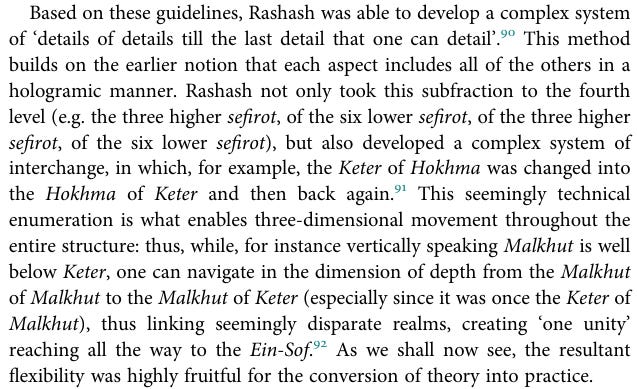
How did Sharabi achieve this? First, he took the already extremely cumbersome Lurianic system and made it an order of magnitude more cumbersome. Take it away Jonathan Garb:
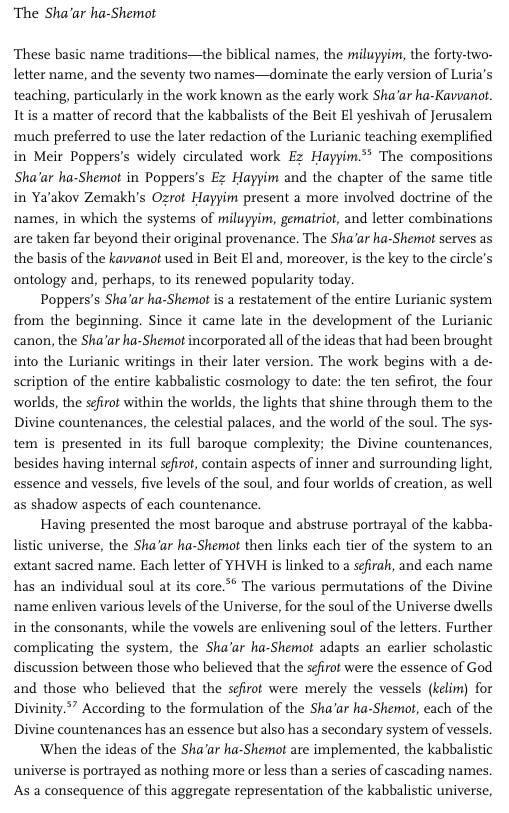
Secondly, Sharabi and his heirs moved the location of essential metaphysical reality from the entities described in the Zohar and Lurianic writings that are kind of cool in a pagan way to the most intensely boring stratum of explanation, namely the system of divine names. Pinchas Giller explains:
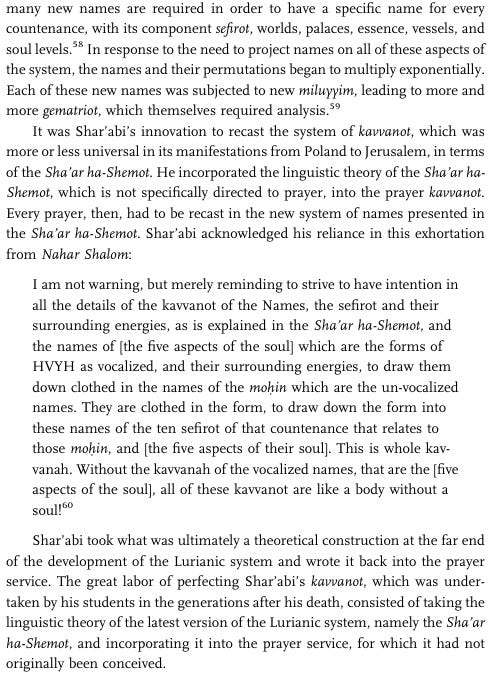
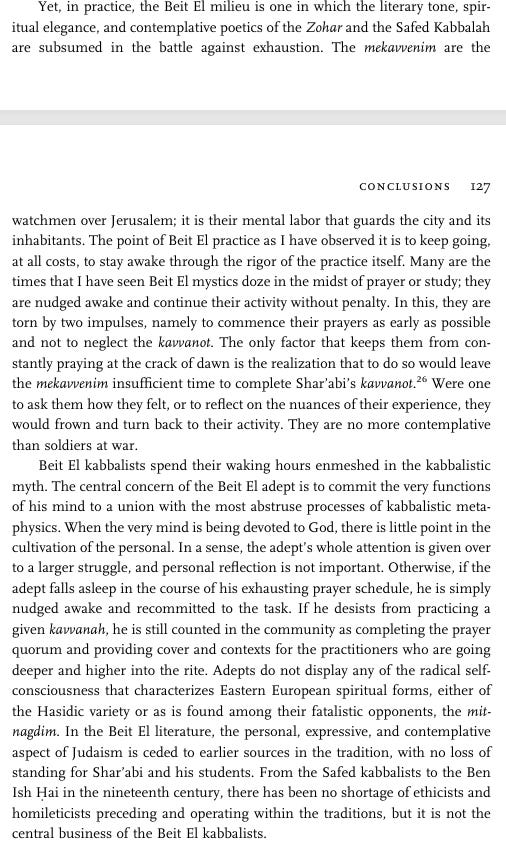
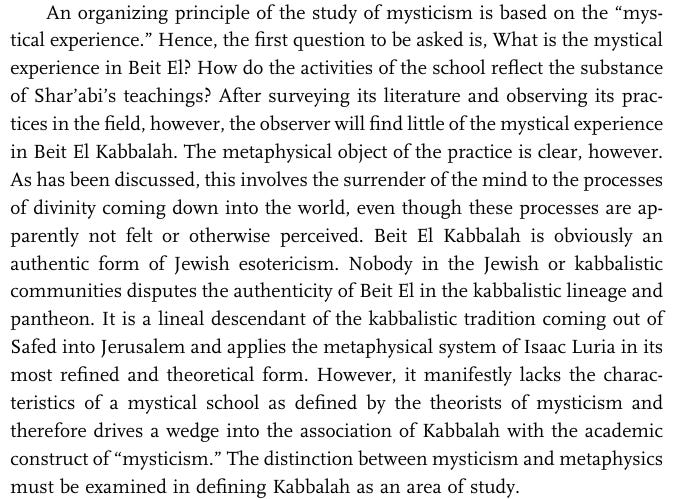
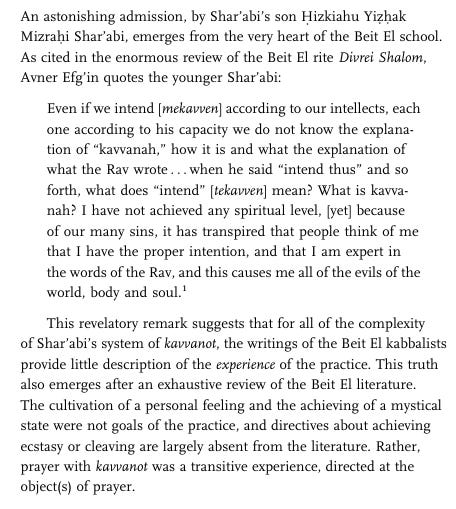
This brings us probably the most important innovation of the Sharabian school. According to Sharabi, kabbalah was a completed discipline (and whatever innovations his students made, they were careful to justify with references to his own works, and never any prior source). There was nothing left to learn, and very few people to teach, so what was a kabbalist supposed to do? The answer was that he was supposed to pray, and pray, and pray. For the Sharabian adept, daily prayer takes a minimum of six hours, during which time the recitation of each word must be accompanied by mental concentration on dozens of other words and their relation within a system to hundreds of other words.1 This sounds incredibly boring, and it is incredibly boring, but the Sharabians believe that this is their solemn duty without which the Jewish people will be beset by plagues and famine. Giller has spent a lot of time observing goings on at the Beit El yeshiva:
If you are thinking, ‘this doesn’t sound very mystical’, you would be correct.
This, of course, is in clear opposition to the Safedian tradition whose members were constantly tripping their nuts off, experiencing vivid hallucinations induced by extreme sleep deprivation and fasting, as well as breathing exercises that approximate asphyxiation and probably drugs. Matt Goldish recently wrote a book on Shabtai Tzvi which adds very little to Scholem and is quite boring, but he does do a good job of establishing that the Sabbatean tradition was in complete continuity with Zoharism in basing doctrinal development on ecstatic visions, demonstrating that Nathan of Gaza’s famous Shavuot schiz-out was closely modelled on precedents by famous approved members of the tradition. In abandoning this tradition, it was Sharabian Zoharism, and not Sabbateanism, that deviated.
To sum up, R. Sharabi and his disciples achieved the apparently impossible and tamed Zoharism. When people use the tHAT’S nOT rEAL kABBALAH ‘argument’ in response to the latest monthly outrage committed by a Zoharist leader today it is because they are working on the assumption that something similar to Sharabianism is the normative version. And perhaps, indeed, they are right, or at least they were right. Sharabianism was clearly a deviation from the tradition, but since there is no actual truth behind Zoharism, it can be defined as what it is by what it does. Two hundred years of dominance is a long time.
I will say one more thing in praise of the Sharabians. One of the objections to Zoharism; not the only one, but a weighty one for sure, is that it violates monotheism. Anyone who has ever got into such a debate will know how fruitless it is, but what should perhaps be more readily accepted is that some versions of Zoharism are more amenable to explanation as being compatible with monotheism than others. In some senses, Sharabian kabbalah is worse than other systems because it is based on a strong realism regarding the entities that are parts of the Zoharic corpus, ruling out the most popular form of apologetic argument, namely that divine multiplicity is only from the human perspective. However, in its monumental complexity it offers a different kind of way out. Paradoxically, by multiplying the parts of the godhead into the thousands, it makes it impossible to focus on any one part to the exclusion of others. Zoharists have always stuck to the mantra of ‘it is all one’, but have violated it to various degrees in practice. The Sharabists patched things up by making the system so elaborate and cumbersome that it’s impossible to get a working pagan myth out of it. Luria’s genius was to take the mythic power of the Zohar and turn it into a mechanistic system, without losing (and in fact boosting) its mythic power. Sharabian orthodoxy drains the system of myth, leaving behind just one big snooze.
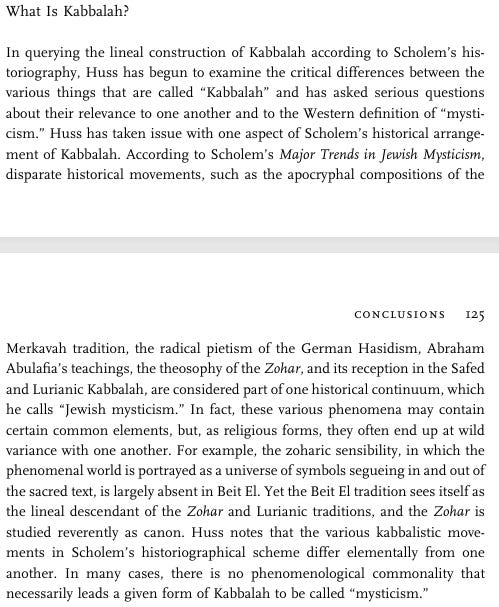
Gershom Scholem has often been criticised for undervaluing, if not ignoring outright, Sharabian kabbalah, importing normative considerations into supposedly objective historical research so as to dub the mainstream form of kabbalah a fossilized form of a once-vibrant and alive tradition, barely worthy of interest. However, as usual, Scholem was completely correct. It’s just that, compared to the alternatives, that’s a good thing.
Coda
So, after all that, have we arrived at the conclusion that Zoharism is actually basically fine after all? Sure, it started off pretty ropey, and everything went to hell in the mid-17th century, but after that, things got ironed out eventually and it became just a bit of harmless, well not fun, but harmless something. Haha. If we’re going to say something nice for a change, we’re certainly not going to sign off that way. My objections to Sharabian kabbalah are threefold.
First of all, that’s not Judaism. It’s a cliche to say that, in contrast to other faiths, Judaism aims not to facilitate the flight from impurity for a religious elite, but to sanctify the community at large, but it’s a cliche because it’s true. Sharabian kabbalists are like monks, except they don’t do anything cool or worthwhile like make beer or copy manuscripts of Aristotle. Sharabianism thus amounts to the degeneration of Judaism into a faith like that of the Druze (no offense Druze), which is OK for a goy, but obviously kind of a let-down if you believe in a unique one-of-a-kind covenant between God and a chosen nation.
Secondly, it’s an incredible waste of time. Whatever elegance Sharabian kabbalah might have as an intellectual system (and I’m not seeing it), none of the entities that its practitioners think about actually exist in any way whatsoever and so forming an immense and intricate mental map of how they are interconnected is totally fruitless expenditure of mental energy. Sephardi Jewry historically was like the Ashkenazim, but turned down a few notches. Then, in the eighteenth century, they just kind of dropped out of history, occasionally popping up to run a chain of factories in Iraq or something. In large part, that’s because their greatest brains were being sent to endlessly ponder figments of their imagination to no purpose. If the alternative is Sabbateanism, then I guess it’s better, but it’s still an ignominious finale for an accomplished ethnic group.
Thirdly, and most importantly, Sharabianism smothered the Zohar and Lurianic writings in multiple layers of protective theory, but underneath it all, they were still there, just as radical and blasphemous as before, and invested with supreme sanctity and authority. Sharabianism rescued Zoharism from Sabbateanism but because Sabbateanism is Zoharism it could only do so by making Zoharism something other than itself. Zoharism was attractive initially because it offered what medieval Judaism lacked: a place for emotion, and emotional turmoil, in religious life; a god that was accessible to the ordinary man whose powers of imagination exceeded his intellect; a way of imbuing ordinary Jewish ritual with cosmic significance. However, the Sharabian reformation of Zoharism produced something that was just as elitist, austere and irrelevant to the life of the multitude as any kind of Maimonideanism, but without its intellectual respectability.
The Sharabians argued that not only could the Zohar not be understood according to its plain meaning, but nor could large parts of the Lurianic writings. Their proof for this, however, was nothing more than that they said so. The conditions in which Zoharism was kept in suspended animation were fragile and contingent and, in particular, the Ben Ish Hai in Iraq used his prestige to re-embark on a project of popularisation without ever formally critiquing the Sharabian synthesis. How long it would have taken matters to crack up and go mental again is an interesting question, and one that is hard to answer in the absence of much research into religious trends in the early 20th century among oriental Jewry. However, it’s a moot point because these communities were emptied out one after another and their inhabitants dumped into Israel. The kabbalists of Beit El and its various offshoot yeshivot have done their best, in cooperation with R. Ovadya Yosef, to maintain a plausible synthetic traditionalism that could keep Zoharism in check, but they will fail. In fact, they already have and we’re just here to watch.
It should be added that the Sabbateans dispensed with the Lurianic kavanot on the grounds that they were intended to bring closer redemption and redemption had already arrived. Appropriately, the Sharabians went the opposite way and essentially did nothing but kavanot, while diluting their messianic connotation claiming, instead, that they were necessary for ongoing sustaining of the world and the Jewish people.
I remember at the Kabalah yeshiva in the Old City the Rashash guys always asking for someone to come in off the street for kadish. I went in once because,hey, it's just for kadish how long could it take...
When Bet El started its intellectual decline (it took a few generations to finish working through the Rashash's system) it was replaced by the Sadeh and his Talmidim. Notably, the haskamos to Sadeh are from the European Leshem and Munkatcher. He revived intellectual stimulation (and acceptance of Ashkenazi mekubalim) and together with others like Emes Leyaakov who worked with the Toras Chochom, caused the revival of both creativity and personal growth.