

To read previous items in the series, go here.
The general orthodox view of the Haskalah is as follows. The Jews were all religious and everything was good, except for poverty and trouble from goyim. Then the maskilim came along and said that Jews should be more enlightened and change some of their outdated practices. Perhaps they meant well and just lacked a proper appreciation of Jewish tradition, or perhaps they were snakes who knew that they were pulling at a thread that would unravel the whole garment. Either way, their programme led to disaster. The Jews who heard the call of the new enlightenment were not content, at least not for long, to be a Jew in the home and a mensch in the street; they wanted to be a goy everywhere. After nearly two thousand years of patiently and faithfully waiting for exile to end, an unprecedented wave of assimilation and apostasy hit European Jewry. The leaders of the Misnagdim and Chassidim wisely foresaw where the Haskalah would lead and agreed to bury the hatchet over their relatively trivial disagreements so as to attack the new movement together. It wasn’t enough to save the masses of European Jewry bewitched by promises of liberal equality that ultimately led to the ovens of Auschwitz, but it did preserve a faithful Jewish core which would rise from the ashes while enlightened Jewry dissolved into the upper class of the emerging Hapa ethnicity in the United States.
If you’ve been following the series, you’ll be aware of the first problem in this narrative, which is that, long before any maskilim arrived on the scene, European Jewry was in a right mess. In the Sephardi lands, the mystics had eventually responded to their particularly acute crisis by coalescing around an arcane, explicitly elitist and ossified version of Zoharism that was Sabbatean-proof, but the lands of Ashkenaz were a free-for-all, with Sabbatean preachers able to go more or less anywhere they wanted and promote the most batty forms of heresy without anyone intervening. If anyone did try to intervene, be they even top-tier Rabbis, they quickly found out it was more trouble than it was worth. Things got so bad that the generally admitted rabbinical genius of Europe was an outright fruitcake who thought the God of Israel had to do anal sex because he was impotent or something. Perversely, things eventually got so out of hand that it actually ended up saving the day. Depraved weirdo Jacob Frank managed to build up such a large following, and was so immunised from any form of rabbinical control, that he decided to go all-in and form a wholly new religion by leading his followers into the Catholic Church, solving the problem that Judaism couldn’t solve on its own. Concurrently, the moderate wing of the Sabbatean movement went underground and one branch of it rebranded itself as ‘Chassidim’, reapplying the Sabbatean theology of the redeeming tzaddik to a wider range of charismatic holy men.
The other problem with the orthodox narrative is that the supposed relationship between Haskalah and mass secularisation doesn’t really pass the chronology test.
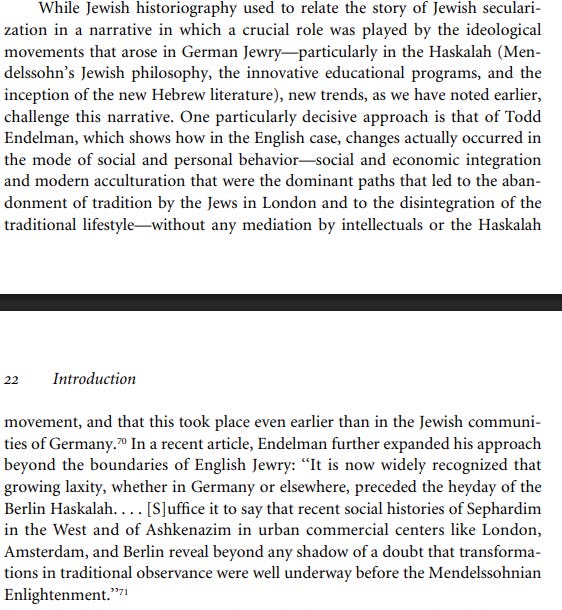
In short, the relationship between Haskalah and secularisation is not one of cause and effect, but of a common cause. The collapse of traditional belief and therefore adherence to the onerous lifestyle it mandated happened among Jewry for the same general reasons that it has happened everywhere. With Jews it happened on average a bit earlier than surrounding groups, partly because Jews had higher literacy rates, partly because the Jews had more to gain by throwing off their religious obligations than the surrounding Christians, and partly because European Jewry was pretty messed up, caught between grim misanthropy and total nonsense (not necessarily even being able to pick merely one). Secularisation came later to Eastern Europe than Central Europe because the Jews of the former were more backward, and the gentiles less tolerant, offering fewer advantages to Jews who assimilated unless they were willing to convert to Christianity.
Seen in this light, it’s possible to see the maskilim precisely as opponents of secularisation because they were engaged in trying to articulate a vision of Judaism that a thoughtful and well-read person could feel comfortable in instead of bouncing. Far from providing a way station on the path to becoming a goy, they were offering, or trying to offer, a viable option for remaining a Jew. This is roughly speaking the argument of Olga Litvak in Haskala: The Romantic Movement in Judaism. At least I think that’s the case, but it’s hard to know because this may be the worst book I’ve ever read. You might say it’s easy to lose the thread of her argument amidst the endless digressions articulating novel interpretations of texts no-one’s ever heard of in the first place, but it would be more accurate to say I never picked up a thread in the first place. In any case, though, this is roughly speaking the general view of contemporary scholarship: the maskilim acted within an unfolding reality of secularization that they had the power neither to promote nor to resist and in which they saw both opportunities to be exploited and dangers to be fought.
Of course, they failed. There is no maskilic Judaism today. At any rate, there is no form of Judaism that marks itself as maskilic. In most respects, Modern Orthodoxy fulfils the demands of the Haskalah, including almost all of what were once its most controversial demands. For that matter even Charedi Judaism, to varying extents, has adopted many signature maskilic innovations. But this adaptation of Judaism to modernity was forged by those who identified as the Haskalah’s opponents. Indeed, opposition to Haskalah was perhaps the principal thing they had in common. The Haskalah itself left little in the way of an institutional footprint.
This was not by accident either. Haskalah was not merely difficult to transmit from one generation to the next, it was in a certain sense impossible. Properly speaking, you couldn’t be raised to be a maskil, even by another maskil, perhaps especially by another maskil.
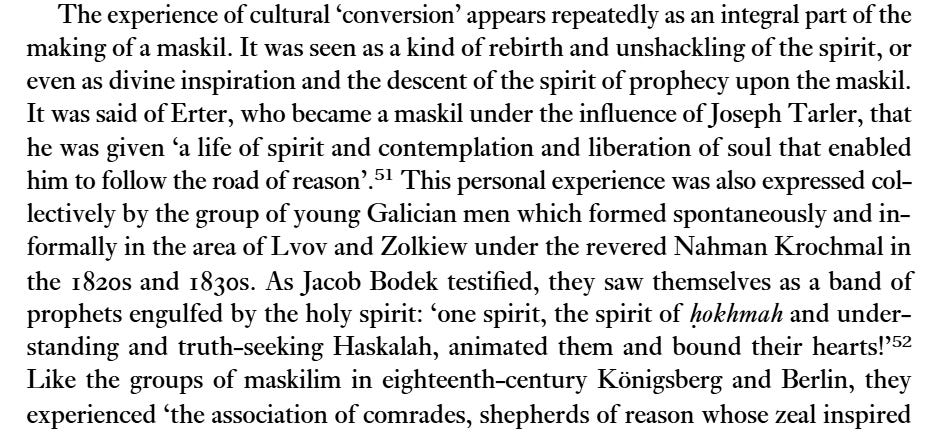
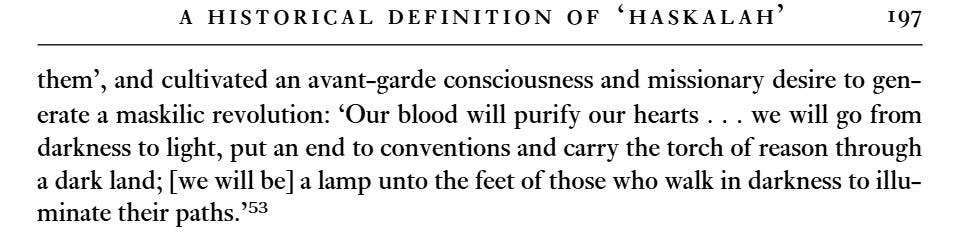
What did the maskilim want? Mostly they wanted Judaism not to be stupid. It’s easy to paraphrase that in a hostile fashion by saying they wanted Judaism not to make them look stupid in front of the goyim. No doubt that’s true and there’s nothing especially wrong with that, at least as far as the Torah is concerned, though, as with many things, it’s important to not get too carried away. Another way of looking at it is that they couldn’t bear the idea of being fools in the eyes of God, which is perhaps worse, since we are all ineluctably in such a condition. As to what that meant in practice, it could mean a lot of different things.
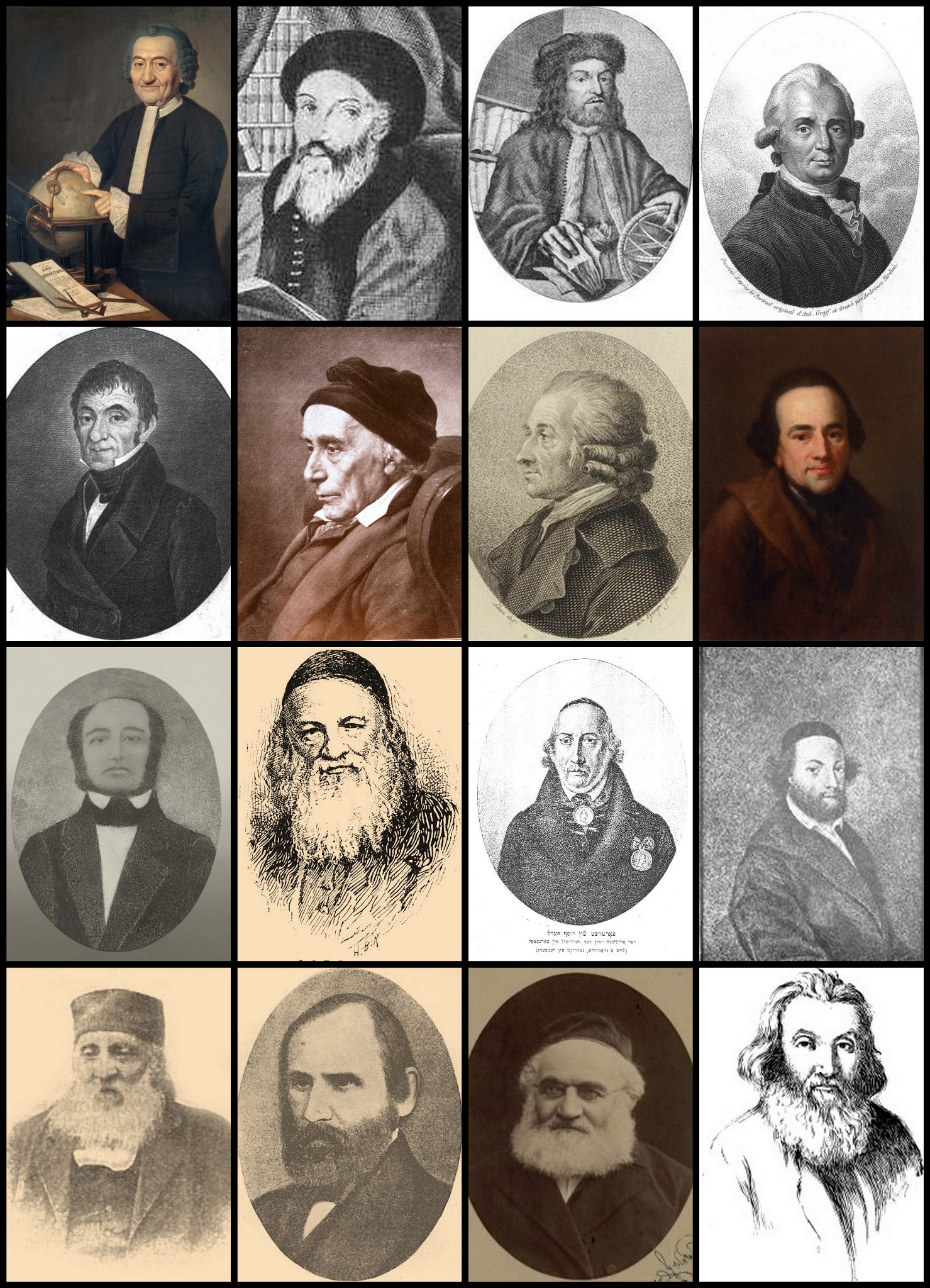
Some of these guys look frummer than other ones because that’s what they actually were. The common thread of the Haskalah was to promote a moral and spiritual revival in Jewry through reviving lost or neglected forms of learning, but that could mean a lot of different things. The maskilim were linked to each other through participation in the journal Me’asef and other organisations in which ‘enlightenment’ was the goal, but not by a specific programme for what that meant. What united them was a certain seriousness, sometimes bordering on the hysterical, which distinguished them from mere secularisers who sought an easier and more comfortable life away from the constraints of the traditional Jewish community. Lazarus Bendavid and Isaac Baer Levinsohn didn’t agree on very much, and disagreed about most of the fundamental issues of religion, from a Jewish perspective at least. What made them both maskilim, beyond a general orientation towards making Judaism more dignified, was that they really meant it. They were for real.
That’s not to say that among the maskilim there weren’t bad apples. The most famous was Hirsch Ber Hurwitz of Uman, Nachman’s chess buddy, who, after trying to promote educational reform at home, went to England and became a teacher of Hebrew at Cambridge. This must have involved an affirmation of Christianity, which was presumably insincere (whether that makes it better or worse). Even here, though, Hurwitz, or Hermann Hedwig Bernard as his colleagues and students knew him, seems to have wanted nothing more really than to nerd out and study Hebrew grammar at a place where he would be appreciated for doing so. There is no maskil whose personal morality was as low as the devouring venality characteristic of Chassidic Rabbis in the 19th century who lived in opulence funded by redemption payments from their followers (we’ll get back to that in the next installment).
Because they opposed stupidity, both conservative and liberal maskilim, with very few exceptions, were opponents of Zoharism, and thus they were the good guys. They didn’t add a great deal to what Rav Emden had already provided in terms of philological and source criticism, but they did have the guts to say the obvious, namely that it’s all just rubbish and we don’t need it so we should get rid of it. Whatever we can say, therefore, we can’t say we weren’t told. The actual achievement of the maskilim, however, was to polarise the rabbinate into an obstinate defence of the Zohar, a position now maintained based on pure obscurantism, adding to the chronic constipation of post-Sabbatean Judaism a layer of degenerative dementia. The frantic opposition of the maskilim to the chassidim also catalysed the latter’s eventual acceptance by the orthodox who decided, first, that they were the lesser of two evils and then gradually came round to the view that they weren’t an evil at all. The maskilim themselves offered almost nothing in the way of institutional opposition that could compete with the innovative and highly successful social technologies employed by chassidic Rabbis in their fierce competition for paypigs, apparently convinced that if they just wrote a satirical play witty enough then it would all come crashing down; that, or the gentile authorities would solve the issue for them.
‘Twas not to be and the Haskalah failed. Its energies that did not simply fizzle out were eventually redirected into Zionism, or Moritz Steinschneider’s quest to give Judaism a decent burial. But since God will not let us die, the choice of what Judaism would be was left to others, in particular those most emphatic in their scorn for the vision of Haskalah while pragmatically adopting its policy recommendations. I do not think it is inaccurate to say the most successful network of girls’ schools anywhere in the world today is managed by Satmar, but if not, it’s Belz.
In truth, I don’t know very much about maskilim. I couldn’t continue the series without saying something, but I also can’t just take a month out of my life to read a bunch of books to say something informed. So the above is the best you’re going to get. Actually, even if I had a month, I wouldn’t do it because maskilim are boring. As is often the case, those most desperate to escape parochial constraints in the search for timeless truths appear the most parochial when viewed from the perspective of another era. The manifestos of the Haskalah at once have the character of a utopianism that we can’t help but think of as silly nowadays, while also being strikingly mundane, lame even.
One thing I can talk about is Hebrew grammar, which is another interest I share with the maskilim, absent their conviction (shared by a remarkable chunk of educated humanity over history) that it was a tool for the cultivation of character and morality. The maskilim, like the medieval grammarians, took for granted that the Tiberian vocalisation tradition, which is expressed in the diacritics every Jew finds in his Chumash, is the correct form of Hebrew grammar and all forms of Hebrew that depart from it are degenerate. Therefore, they sought to correct Jewish liturgy to reflect Tiberian norms, both because they genuinely thought it to be the right thing to do, and also because it was a weapon against the rabbinical establishment whose Hebrew genuinely was degenerate, an incoherent aramaicised pidgin, deformed by the importation of ill- fitting Yiddish speech patterns.
The problem is that Tiberian pronunciation isn’t a kind of ur Hebrew, it’s a highly academic elite tradition cultivated specifically for the recitation of scripture. It is not how anyone ever talked, and it’s not supposed to be how anyone ever talked. Apart from its specific ritual nature, it has three other chief characteristics. The first is that it is hyper-conservative, preserving ancient features of the Hebrew language that had long since died out in spoken and liturgical Hebrew. However, as Hornkohl has demonstrated at length, many of the characteristically archaic forms it preserved were part of dialects current in the second not first temple, so it is not how the books were originally read. In some cases, ancient linguistic features were preserved while others that were connected with them were allowed to develop, leaving them with no grammatical rationale in the obvious sense (though this is extremely useful today for performing linguistic archaeology). The second is that it reflects what was considered to be an elevated form of Hebrew, what we might call posh. The third is that it contains ‘orthopeic’ features that do not reflect natural linguistic evolution, but rather were employed to resist it. In particular, the Masoretes were on guard against the slurring of syllables and the omission of guttural letters (the latter being considered both the mark of an ignoramus and Hellenistic acculturation). This typically manifests itself in the extension of vowels, or the introduction of new ones to allow more time to pronounce letters. Thus, the verb ‘to do’ is not la’soth or li’soth but la’asoth, so as to avoid dropping the ע and becoming lasoth (as certainly happened in speech).
With that in mind, let’s look at one of the most characteristic feature of maskilic Hebrew reform, the introduction into liturgy of pausal forms, so hagafen in בורא פרי הגפן and hagashem in משיב הרוח ומוריד הגשם. This is based on the observation that at the end of verses and other strong pauses, Tiberian Hebrew has pausal forms with longer vowels, thus ארץ becomes aretz instead of the standard eretz. The maskilim reasoned that this ‘rule’ should apply to liturgy and thus started printing siddurim with קמץ in the relevant places instead of segol, because that’s correct and also made ordinary frum people look uncouth.
The problem is that there is no such rule in the sense of a principle that obligates, or rather that this rule only emerges from analysing the Tiberian vocalization of the Bible as an artefact of a timeless Hebrew, which it isn’t. The real story goes like this.
Most segolate nouns in Hebrew originally had a short vowel (often an a) followed by a consonant cluster. Thus גפן was gapn and גשם was gishm. This is preserved in the construct forms of these words (e.g. ארצכם, גפני, גשמיכם)
A short vowel emerged between the last two consonants. In the Babylonian tradition this was a short a, and in Palestine it was something in the region of e (thus making gafen, gashem, aretz). In the Tiberian tradition this vowel was distinguished from the tzere whereas in other traditions it was categorised as a shortened version of it.
At pauses, the opening vowel was lengthened (so áretz, gáfen) in line with a general principle in Hebrew and languages generally.
Subsequently in the Tiberian tradition specifically this opening long vowel in pausal forms was transformed into the kamatz as was the long á generally.
Separately, in the Tiberian tradition or its forebear, the first vowel in these words assimilated to the second one, thus aretz → eretz, gashem → geshem. This didn’t happen with pausal forms, which thus preserve an exaggerated form of a more archaic pronunciation.
Over time the Tiberian tradition developed melismas for pauses, marked by specific diacritics. As a result, the lengthened vowel in the developed form of the tradition is strictly obsolete (because you can lengthen any vowel by melisma), but preserved because of the general principle of conservatism.
The Tiberian school collapsed, but not before its diacritic system became generally accepted across Jewry. Unfortunately, very few communities knew what the marks were supposed to mean and established pronunciation cargo cults of various degrees of failure usually roughly proportional to their distance from Palestine.
Now, what do you do with that? My view is that what we really need to do is to recreate the Tiberian school and let them continue where the old one left off but with the benefit of modern linguistics. Teach us, Geoffrey Khan. What is silly though is taking the Tiberian vocalisation system and trying to make a living language out of it, which is what the Zionists, following the maskilim, did. It’s also silly to import every historical quirk of the system and stick it into liturgical Hebrew, which is basically a moderately archaising post-temple dialect. The fact is that in Hebrew dialects used around most of Jewry for the last thousand years the word גפן is ‘gefen’ (and actually segol is one of the few things almost everyone got right). Lengthening it at pauses makes sense. I can even grok the idea of transforming it into a tzere for effect, since these two vowels are not infrequently paired in morphological changes that lengthen or shorten a vowel. But changing it to some totally other unrelated vowel is just dumb. If you have to do it because that’s what the book already says (as is the case with Tanach), then maybe that’s too bad. But if your book doesn’t already say that (as is the case, or was, with the siddur) then don’t go and make it worse. And definitely don’t do it with משיב הרוח ומוריד הגשם, which isn’t even a major pause. Some exceptionally reactionary Charedim insist on geshem, and, as is not untypically the case, they are right.
There is an important lesson here about not jumping the gun on academic-based religious reform until you’ve done the groundwork. And that’s what I have to say. Grammar is cool. The maskilim were right. More importantly, Zoharism is fake and sucks. The maskilim were right about that too. But no-one very much listened to them. You could say that they failed, or you could say that the Jewish people failed. You should say both, because both are correct.