

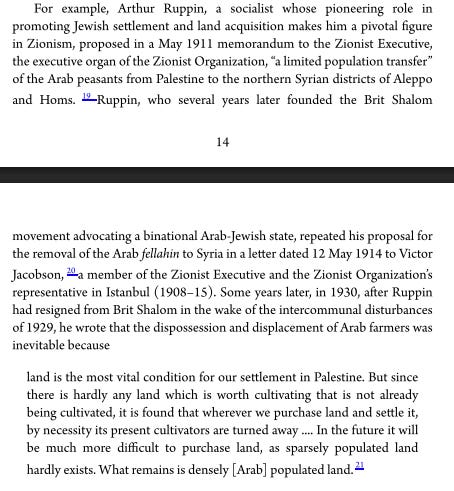
You can tell the quality of a blog from its commenters and NonZionism does pretty well on that score. In the article on Israel Shahak, we saw his unevidenced and prima facie outlandish claim that Hugo Bergmann, founder of Brit Shalom and lifelong peacenik, ‘advocated the expulsion of all Palestinians to Iraq’. Commenter, khoker, found Shahak’s apparent source, Expulsion of Palestinians: The Concept of Transfer in Zionist Political Thought, 1882-1948 by Nur Masalha. This book, first published in 1992, quickly became a sort of Bible for global anti-Zionism and, two years later, Israel Shahak, who I believe was in the early stages of cognitive decline, seems to have had it in mind when he banged out his screed. Here is the relevant passage from Masalha.
For reference, here is Shahak’s paraphrase.
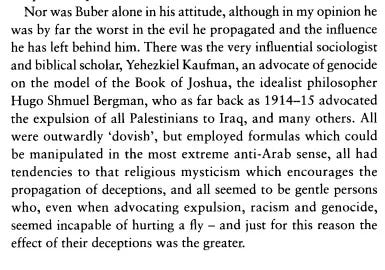
Even the real dopes, I hope, will have noticed a few differences. First of all, though it might seem a bit trivial, the proposal was to transfer Arab peasants from Palestine, not to Iraq, but to Syria. This is not a distinction without a difference, because the most popular opinion of educated Arabs in Palestine was that they were part of a Greater Syria (Bilad al Sham), so the proposal was not to transfer these peasants to a different country, but a different place in the same country. More importantly, the idea was not at all the ‘expulsion of all Arabs’, but ‘a limited population transfer’ of those who were dispossessed when Zionists bought land from absentee landowners and removed their new tenants, as was their legal right (subject to adjudication at court which, of course, Arab peasants did not have the wherewithal to organise). Thirdly, Shahak remembered the wrong man. It wasn’t Bergmann, but one of his Brit Shalom cofounders Arthur Ruppin, a man who certainly never seemed to anyone incapable of hurting a fly.
The man who built the Yishuv
Arthur Ruppin is not one of the better-known Zionists. Most Israelis would not recognise his picture.
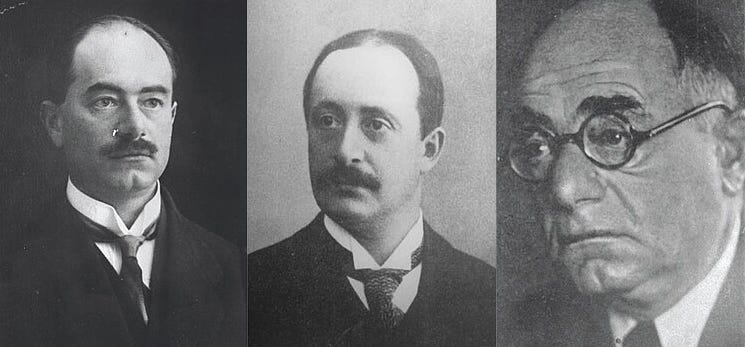
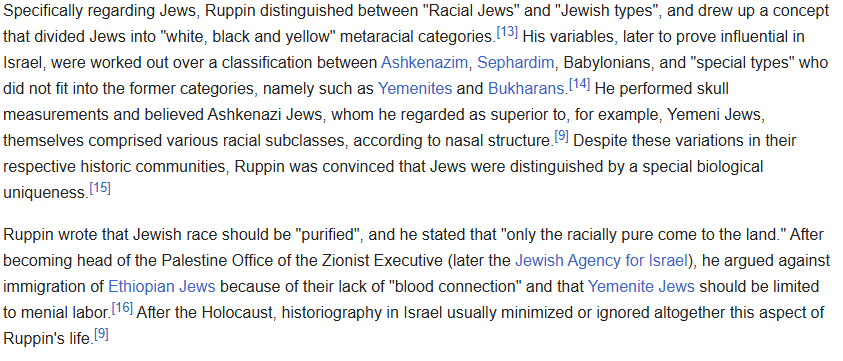
The reasons for this are not mysterious. Ruppin was a race crank. There were a lot of race cranks knocking around in the early 20th century, but because the Nazis lost the plot in the middle, everyone afterwards did their best to try and forget about it, unless it was to smear their enemies. Mainstream Zionism, both in its socialist and liberal forms, therefore preferred to pretend he never existed. Right-wing Zionists, for their part, reject him because he wasn’t a race crank enough. The theory for which he is best known, namely that the ancient Hebrews were a non-Semitic race might not be correct,1 but he did recognise the obvious fact that the category ‘Jewish’ includes different ancestry clusters, with different average characteristics and capabilities. This, of course, is absolute kryptonite to the Israeli Right built by Begin, whose central conceit is that the honours accrued by Einstein and von Neumann demonstrate that an illiterate Breslov junkie in Afula with tattoos is the master race. Thus, no-one is interested in making Ruppin part of their Zionist history. They prefer to claim continuity with terrorists and fruitcakes.
Nevertheless, Ruppin was extremely influential in the establishment of the state of Israel, and, with the probable exception of the big man himself David Ben Gurion, you can tell the history of the Zionist movement through his life story better than anyone else.
Herzl, as is well known, did not invent the Zionist movement, but reinvented it. His big idea was that efforts to buy land and establish settlements in a run-down malaria-ridden, bandit-infested shithole under the radar of the Ottoman authorities were both demeaning and pointless. What was needed, instead, was to get a charter from the Ottomans, or from someone else who would take over the territory, giving Jews legal right to settle and then move in as an organized national unit. Herzl was obviously right that Zionist efforts up to that point had not borne much fruit, and the movement, hitherto centered in the Russian empire, lined up, with varying degrees of enthusiasm and resentment, behind the new Western European leadership. Before too long, however, it became clear that Herzl’s ‘Political Zionism’ had failed too. Half a decade of start-up shuttle diplomacy had resulted only in the offer of some land in Uganda. At this point, the movement fractured, with many orthodox Herzlians leaving to become ‘Territorialists’, and the Russian old guard taking the opportunity to seize back control and turn Herzl’s new institutions into vehicles for their sundry plans for spiritual and intellectual renewal in the Holy Land.
What eventually came out of this was ‘Synthetic Zionism’, the idea that you could focus both on practical settlement and diplomacy because each one made it easier to make progress with the other. The political representatives of Synthetic Zionism were the General Zionists, led by Chaim Weizmann and Nahum Sokolow, who dominated the elected parliament of the World Zionist Organisation until the early-1930s and were tied to the largest Zionist education system in Palestine, but were a small minority in the Yishuv’s local representative body and eventually also the WZO, totally outmanoeuvred by the better-organised and more ruthless Labour movement. However, the key figure in implementing Synthetic Zionism on the ground was Arthur Ruppin, who directed the Palestine Office of the WZO from 1908, organizing the settlement and colonization policy during the second half of the Second Aliyah, while acting as the movement’s principal land agent.
Ruppin was a German bourgeois with no moral commitments to socialism, and untainted by adherence to Marxist economics or historical theory. Nevertheless, in practice, he worked to set up agricultural collectives run on egalitarian principles in Palestine because he understood that this was what was necessary to get the state off the ground. He steered idealistic pioneers from the Poalei Tziyon and HaPoel haTzair movements into collective agriculture projects because this was what could reliably bring young Jews to the Land of Israel and keep them there. Indeed, while the Labour Zionist movement in theory owes its origin to Dov Ber Borochov, in reality its working model contradicted his consistently expressed views, excepting a few speeches made towards the end of his life. Of course, the kibbutz and moshav system as it eventually emerged was the result of trial and error on the part of many people, but the quiet father of Labour Zionism was not a theorist like Syrkin or Gordon, but the bureaucrat Ruppin.
Ruppin was also unusually precocious in understanding that the Arab Question was by far the most serious one Zionism had to face. The typical approach of the Zionist movement to the issue of fellahin displaced following Jewish land purchases was strictly legalistic. We bought it fair and square, and they have to go. This can (and from a leftist perspective certainly should) be questioned on ethical grounds, especially since many formal land titles had been acquired in the mid-19th century through political intrigue and corruption, but in practice it’s easy to ignore ethics if you are pumped up enough. However, Ruppin saw that the more important issue was urgently practical: displaced Arab peasants weren’t going to just dissolve or wander off, they would form a restless and bitter proletariat open to propaganda from the Arab nationalist bourgeoisie. All around the world, modernisation of agriculture led to peasants relying on informal and customary tenant arrangements getting screwed over, and Palestine, being a dump, was long overdue for this process. However, while always and everywhere this process presented challenges to political stability, its racialisation in Mandate Palestine was obviously disastrous. It is not necessary to ascribe to Ruppin an unusual degree of benevolence to see that his Syrian relocation scheme was an attempt to solve a real social issue in a way that didn’t involve people murdering each other.
Ruppin’s hard-headed and open-eyed approach to the Arab problem eventually led to him co-founding Brit Shalom. There have always been two strains in dovish Zionism, one, represented by Bergmann, being primarily ethical, and the other, represented by Ruppin, being essentially pragmatic. Ruppin arrived at binationalism while much of the Zionist movement was still stuck in its ‘fingers in ears’ stage of thinking about the Arab problem, because he became convinced that, whatever one may wish to be the case, Arab national feeling in Palestine was an objective social fact that had to be dealt with no less than the presence of Arab individuals. What is perhaps most interesting is that he didn’t arrive at this position because of Arab political violence. To the contrary, he drifted away from Brit Shalom after the riots and massacres of 1929, convinced there was no Arab party with enough control worth talking to. Rather the more boring work of Arab nationalist propaganda, strikes and petitioning over the 1920s had won him round to the inevitability of compromise. Palestinians don’t want to hear it, but the resort to violence has always been their movement’s Achilles heel. Of course, acceding to binationalism, while being beneficial to the Arab population from any reasonable utilitarian perspective, would not have satisfied certain ethnonationalist aspirations. People can believe what they want, but no-one is obligated to indulge them in it. In cases like this, I would say they are obligated not to indulge them in it.
Arthur Ruppin today
Ruppin was the most quintessential of Zionists, both a General and Labour Zionist at the same time, without ever being formally either. He did more to build the new Zionist society than any other non-politician, and a great deal more than most politicians. He saw more clearly than most that the real obstacle to Zionism was not Jewish apathy or international interference, but the opposition of the local population, and his journey from indifference to compromise to gritty determination to do what it took prefigured Ben Gurion’s by about a decade. As a middle-class German, he was a part of a minority in the Yishuv’s population, and didn’t fit in well with its leadership class. However, the German-speaking bourgeoisie, about 10% of the Yishuv population thanks to the Nazis, did more to build the State of Israel than is generally appreciated, disproportionately creating the capitalist economy and university system that would, in due course, eat the kibbutz movement and provide the economic might necessary to survive in the region. But who today wants Arthur Ruppin the racist peacenik and snob? Is the true Zionism NonZionism after all?
In fact, Ruppin’s race-crankery is seriously exaggerated. Internet accounts usually only mention his early idea that the Hebrews were originally a non-Semitic race who then degenerated by mixture with the Semitic locals, which was wrong, as are most early drafts of theories. His more developed theories hold up surprisingly OKish in light of modern genomic research (the results of which are still coming in). The fact is that the tools he had were pretty crap, but he was one of the figures trying to drive race science forward rather than down into mysticism. There’s also a broader point that even those of us who are racist tend by default to have a more negative reaction to race cranks than egalitarian cranks, even though the race-denialist thesis is genuinely one of the dumbest possible things a person can believe, and this isn’t necessarily helpful.
Based on the photographs it seems that as his theories changed so too did his race.